The Macro Shift: Celebrity capital is moving from transactional endorsements to strategic equity investments, driven by a desire for long-term wealth creation and the recognition that personal brand power can significantly accelerate startup growth.
The Tactical Edge: Cultivate a diverse network of mentors and partners, prioritizing those who bring complementary expertise and can challenge your assumptions.
The Bottom Line: The future of wealth creation for high-profile individuals and savvy investors lies in strategic, long-term equity plays, supported by strong teams and a willingness to partner.
AI agents with system-level access are shifting the core value proposition of software from discrete applications to fluid, context-aware personal assistants.
Cultivate "agent empathy" by learning to guide AI models effectively, understanding their limitations, and designing projects for agent-first navigation.
The rise of autonomous agents will redefine software's purpose and value.
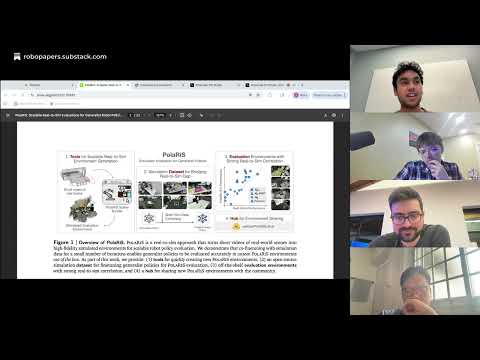
Adopt PolaRiS for rapid policy iteration. Leverage its real-to-sim environment generation and minimal sim data co-training to quickly validate robot policies in diverse, unseen environments before committing to expensive real-world deployments.
The era of generalist robot policies demands a new paradigm for evaluation. The shift is from bespoke, real-world testing to scalable, high-fidelity sim-to-real correlation, enabling faster iteration and broader generalization testing.
Reliable sim-to-real evaluation is the missing link for accelerating robot AI. PolaRiS offers a pragmatic, community-driven path to unlock faster development cycles and more robust generalist robot policies over the next 6-12 months.
Generalist robot policies demand evaluation that tests true generalization across diverse, unseen environments. The shift is from hand-tuned, task-specific benchmarks to scalable, community-driven evaluation suites that can keep pace with rapidly improving model capabilities. This requires tools that make environment creation cheap and ensure real-world predictive power.
Adopt PolaRiS for rapid, correlated policy iteration. Builders should leverage its real-to-sim environment generation (Gaussian splatting for scenes, generative models for objects) and the "sim co-training" trick to quickly validate policy improvements against real-world performance, especially for pick-and-place tasks. Contribute new environments to the Polaris Hub to expand the collective benchmark.
The future of robotics hinges on fast, reliable evaluation. PolaRiS offers a pragmatic, immediate solution to accelerate policy development by providing high-fidelity, correlated sim environments. Over the next 6-12 months, expect this hybrid approach to become a standard for iterating on generalist robot policies, while fully learned world models continue to improve for more complex, deformable tasks.
The push for generalist robot policies demands scalable, trustworthy evaluation. PolaRiS democratizes high-fidelity sim evaluation, moving robotics closer to rapid iteration cycles seen in other AI fields.
Builders should explore PolaRiS's open-source tools and pre-trained checkpoints to quickly test policies in diverse, real-world-correlated environments. Prioritize visual fidelity and use small, unrelated sim data for alignment.
Rapid, reliable sim evaluation with strong real-world correlation is a significant advancement. This tool enables faster policy iteration, broader generalization, and community-driven benchmarking, setting the stage for the next generation of robot capabilities.
Generalist robot policies demand community-driven, scalable evaluation, mirroring LLM benchmarking. PolaRiS provides the technical foundation by making high-fidelity, correlated sim environments accessible.
Adopt PolaRiS for rapid policy iteration. Use its browser-based scene builder and Gaussian splatting for quick environment creation, incorporating minimal, unrelated sim co-training data for strong real-world correlation.
PolaRiS accelerates robot development with a reliable, scalable simulation tool. This means faster iteration, more robust policies, and a clearer path to real-world deployment for your robot applications over the next 6-12 months.
The era of generalist robot policies demands evaluation tools that can keep pace with rapid development and broad generalization. PolaRiS pushes robotics toward the LLM benchmark paradigm, where models are tested on unseen environments and tasks, rather than being trained on specific benchmarks.
For builders, leverage PolaRiS's browser-based scene builder and Gaussian splatting pipeline to quickly create diverse, high-fidelity evaluation environments from real-world scans. This enables faster policy iteration and more reliable real-world deployment.
PolaRiS offers a pragmatic, scalable path to more effective robot policy development. By providing a tool that makes sim performance a reliable predictor of real-world success, it accelerates the journey from lab to real-world application, especially for pick-and-place tasks, and sets the stage for community-driven benchmarking.
Celebrity capital is evolving from passive endorsements to active, strategic equity investment, transforming athletes and entertainers into powerful venture partners who bring more than just money to the table.
Prioritize building a diverse, expert team that can challenge your assumptions and vet opportunities, especially when entering new sectors like AI or overlooked geographic markets.
Long-term thinking, a willingness to invest in growth, and a focus on strategic partnerships are non-negotiable for building lasting wealth and influence in both traditional and emerging industries over the next 6-12 months.
Predictable Risk Management is Paramount: DeFi's long-term success hinges on building transparent, predictable, and fair risk management systems that demonstrably outperform TradFi, especially for institutional players.
Incentive Alignment is Critical: Investors and builders must scrutinize the relationship between DevCo equity and protocol tokens. Misaligned incentives can lead to value destruction for token holders during M&A or other strategic shifts.
The "So What?": The next 6-12 months will see continued innovation in DEX fee models (Lighter's zero-fee tier for retail), RWA derivatives (FX, fixed income), and composability (Lighter's ZKVM sidecar). However, the underlying tension between decentralization ideals and market realities will persist, demanding robust solutions for ADL, governance, and value accrual.
Productive Stablecoins are Key: The transition from unproductive to productive stablecoins like hUSD is a significant catalyst for Solana DeFi growth, attracting capital by offering intrinsic yield.
Builders, Simplify Leverage: Hylo's success with xSOL demonstrates the demand for simplified, liquidation-proof leverage products. Builders should focus on making complex DeFi primitives accessible through intuitive design.
The X-Asset Frontier: Hylo's move into XBTC and other X-assets signals a broader trend: tokenizing leverage for diverse crypto assets will be a major growth driver for DeFi in the next 6-12 months.
Institutional Inevitability: Major financial institutions will continue tokenizing traditional assets, creating a clear, low-risk entry point for TradFi into crypto.
Builder Focus: Build infrastructure that bridges TradFi and crypto, or specialize in high-throughput retail solutions. Regulatory compliance and education are paramount.
Market Patience: Expect continued pressure on high-beta crypto assets until a clear market shift occurs, likely requiring high-beta assets to become oversold and the "value" rally to top out.
Strategic Implication: The future of crypto is increasingly defined by institutional adoption, driven by the need for verifiable, private, and compliant digital assets and systems.
Builder/Investor Note: Focus on foundational technologies like ZK proofs and secure interoperability. Avoid speculative retail trends that lack long-term utility.
The "So What?": The convergence of AI and blockchain will redefine trust. Builders who integrate ZKPs to authenticate AI outputs and ensure agent accountability will capture significant value in the next 6-12 months.
Strategic Implication: Crypto is transitioning from a niche, retail-driven asset class to a mainstream, institutionally-backed financial infrastructure. This shift will drive sustained growth, reduced volatility, and lower correlation with traditional assets.
Builder/Investor Note: Re-evaluate crypto allocations, recognizing the shift from retail-driven cycles to institutional adoption. Explore diversified exposure beyond Bitcoin, including ETH, Solana, and high-quality DeFi tokens as their economic capture improves. The rise of on-chain vaults indicates demand for professional, diversified asset management strategies on-chain.
The "So What?": The market is vastly underestimating the fundamental progress and institutional acceptance of crypto. The "suit coiners" are bullish for a reason, and their capital will reshape the landscape in 2026 and beyond.
Strategic Implication: The crypto market is maturing. Expect smaller percentage returns and less volatile swings, but a stronger foundation for assets with real value.
Builder/Investor Note: Focus on Bitcoin accumulation in the identified value zone. Avoid speculative altcoin bets unless they demonstrate clear utility and sustainable economics.
The "So What?": The market is in a temporary lull due to year-end flows and M2 divergence. Position for a potential rebound in January, driven by fresh capital and anticipated Western stimulus.