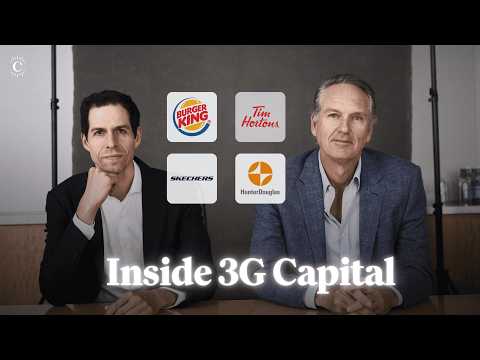
3G commits to one investment per fund, deploying significant house capital alongside partners. This singular focus drives an unparalleled rigor in due diligence and operational execution, because failure isn't an option—it's the only dish.
3G attracts top-tier talent by offering founder-like economics and accelerated responsibility. This creates a meritocracy where young leaders are given significant control and ownership earlier than traditional paths.
3G favors businesses with strong, direct customer relationships and physical assets, like Burger King or Hunter Douglas. These "atoms" businesses are inherently harder for new tech to disintermediate.
As capital markets become more efficient and valuations stretch, the edge shifts from financial engineering to deep operational expertise and a relentless focus on business quality.
Cultivate an owner-operator mindset throughout your organization, aligning incentives from the top down.
In the next 6-12 months, re-evaluate your investment criteria. Focus on businesses with clear customer relationships and robust, non-disruptable core offerings.
As market valuations stretch and technological disruption accelerates, the enduring value of well-moated, customer-centric businesses with strong physical components becomes clearer. 3G's focus on "harder to disrupt atoms" businesses, enhanced by technology, offers a resilient investment thesis.
Cultivate an owner-operator mindset, pushing decision-making closer to problems and aligning incentives with long-term success. Prioritize hiring ambitious young talent and empower them with responsibility, backed by strong mentorship.
In a world obsessed with speed and breadth, 3G Capital reminds us that deep, patient, operator-driven concentration in quality businesses, coupled with a fierce ownership culture, remains a powerful formula for outsized returns. This model builds enduring value, not just short-term gains.
In a market where digital disruption dominates headlines, 3G's success with physical, "atoms" businesses highlights that enduring value often lies in strong brands with direct customer relationships, where operational excellence and long-term thinking create defensible moats against technological fads.
Cultivate an "owner-operator" mindset in your investments and teams. Prioritize businesses with clear, simple value propositions and strong customer ties, then give young, ambitious talent significant ownership and autonomy to drive execution.
The next 6-12 months will reward investors and builders who resist the urge to chase every shiny new object. Instead, focus on fundamental business quality, deep operational involvement, and patient capital deployment in businesses that own their customer relationships. This disciplined approach, though counter-cultural, consistently compounds wealth.
As markets become more volatile and technology accelerates disruption, the traditional diversified portfolio approach faces increasing headwinds. 3G Capital's model signals a shift towards concentrated, operator-led bets on resilient, customer-owning brands with strong unit economics.
Identify businesses with deep moats, direct customer relationships, and long-term growth potential, then instill an owner-operator mindset throughout the organization, empowering young talent with significant equity and autonomy.
In a world of fleeting trends, focusing on fundamental business quality, operational excellence, and a long-term horizon offers a robust strategy for compounding capital, proving that sometimes, less truly is more.
3G commits to one investment per fund. This extreme concentration forces rigorous downside analysis and patience, ensuring capital is deployed only into truly exceptional opportunities.
Leaders are treated as shareholders, not just management. This alignment, often through outsized equity grants, drives decisions that prioritize the business's long-term health and value creation.
3G seeks businesses that own the relationship with their end customers. This direct connection provides a moat against disruption and disintermediation, as seen with brands like Burger King and Hunter Douglas.
The Macro Shift: As digital disruption accelerates, the value of businesses with inherent physical moats and direct customer relationships grows. 3G's focus on these "atoms" businesses, rather than "bits," positions them to capitalize on enduring consumer needs.
The Tactical Edge: Cultivate an owner-operator mindset in your ventures by aligning incentives deeply, empowering young talent, and relentlessly focusing on core business quality. This means prioritizing long-term value creation over short-term financial engineering.
The Bottom Line: In a world obsessed with speed and diversification, 3G Capital's patient, concentrated, and operator-driven model offers a powerful counter-narrative. For investors and builders, this means recognizing that deep, hands-on involvement in a few great businesses can still yield outsized returns, especially when others are chasing the next shiny object.
As technology accelerates disruption, businesses that own the direct customer relationship and operate in "atoms" industries become increasingly resilient.
Cultivate deep, long-term relationships with founders and owners of enduring businesses, positioning yourself as a patient, operator-led partner rather than a short-term financial buyer.
In an environment of stretched valuations and abundant capital, a disciplined, concentrated, and operator-driven approach to acquiring and growing high-quality, customer-owning businesses remains a powerful, albeit rare, path to outsized returns.
The AI infrastructure boom is transitioning from speculative buildouts to financially engineered, risk-managed investments, driven by the commodification of compute and memory.
Evaluate your compute procurement and data center buildout strategies through a financial lens, exploring futures contracts and residual value products to lock in costs and de-risk hardware investments.
The ability to quantify future compute demand and hardware value will be the differentiator for AI infrastructure players over the next 6-12 months, enabling smarter capital deployment and competitive advantage.
The transition from "governance" to "on-chain equity" is the defining trend for 2025. As regulatory clarity improves, capital will migrate to assets with legally enforceable rights.
Monitor MetaDAO ICOs like Ranger Finance to gauge if retail appetite for "ownership coins" can sustain high valuations. Watch for the first "home run" success story to validate the model.
The next cycle belongs to applications with legally enforceable revenue rights, not L1s with vague utility. Founders who prioritize investor protections will trade at a permanent premium.
The Macro Transition: From Utility to Persuasion. We are moving from tools that answer questions to entities that form personality through constant sycophantic interaction.
The Tactical Edge: Audit your stack. Prioritize decentralized data protocols to ensure user ownership over intimate conversational data.
The Bottom Line: The next decade is about the "Right to Play" and data sovereignty. If we do not build guardrails now, we risk raising a generation that cannot handle human friction.
As globalism fractures, the US is building a fortress in the Western Hemisphere. This links military tactical success directly to the valuation of high-beta assets like Bitcoin.
Buy companies focused on SMRs or domestic rare earth refining. These are the "must-haves" for the AI era that will receive fast-tracked deregulation.
The Maduro raid proves the US can protect its interests without long wars. For the next year, expect a "ProSec" boom where security and energy independence drive every major capital allocation.
The Macro Shift: Credit creation is the primary driver of Bitcoin and Ethereum price action. As geopolitical shifts in Venezuela and US policy signal a return to the "money printer," capital will flow to assets with fixed supplies.
The Tactical Edge: Consolidate positions into category winners like Hyperliquid or Sky. Avoid the "beta" of new venture-backed copycats that lack the network effects of established incumbents.
The Bottom Line: 2026 is the year infrastructure becomes invisible. The winners will be those who bridge the gap between institutional trust and decentralized execution.