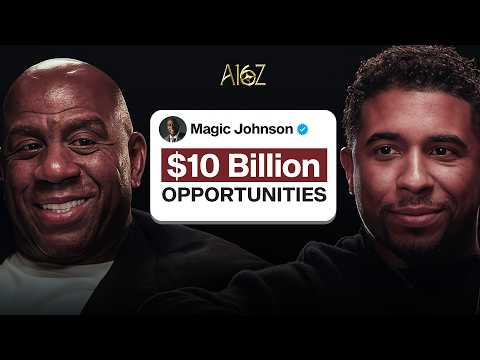
The shift from celebrity endorsements to equity-driven business ownership is accelerating. This is fueled by increased access to capital, sophisticated deal-making networks, and the ability of AI and blockchain tools to enable smaller teams to build billion-dollar companies, fundamentally changing how personal brands translate into lasting enterprise value.
Cultivate a diverse, expert team that can challenge your assumptions and execute your vision, allowing you to scale beyond your individual capacity. Prioritize long-term equity plays and strategic partnerships over short-term cash, even if it means investing in "boring" businesses with consistent growth.
The next 6-12 months will see an explosion of "creator-led" ventures leveraging AI for efficiency and market penetration. Understanding Magic Johnson's blueprint for strategic partnerships, long-term asset appreciation (especially in sports), and disciplined investment in underserved markets provides a high-signal roadmap for identifying and participating in these high-growth opportunities.
The Macro Shift: Celebrity capital is moving from passive endorsements to active equity ownership, mirroring a broader market trend where brand power translates directly into venture influence. This shift is accelerated by AI and blockchain tools, allowing individuals to build and scale businesses with unprecedented efficiency, making strategic capital more potent.
The Tactical Edge: Cultivate "boring" businesses in underserved markets. Magic Johnson's success in urban pharmacies and early-stage sports teams demonstrates that high demand in overlooked sectors, combined with strategic investment in customer experience and analytics, yields outsized returns.
The Bottom Line: The future of wealth creation hinges on long-term equity plays, strategic partnerships, and a willingness to invest in overlooked markets and cutting-edge tech like AI. For investors, this means prioritizing value-add capital and patient growth; for builders, it means leveraging new tools to create businesses that address real, unmet demand.
The field is moving from predicting existing biological structures to generating novel ones, driven by open-source AI models. This transforms biology from an observational science into a design-first engineering discipline, where computational power and accessible tools dictate the pace of innovation.
Invest in platforms that abstract away the computational complexity of molecular design, offering robust, validated generative AI tools and scalable infrastructure. This allows scientists to focus on therapeutic hypotheses, not GPU management, accelerating time to experimental validation.
The next wave of biological breakthroughs will come from those who can rapidly iterate on designed molecules, not just discovered ones. Access to powerful, user-friendly generative AI platforms like Boltz Lab will be a critical differentiator for biotech and pharma in the near future.
Prioritize low-latency, multi-turn interaction models for agentic workflows. Invest in prompt engineering as a core skill, treating it as advanced executive communication to precisely guide AI agents.
The AI industry is moving beyond raw model size as the sole metric of progress. The true frontier is now defined by the efficiency of capability delivery—how quickly, affordably, and contextually a model can perform complex tasks for a user, driven by hardware-software co-design and intelligent data management.
The next 6-12 months will see a bifurcation in AI development: hyper-specialized, low-latency "flash" models for ubiquitous, agent-driven tasks, and ultra-capable "pro" models for deep reasoning, with hardware co-design and multimodal data integration being the key differentiators for sustained competitive advantage.
The shift from transactional endorsements to equity-driven ownership for public figures is accelerating, driven by soaring asset valuations in sports and entertainment, and amplified by new tech that allows for more direct brand building and value creation. This means the "celebrity investor" is no longer a novelty but a strategic force, demanding a different approach to deal flow and value add.
Cultivate a diverse, expert team that can challenge your assumptions and vet opportunities, especially in unfamiliar sectors. Prioritize long-term equity plays over short-term cash, and actively seek out "boring" businesses with consistent growth potential, as these often hide outsized returns.
The future of wealth creation for founders and investors lies in understanding that relationships are capital, equity is king, and a "win-at-all-costs" mentality must extend beyond your core expertise into every business venture. Position yourself to identify and participate in deals that leverage both established industries (like sports) and emerging tech (like AI), recognizing that early entry and strategic partnerships are paramount for exponential growth.
The athlete-investor archetype, pioneered by Magic Johnson, signals a broader trend where personal brand and strategic capital disrupt traditional investment. This shift is accelerated by AI and blockchain, enabling individuals to build billion-dollar enterprises.
Cultivate a "give-first" network by consistently adding value to relationships. Attend industry events early to maximize quality time with key decision-makers.
Long-term wealth creation hinges on disciplined equity ownership, investing in "boring" but essential sectors, and assembling an expert team. This framework is crucial for navigating tech opportunities over the next 6-12 months.
The era of celebrity endorsements is giving way to direct equity ownership and entrepreneurial ventures, as high-profile individuals increasingly seek to build lasting business empires rather than just collect checks. This trend is amplified by new technologies like AI, which lower the barrier to entry for creating and scaling businesses.
Cultivate a powerful network by consistently showing up early to meetings and prioritizing long-term relationships over immediate transactions. Actively seek out "boring" businesses or underserved markets with high demand, as these often yield consistent, outsized returns.
Success in the next 6-12 months hinges on a "win-first" mentality, strategic team building, and a willingness to invest capital into core value drivers. Embrace partnerships and leverage your unique "added value" beyond just capital to secure the best deals and accelerate growth in a rapidly evolving tech and business landscape.
The Macro Shift: Celebrity capital is moving from transactional endorsements to strategic equity ownership, mirroring a broader trend where individuals, powered by AI and blockchain tools, can build high-value companies with leaner teams, making strategic capital more impactful than ever.
The Tactical Edge: Cultivate a network of mentors and partners, prioritize equity in "boring" but high-demand sectors, and be prepared to invest significant capital into improving core product and customer experience.
The era of celebrity endorsements is giving way to a new reality where personal brand power is directly converted into equity ownership and enterprise building, accelerated by accessible tech like AI for rapid business creation.
Cultivate a diverse network through consistent, intentional engagement, and prioritize investments in demand-driven, "boring" businesses that offer long-term growth and opportunities for strategic value addition.
Success in the next decade demands a "win-at-all-costs" mindset, a willingness to invest in operational excellence (including AI and analytics), and a strategic shift from short-term gains to long-term equity and partnership.
Capital no longer distinguishes between AI stocks and rare metals. Investors treat these as a single risk-on bucket settled on-chain.
Monitor Hyperliquid deployers. Identify protocols moving from passive yield to active market-making to capture the next commodity rotation.
The next year will favor platforms providing access to diverse asset classes. Pure crypto protocols must adapt or lose mindshare to trade everything venues.
The Macro Transition: Hard Asset Migration. As fiat currencies lose purchasing power, capital moves into finite assets, starting with Gold and Bitcoin before trickling down to Silver and Ethereum.
The Tactical Edge: Buy the Laggard. Identify assets with strong fundamentals that have underperformed the market leader by more than 30%.
The Bottom Line: The catchup trade is the most profitable strategy when the primary leaders are consolidating.
The institutionalization of Bitcoin has temporarily sacrificed its digital gold status for liquidity, creating a massive opportunity for those who can stomach the volatility before the next decoupling.
Monitor Japanese government bond yields as a leading indicator for global risk tolerance.
Bitcoin is currently a liquidity sponge, not a bunker. Expect it to follow the Trump Put and tech earnings until its volatility profile mirrors a currency rather than a speculative stock.
The market is moving from the "Compute Layer" to the "Agentic Layer." Owning the GPU is less valuable than owning the agent that controls the wallet.
Build agent-first interfaces. Stop designing for human clicks and start structuring your data so an LLM can execute transactions on your behalf.
The next 12 months belong to on-chain agents that handle treasury ops and commerce. The "decentralized GPU" narrative is dead. The "AI Agent with a bank account" narrative is just beginning.