Strategic Implication: The value in software development shifts from manual coding to high-level architectural design and prompt engineering.
Builder/Investor Note: Experiment with AI Studio's agentic and design capabilities. Focus on describing desired functionality rather than low-level code.
The "So What?": The next 6-12 months will see a surge in AI-powered, full-stack applications built by a broader range of creators, disrupting traditional development paradigms.
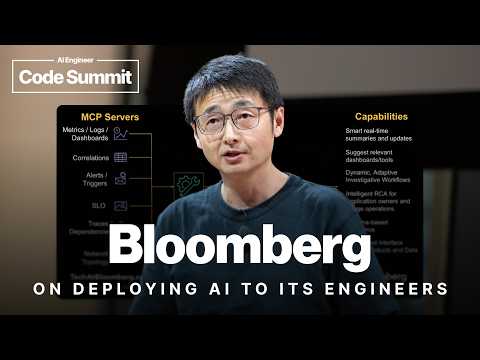
Strategic Shift: AI's impact extends beyond simple productivity. The real opportunity lies in fundamentally changing the cost function of engineering, making previously expensive or undesirable tasks cheap and feasible.
Platform Imperative: For large organizations, a "golden path" platform is not optional. It's how you manage complexity, ensure quality, and scale AI adoption safely and efficiently.
Human-Centric Adaptation: Technology is only half the battle. Investing in cultural adaptation, community building, and leadership training is crucial for realizing AI's full potential.
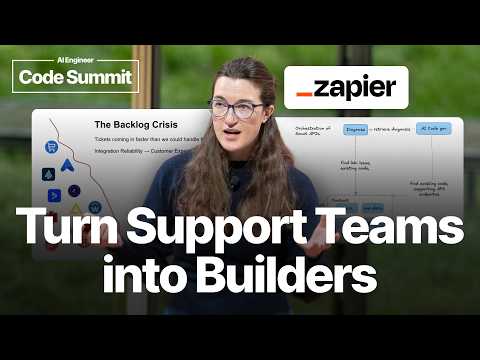
Strategic Implication: Companies integrating AI-driven code generation into non-engineering roles will see significant efficiency gains and improved product reliability.
Builder/Investor Note: Focus on building AI tools that deeply embed into existing workflows. Orchestration of multiple AI tools into an agent-like system is key for adoption and value.
The "So What?": The next 6-12 months will see a redefinition of "support" from reactive reporting to proactive, code-shipping problem-solving, unlocking new talent pools and accelerating development cycles.
Strategic Implication: The AI era will disproportionately reward existing businesses that deeply integrate AI to create unassailable cost structures, not just new AI-native ventures.
Builder/Investor Note: Seek out resilient "Act II" leaders who embrace the "and" business—growth, innovation, and profitability—and are willing to navigate public market scrutiny for long-term alignment.
The "So What?": Over the next 6-12 months, expect market volatility to create opportunities to invest in disciplined companies leveraging AI for fundamental operational shifts, rather than just hype.
Strategic Implication: The next wave of industrial growth will come from applying manufacturing principles to large-scale infrastructure, not just consumer goods.
Builder/Investor Note: Focus on companies that are standardizing designs and processes for physical assets, particularly those leveraging AI to navigate regulatory complexity and accelerate deployment.
The "So What?": The rapid build-out of data centers is a live experiment for a broader industrial renaissance, providing a blueprint for how America can rebuild its capacity to build at scale over the next 6-12 months.
Strategic Implication: The "AI safety" narrative is shifting from content moderation to systemic security. Focus on hardening the entire AI ecosystem, not just restricting model outputs.
Builder/Investor Note: Be wary of "AI security" products that claim to "secure the model" through guardrails. These are likely security theater. Invest in full-stack AI security solutions, red teaming services, and platforms that facilitate open-source adversarial research.
The "So What?": The future of AI security is not about building higher walls around models, but about understanding and hardening the entire ecosystem in which they operate. Open collaboration and adversarial testing are the fastest paths to robust AI.
Strategic Implication: The quality and sophistication of LLM evaluation frameworks are now as critical as the models themselves. This is a foundational layer for AI progress.
Builder/Investor Note: Builders must adopt adaptive evaluation. Investors should scrutinize how LLM performance is measured, not just the headline numbers.
The "So What?": As LLMs gain complex reasoning and instruction-following abilities, evaluation frameworks that can accurately measure these capabilities will be essential for identifying true innovation and avoiding misallocated resources in the next 6-12 months.
Sovereign AI is Real: Nations are investing in domestic AI capabilities to counter linguistic bias and ensure data control. This creates opportunities for specialized models and infrastructure.
Builder's Edge: Meticulous parameter tuning, high-quality data curation, and innovative architectures like MoE are crucial for achieving top-tier LLM performance.
The Agentic Future: AI agents are rapidly becoming indispensable tools in research and education, demanding robust, reliable, and culturally relevant LLM backbones.
Strategic Implication: The future of AI code generation hinges on dynamic, robust evaluation systems that adapt to evolving model capabilities and detect sophisticated exploitation.
Builder/Investor Note: Invest in or build evaluation infrastructure that incorporates dynamic problem sets, LLM-driven hack detection, and granular, human-centric metrics.
The "So What?": Relying on static benchmarks is a losing game. The next 6-12 months will see a push towards more sophisticated, real-world-aligned evaluation methods, separating genuinely capable models from those that merely game the system.
Investigate platforms offering regulated perpetual futures on traditional assets. These venues are positioned to capture significant institutional flow by combining crypto's product innovation with TradFi's risk management.
The global financial system is bifurcating, with a clear trend towards regulated, institutional-grade venues for all tradable assets, including novel ones like compute power.
The future of finance involves crypto-native products like perpetuals, but their mass adoption by institutions hinges on robust regulation and superior risk management.
The Macro Shift: AI's productivity gains are consolidating power and profits within vertically integrated tech giants, fundamentally altering the competitive landscape for software and infrastructure providers.
The Tactical Edge: Re-evaluate SaaS investments, favoring mega-cap tech companies poised to absorb former SaaS revenues through internal AI-driven development. For crypto, identify and accumulate projects with genuine revenue generation during the bear market.
The Bottom Line: Position your portfolio for a world where AI drives corporate insourcing, crypto valuations reset to fundamentals, and core digital assets like Bitcoin undergo necessary technical upgrades to survive future threats.
Traditional finance is integrating with crypto, but often on its own terms, demanding more transparency from protocols while VCs continue to deploy significant capital into specific, high-potential crypto and AI intersections.
Scrutinize institutional "partnerships" for concrete terms and evaluate protocols based on their true moat against easy forks or platform risk.
The market is bifurcating: clear regulatory wins for specific crypto applications (like prediction markets) and innovative AI/crypto plays are attracting capital, while opaque TradFi deals and general L1 infrastructure face increased scrutiny. Position for clarity and genuine value accrual.
The digitization of finance is accelerating, with institutional capital now actively seeking onchain yield and efficiency. This is creating a competitive pressure cooker for traditional banks, while opening vast opportunities for nimble DeFi protocols.
Focus on protocols building robust RWA infrastructure and those providing deep liquidity for tokenized treasuries. These are the picks and shovels for the coming institutional capital wave.
The fight for stablecoin yield and institutional adoption will define the next 6-12 months. Position yourself to capitalize on the inevitable flow of capital from TradFi to transparent, yield-bearing onchain assets, even if it's just a fraction of the total.
Explore DeFi protocols in the N7 index (Morpho, Frax, Aave, etc.) for early exposure to institutional capital flows and RWA looping opportunities.
Experiment with AI agents to automate content creation, research, and even software development, drastically cutting operational costs.
The financial system is bifurcating into a "Neo Finance" layer where tokenized real-world assets are integrated with DeFi primitives, and an "AI-augmented" layer where autonomous agents supercharge individual and small team productivity.
Bittensor is transitioning from a purely experimental decentralized AI network to a performance-driven marketplace, demanding real-world utility and robust economic models from its subnets.
Builders launching subnets must secure initial TAO liquidity and a clear, executable product roadmap from day one to navigate the competitive landscape and achieve emission.
The network's continuous adaptation, from chain buys to MEV mitigation, signals a commitment to long-term stability and value.