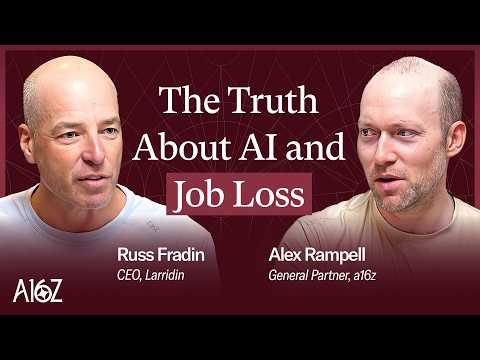
Measure Usage, Not Just Spend. The biggest failure in enterprise AI is tracking software purchases as a proxy for progress. The focus must shift to measuring actual tool usage correlated with output.
Solve for Fear, Not Features. Employee adoption hinges on psychological safety. The most powerful tools will fail if users are afraid of looking incompetent or getting fired for making a mistake.
Competition Drives Augmentation, Not Unemployment. The "AI will take our jobs" narrative is a red herring. Companies will reinvest AI-driven productivity gains to crush competitors, not just to cut headcount.
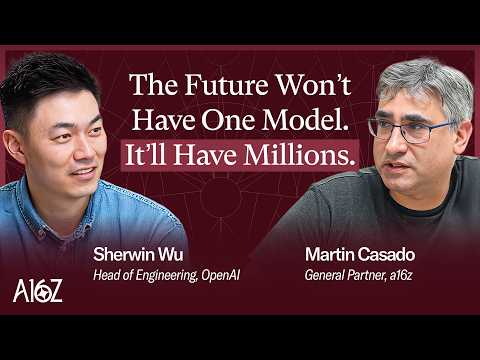
**The "One Model" Thesis Is Dead.** The future belongs to a portfolio of specialized models. This creates distinct opportunities for both foundational labs and companies that can leverage proprietary data to build best-in-class models for niche applications.
**Data Is the Ultimate Differentiator.** Reinforcement learning fine-tuning elevates proprietary data from a simple input for RAG systems to the core ingredient for building a defensible, state-of-the-art product.
**Agents Will Specialize.** The agent ecosystem is bifurcating into two primary types: open-ended, creative agents for knowledge work and deterministic, procedural agents designed for enterprise automation where reliability and adherence to standard operating procedures are critical.
Politics Will Trump Tech. Expect a policy pivot ahead of the 2024 election. The administration’s singular focus on AI stimulus is creating populist backlash, forcing a shift toward policies that support the broader labor market to secure votes.
The AI Trade Is Evolving. The "Mag 7" may soon become regulated utilities. The next wave of winners will be legacy companies that successfully integrate AI to boost margins and the overlooked players in the AI supply chain, such as power and commodity providers.
Prepare for a New Monetary Regime. The era of "QE Infinity" is ending. A post-Powell Fed is expected to move credit creation from its own balance sheet back to commercial banks, using deep rate cuts and deregulation to stimulate the economy.
AI Demand Is Not Cyclical; It's Infinite. Forget boom-and-bust. The mission to solve humanity's greatest problems—from disease to space travel—creates limitless demand for intelligence, underpinning a durable, multi-decade investment cycle.
Scrap GDP; Watch Profit Margins. The widening chasm between the astronomical profit margins of tech companies and the rest of the economy is the single most important macroeconomic signal today.
Bitcoin Is the Apex Predator of Moats. In a world where AI can replicate any business model, the only defensible moats are those built on time-tested belief and mathematical scarcity. Bitcoin is the emerging winner for the digital age.
AI's Physical Footprint is Astronomical: Individual AI data centers are now multi-billion dollar megaprojects, with construction timelines accelerating to as little as one year for a gigawatt-scale facility.
Power is a Solvable Problem, Not a Hard Cap: AI firms will pay whatever it takes to secure electricity, making power costs a secondary concern to the price of GPUs. The real constraint is getting chips, not watts.
Open-Source Intelligence Unveils All: By combining satellite imagery, public permits, and news reports, the physical expansion of the AI industry can be tracked in near real-time, providing unprecedented transparency.
AI Isn't a Bubble; It's a Buildout. The market is rational. Massive spending is backed by real revenue from inference. The true bottleneck is the speed at which capital can be deployed to build city-sized data centers.
Brace for Economic Whiplash. A sudden, AI-driven unemployment spike is the most likely trigger for massive government intervention. The political response will be swift, decisive, and potentially radical.
Superintelligence is a Hardware Problem. The path to 2045 runs through physical infrastructure. Progress is gated by the brute-force economics of building data centers, not a quest for a magical algorithm.
**Escape the Architecture Lottery.** The inertia behind Transformers is immense. A new model must be demonstrably superior across the board to justify a paradigm shift.
**Nature's Algorithms are the Next Frontier.** The CTM proves that biologically-inspired principles like neuron synchronization can unlock powerful capabilities like adaptive computation and better calibration naturally.
**Reasoning is Deeper Than Scaling.** The Sudoku Bench benchmark shows that current SOTA models cannot perform the creative, nuanced reasoning humans do. Brute-force scaling has hit a wall against truly complex problems.
Your Data is the New Oil, and You're Giving It Away. Every smart device, social media post, and email you create is a valuable asset used to build multi-billion dollar AI empires, yet you receive no compensation.
The Creator Economy is Facing an Existential Threat. The outcome of lawsuits like *NYT vs. OpenAI* will determine whether creative work remains intellectual property or becomes free raw material for AI, potentially decimating entire professions.
Reclaim Your Digital Sovereignty. Losing control of your data isn't just a privacy issue; it's a slide into "digital feudalism." The podcast champions decentralized technologies as a tool to break these data monopolies and reassert individual ownership.
AI's Debt Rally vs. Fed's Tight Grip. The AI boom is now fueled by credit markets, making it highly sensitive to the Fed's hawkish policy and rising real rates. An epic battle between tech momentum and macro gravity is brewing.
The Fed's Playbook Is Evolving. Forget immediate QE. The Fed is signaling a long-term plan to steepen the yield curve by offloading its long-duration assets. This strategy aims to ease pressure on "Main Street" while making financing more expensive for "Wall Street."
Crypto Is in a Historic Washout. On-chain and ETF flow data paint a picture of extreme capitulation. Both new and old hands are selling heavily, suggesting a major market reset is underway before the next cycle can truly begin.
Trust is moving from opaque balance sheets to verifiable, cryptographically enforced infrastructure. This means financial protocols, not just institutions, will increasingly dictate settlement, custody, and compliance.
Prioritize tokenized assets and investment vehicles that offer direct legal claims and verifiable on-chain mechanics. For builders, focus on creating infrastructure that eliminates intermediaries and provides transparent, programmable utility, like vaults.
The future of finance is about verifiable infrastructure and programmable ownership. Understanding the nuances of tokenized security structures and the rise of on-chain vaults will be critical for investors and builders navigating the convergence of traditional finance and DeFi over the next 6-12 months.
The market is demanding verifiable, transparent, and capital-efficient trading venues that eliminate the hidden risks of centralized intermediaries. This pushes innovation towards fully onchain, unified risk engines.
Explore platforms that integrate multiple DeFi primitives (spot, perp, lending) under a single, onchain risk engine. These venues offer superior capital efficiency and potentially higher risk-adjusted returns for sophisticated strategies like basis trades.
The next wave of DeFi success will come from platforms that solve for capital productivity and verifiable safety, attracting institutional and sophisticated retail capital by offering returns previously unattainable in fragmented or opaque markets.
The Macro Shift: Institutional capital flow dictates market cycles; the current downturn purges weak projects, paving the way for a value-driven recovery.
The Tactical Edge: Identify projects with genuine value accrual, strong fundamentals, and potential for buybacks, preparing to dollar-cost average into these "Carvana" plays.
The Bottom Line: The current "gross" feeling is a signal to strategically deploy capital into long-term, high-conviction assets, rather than short-term trading.
Capital is migrating from speculative, long-tail crypto assets to tokenized real-world assets and sophisticated derivatives. This reflects a broader market demand for yield, hedging, and perceived stability.
Explore tokenized commodities (gold, silver) and equity perpetuals for new leverage and yield opportunities. Exercise extreme caution with prediction markets and weekend tokenized equity trading due to information asymmetry and manipulation risks.
The crypto market is maturing beyond pure digital assets, integrating with traditional finance through tokenization and derivatives. Position your portfolio to capture value from this convergence, prioritizing robust liquidity and verifiable information over pure speculation.
The Macro Reallocation: As global liquidity loosens and traditional assets falter, capital is migrating from "atoms" (metals) to "bits" (crypto), particularly into DeFi protocols offering superior yield and ownership.
The Tactical Edge: Investigate DeFi neo-banks like Superform that aggregate yield, simplify UX, and offer tokenized ownership. These platforms are positioned to capture retail and institutional capital seeking higher returns and self-custody.
The Bottom Line: A crypto-friendly Fed, capital rotation from traditional assets, and maturing user-owned DeFi platforms mean the next 6-12 months will see significant growth in onchain finance, making it a critical area for strategic investment and building.
Global liquidity, traditionally seeking refuge in gold and equities, is increasingly flowing into Bitcoin and tokenized real-world assets on compliant crypto platforms. This economic reality is forcing exchanges to prioritize regulated, high-value offerings over speculative altcoins.
For builders, pivot from pure cryptonative narratives to projects with tangible products, clear revenue models, and infrastructure plays (RWA, AI, stablecoins). For investors, accumulate Bitcoin and explore tokenized traditional assets on compliant universal exchanges, recognizing the market's flight to quality.
The crypto market is maturing, demanding real value and regulatory adherence. Over the next 6-12 months, success will hinge on participating in platforms and projects that bridge traditional finance with blockchain, leaving pure altcoin speculation behind.