The Macro Shift: The Great Re-Shoring. National security now depends on domestic production of critical minerals and semiconductors.
The Tactical Edge: Build for Scale. Prioritize manufacturing competence over pure software features to win government contracts.
The Bottom Line: The defense industrial base is being rebuilt from the ground up. The next decade belongs to the builders who can merge Silicon Valley speed with the Pentagon's scale.
The Macro Trend: Biological Sovereignty. As global systems destabilize, the Amazon remains the most critical piece of biological infrastructure on the planet.
The Tactical Edge: Support Jungle Keepers. Direct capital to organizations that convert loggers into rangers to secure land concessions.
The Amazon is a finite asset under active siege. Protecting it requires a blend of primitive survival skills and high-tech surveillance over the next 18 months.
The Macro Pivot: As generative AI masters simulation, the physical world becomes a high-fidelity playground for software.
The Tactical Edge: Invest in the "brain" layer rather than the "limb" layer. Software that can generalize across different hardware forms will capture the most value.
The next decade belongs to embodied AI that reasons in real time. If you are waiting for the hardware to look perfect before paying attention, you will miss the moment the software takes over the physical world.
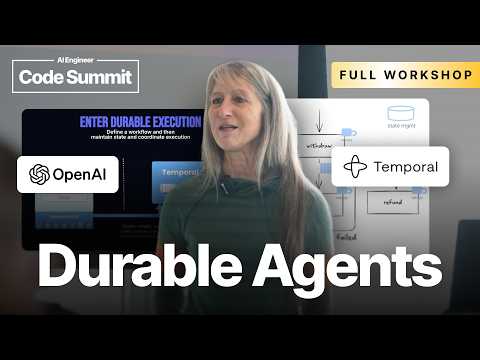
The industry is moving from "Agent as a Script" to "Agent as a Durable Service" where state management is handled by the infrastructure.
Wrap your existing API tools in the `activity_as_tool` function to gain automatic retries and execution history.
Reliability is the only moat in the agentic economy. If your agent cannot survive a server restart during a three-day task, it is not ready for the enterprise.
The Macro Trend: The move from fragmented content libraries to integrated health systems where AI synthesizes biomarkers and movement.
The Tactical Edge: Construct internal LLM tools to categorize qualitative feedback. This turns thousands of raw reviews into a precise roadmap.
The Bottom Line: Building a $100M ARR consumer app requires mastery of both growth loops and product retention. Solve for the daily habit to win the long game.
The transition from general-purpose AI to specialized application layers. As foundation models commoditize, value migrates to the "fat tail" of human-centric complexity.
Prioritize building or investing in "DNA of the future" companies that incumbents must eventually acquire to survive. Focus on winning the "point of attack" by staying deep in the technical details.
We are in a unique market where demand growth justifies high valuations. Success over the next year depends on identifying founders who are the absolute best in the world at one specific thing.
The US is pivoting from a QE-fueled, government-led economy to a "free market" model under the new Fed Chair, Kevin Warsh. This means a potential reduction in the Fed's balance sheet (QT) and lower rates without yield curve control (YCC), leading to decreased US dollar liquidity.
Adopt a phased, data-driven allocation strategy. Michael Nato recommends an 80% cash position, deploying first into Bitcoin (65% target) at macro lows (around 65K-58K BTC, MVRV < 1, 200WMA touch), then into high-conviction core assets (20%), long-term holds (10%), and finally "hot sauce" (5%) during wealth creation.
The current "wealth destruction" phase, while painful, presents a rare opportunity to accumulate assets at generational lows, provided one understands the macro shifts and adheres to a disciplined, multi-stage deployment plan.
The financial world is splitting into two parallel systems: opaque TradFi and transparent onchain finance. Value is migrating to platforms that can simplify and distribute onchain financial products globally.
Invest in or build applications that prioritize mobile-native experiences, abstract away crypto complexities (like gas fees), and offer tangible real-world utility for onchain assets.
The future of finance is onchain, and "super apps" like Jupiter are building the necessary infrastructure and user experiences to onboard the next billion users.
Crypto's initial broad vision has narrowed to specific financial use cases, while AI and traditional markets capture broader attention. This means builders must focus on tangible value and investors on proven models.
Identify projects with novel token distribution models (like Cap's stablecoin airdrop) or those building consumer-friendly applications within new ecosystems (like Mega ETH) that address past tokenomics failures.
The industry is past its naive, speculative phase. Success hinges on practical applications, robust tokenomics, and competing with traditional finance, not just abstract ideals.
The Macro Shift: From unbridled, community-driven idealism to a pragmatic, business-focused approach. Early crypto imagined a world where "everything is a thing on Ethereum," but reality has narrowed its primary use cases to finance and trading, forcing a re-evaluation of tokenomics and community models. This shift is also driven by AI capturing mindshare and traditional finance co-opting blockchain tech.
The Tactical Edge: Re-evaluate token distribution models. Instead of relying on inflationary yield farming that creates sell pressure, explore innovative approaches like Cap's "stable drop" (airdropping stablecoins, then inviting participation in a token sale) to align incentives and attract long-term holders. Focus on building real products with defensible business models, even if they lean more "business" than "protocol."
The shift from centralized, static data aggregation to decentralized, real-time, incentivized intelligence networks is fundamentally changing how data-intensive industries operate.
Investigate subnet opportunities where incumbent data quality is low and validation is a core challenge.
The future of sales is not just about more leads, but smarter, fresher, and more relevant ones.
The Macro Shift: As trust erodes in traditional financial systems and geopolitical risks rise, capital is flowing towards more efficient, permissionless DeFi markets. This is forcing traditional finance to adapt or lose market share.
The Tactical Edge: Evaluate DATs trading below NAV for potential M&A or activist plays, as these discounts often reflect management misalignment rather than fundamental asset weakness.
The Bottom Line: The current market volatility, Fed policy shifts, and the rise of DeFi are not just noise; they are reshaping capital allocation. Investors and builders must understand these structural changes to position for the next cycle of institutional adoption.