Go All-In on Embodied AI. The US must aggressively pursue leadership in robotics and advanced manufacturing. This isn't about nostalgia; it's about owning the largest economic and national security opportunity of the 21st century.
Declare War on Regulatory Cartels. The "cost disease" in housing, healthcare, and education is a policy failure. To make the American Dream affordable again requires dismantling the regulations that protect incumbents and block technological disruption.
Bridge the Divide with New Industry. The only sustainable way to heal the urban-rural chasm is to create new economic opportunities in the heartland. A robotics-led industrial boom can provide high-quality jobs across the country, turning a zero-sum political fight into a positive-sum national mission.
A new economic model is emerging where AI and crypto converge, transforming how value is created and distributed.
AI Is Becoming Specialized, Not Generalized. Forget one-size-fits-all AI. The future is in niche, fine-tuned models trained on proprietary data for specific tasks like DeFi optimization and on-chain security, making generic models like ChatGPT look like a blunt instrument.
Your Wallet Is Your Paycheck. Crypto wallets are becoming the interface for a new data economy. Users will transition from being unpaid data sources to active contributors who get rewarded with tokens for training specialized AI models.
Redefine AGI from Consciousness to Commerce. Forget Turing tests. The real benchmark for AGI is its ability to automate ~95% of white-collar work. The biggest missing piece isn't reasoning, but the capacity for continuous, on-the-job learning.
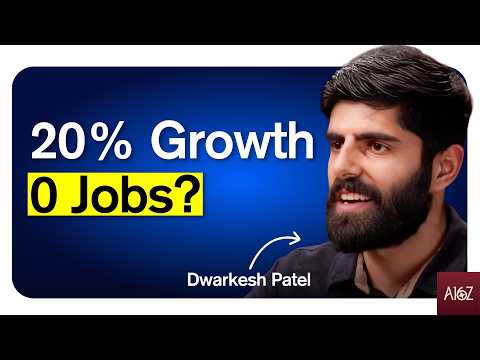
Prepare for an Economic Singularity. Post-AGI growth won't be an incremental bump; it will be an explosive shift to 20%+ annual growth, driven by infinitely scalable AI labor. The bottleneck won't be human demand but the ambitions of the agents controlling the AI.
The AGI Race Is More Industrial Revolution than Cold War. AGI is not a single bomb but a transformative process. The key risk isn't one nation nuking another, but advanced AIs playing nations against each other, much like the East India Company did in India.
Decentralize R&D for Efficiency. Using token-incentivized networks like Bittensor radically cuts costs and accelerates the initial drug discovery phase by tapping a competitive, global talent pool.
Go Upstream for Bigger Wins. Targeting root "behavioral" causes of disease instead of just symptoms creates drugs with multi-condition applications, unlocking massive, previously unseen market potential.
Innovate on Existing Rails. The fastest path to impact is by building on proven systems. Focusing on small molecules and using industry-standard validation partners creates a practical bridge between the worlds of crypto and traditional pharma.
Stagflation is Here: The Fed is poised to cut rates into rising inflation, an unorthodox move that signals how boxed-in monetary policy has become.
The Two-Tiered Economy is Real: Capital is flowing to the "productive frontiers" of AI and tech, while legacy industries and the un-invested class get crushed. Policy is exacerbating this divide.
Be Tactical, but Bet on the Ponzi: Expect a choppy August as euphoria cools. The long-term game, however, remains the same: bet on the assets that benefit from a global flight out of failing fiat and into productive, scarce technologies.
Crypto Is a Niche, Not a Foundation. AI builders are actively scrubbing crypto references from their branding to close enterprise deals. The market has decided: for now, crypto’s role is a payment rail, not the core agent stack.
Bet on Native Protocols, Not Browsers. Browser-based agents are a dead end. The future belongs to agent-native protocols like MCP that enable efficient, bidirectional communication, mirroring the shift from mobile web to native apps.
The AI Race Is a Power Race. The real bottleneck for AGI isn't just chips; it's energy. China's massive infrastructure build-out poses a strategic challenge to the West, which is betting on innovation in nuclear to keep pace. The future of AI may be decided by who can build power plants the fastest.
Energy is the New Scarcity. The race for AI supremacy is a race for power. Platforms like Akash that efficiently harness distributed, underutilized energy offer the only scalable alternative to the centralized model's impending energy crisis.
The Tech is Maturing Rapidly. Asynchronous training and ZK-proofs (championed by projects like Jensen) are making permissionless global compute networks a reality. The performance gap with centralized systems is closing fast.
The Mainstream is Buying In. A confluence of academic acceptance (at conferences like ICML) and favorable government policy (the White House's pro-open-source stance) is creating powerful tailwinds. The narrative has shifted from if decentralized AI is possible to how it will be implemented.
RLVR is the New SOTA for Solvable Problems: For tasks with clear right answers (code, math), RLVR is the state-of-the-art training method. The community is focused on scaling it, while RLHF remains the domain of fuzzy, human-preference problems.
The Future is Search-Driven: GPT-4o’s heavy reliance on search is not a bug; it’s a feature. The hardest problem is no longer giving models tools, but training them to learn when to use them.
Agents Need More Than Skills: The next leap in AI requires training for strategy, abstraction, and calibration. The goal is an AI that doesn’t just answer questions but efficiently plans its own work without wasting compute.
China's Open-Source Models are Winning on Price & Performance. Chinese models offer ~90% of the intelligence of top US proprietary models for a fraction of the cost, driving massive global adoption and threatening to commoditize the model layer. An American open-source champion is desperately needed to compete.
The "Cost is No Object" Compute Buildout is Reshaping the Market. A handful of private companies are spending at a loss to capture market share, fueled by VC. This creates a "sport of kings" dynamic that public companies can't match and makes pick-and-shovel players like Nvidia the biggest winners.
The US Tariff Strategy is Working. Contrary to consensus, the administration's tariff gambit has secured favorable trade deals with the EU and Japan, generating hundreds of billions in revenue without causing significant consumer inflation, and setting the stage for a major renegotiation with China.
Heightened Fraud Risks: The $LIBRA scandal underscores the perpetual risk of manipulation in memecoin markets, urging investors to exercise extreme caution.
Evolving Airdrop Strategies: Airdrops are becoming more sophisticated, but misalignment between expectations and reality continues to challenge their effectiveness.
Regulatory Balance Needed: While the SEC’s efforts to curb fraud are crucial, the crypto industry must develop robust self-regulation to complement external oversight
Ethereum Outshines Solana: Ethereum’s superior decentralization and monetary properties make it a more reliable asset compared to Solana.
Decentralization is Crucial: The degree of decentralization directly impacts an asset’s stability and future predictability, influencing investor confidence.
Bitcoin’s Influence Remains Strong: Despite Ethereum’s strengths, Bitcoin’s dominance sets the benchmark for decentralized digital assets, shaping the competitive landscape for other cryptocurrencies.
1. Regulatory Clarity is Crucial: Effective engagement with the SEC can pave the way for more robust and compliant crypto innovations.
2. Decentralization Enhances Stability: Solana’s efforts to decentralize through Jeto Labs contribute to a more resilient and trustworthy network.
3. DeFi as a Game-Changer: The growth of DeFi offers unprecedented opportunities for financial autonomy and market efficiency, driving future crypto adoption.
1. LIBRA’s collapse underscores the critical need for transparency and ethical practices in meme coin launches to restore investor trust.
2. Innovative projects like Sonic and Berachain are crucial in revitalizing the crypto market, demonstrating strong recovery and growth potential.
3. Utility-driven tools such as Kato are essential for fostering a more transparent and authentic crypto community, paving the way for sustainable development.
1. Institutional Momentum: Bitcoin’s increasing adoption by institutional investors solidifies its position as a stable digital asset, offering a counterbalance to market volatility.
2. Solana’s Resilience: Despite challenges from memecoin fallout, Solana’s strong ecosystem and fundamental value propositions continue to sustain its growth and developer interest.
3. HyperEVM’s Potential: The rise of HyperEVM highlights the ongoing innovation in blockchain technology, emphasizing the need for multi-faceted DeFi solutions to compete with established platforms like Solana.
1. Shift to Utility-Driven Crypto: The decline of meme coins signals a maturation of the crypto market, with a strong pivot towards innovative, utility-focused projects, especially in AI.
2. AI Models Are Accelerating Innovation: Rapid advancements in AI, exemplified by models like Grock 3, are challenging established leaders and driving the next wave of crypto innovation.
3. Kaido’s KITO Token is a Game-Changer: The launch of Kaido’s KITO token represents a significant opportunity for investors and developers, as it aims to create a robust decentralized data layer critical for the advancement of AI agents in crypto.