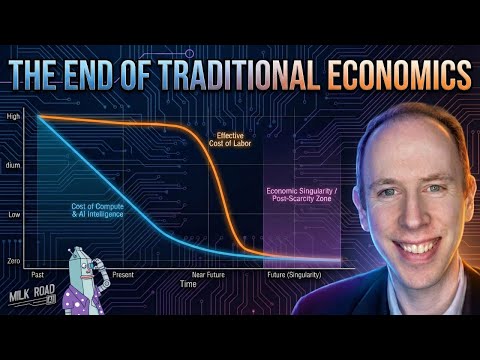
The Macro Shift: AI-driven hyperdeflation is colliding with the technical reality of autonomous AI agents creating their own crypto-backed economies, threatening a decoupling from human fiat systems.
The Tactical Edge: Investigate and build infrastructure that bridges human and AI economies, focusing on fiat-to-crypto rails that can accommodate agent-driven transactions to prevent a complete split.
The Bottom Line: The next 5-10 years will see an unprecedented economic transformation. Understanding AI's deflationary power and the emerging AI agent economy is critical for navigating a world where traditional economic models may no longer apply.
The time of practical AI agents is here, moving compute demand beyond pure GPU inference to a significant reliance on CPUs for coordination, data handling, and security.
Evaluate your agent deployment strategy now, prioritizing sandboxed environments (VPS, dedicated local servers) and exploring cost-optimized model routing to manage API expenses.
Prepare for a future where AI agents become integral to workflows, but recognize the hidden infrastructure costs and security implications, particularly the growing importance of CPU capacity and robust access controls.
The shift from "how" to "why" in AI agent capabilities creates a new, multi-trillion-dollar market for companies that can capture institutional decision logic.
Invest in or build agentic systems that are in the "right path" of business processes, actively capturing decision traces from unstructured data.
Hundreds of context graphs will be in production at scale within a year, defining a new "context graph stack." The winning companies will be those that master this flywheel, extracting value to accelerate automation and build deep, defensible moats.
The shift from linear, bottleneck-driven technological progress to a multi-layered, interconnected advancement model in AI has rendered traditional forecasting obsolete, forcing a re-evaluation of what "singularity" truly represents.
Prioritize adaptability: Invest in modular, composable AI infrastructure and tools that thrive in multi-layered, unpredictable environments, rather than betting on single-bottleneck solutions.
The inability to narrate AI's future means traditional roadmaps are obsolete; success hinges on navigating simultaneous, interconnected advancements and embracing the emergent.
The era of infrastructure-heavy tech deployment is over; AI's internet-native nature means immediate, widespread application. This shifts the competitive advantage from capital-intensive builds to rapid iteration and data leverage.
Invest in companies that are not just using AI, but are fundamentally rethinking their business models around AI's ability to collapse traditional cost structures and accelerate product development.
AI is a force multiplier for both individual opportunity and national power. Understanding its immediate deployability and the new rules of company building is crucial for investors and builders aiming to lead in the next wave of innovation over the next 12-24 months.
Unprecedented fiscal and monetary stimulus, coupled with a deregulatory environment, creates a powerful tailwind for financial assets and tech, driving a capital investment super cycle.
Investors should prioritize companies with proprietary data and GPU access, as these are the new moats in an AI-driven world where traditional software leads are eroding.
The convergence of a stimulative macro environment and AI's disruptive force means capital will flow to those who can scale, innovate, and navigate complex policy landscapes, making strategic positioning now critical for future relevance.
The macro trend of autonomous AI agents is shifting compute demand beyond GPUs, creating an unexpected CPU crunch and forcing a re-evaluation of on-premise inference and cost-optimized model routing for security and efficiency.
Investigate hybrid compute strategies, combining secure local environments (Mac Minis, home servers) with cloud-based LLMs, and explore multi-model API gateways like OpenRouter to optimize agent costs and performance.
AI agents are here, demanding a rethink of your compute stack and security protocols. Prepare for a future where CPU capacity, not just GPU, becomes a critical bottleneck, and strategic cost management for diverse AI models is non-negotiable for competitive advantage.
The move from general-purpose LLMs to specialized AI agents demands a new data architecture that captures the *why* of decisions, not just the *what*. This creates a new, defensible layer of institutional memory, moving value from raw model IP to proprietary decision intelligence.
Invest in or build agentic systems that are in the *orchestration path* of specific business processes. This allows for the organic capture of decision traces, forming a proprietary context graph that incumbents cannot easily replicate.
Over the next 12 months, the ability to build and extract value from context graphs will define the winners in the enterprise AI space, creating a new "context graph stack" that will be 10x more valuable than the modern data stack.
Tokenization is Strategic: BlackRock sees tokenizing assets as fundamental to improving market access and efficiency, dedicating significant focus to this path.
Bridging is Key: Practical solutions like ETPs and tokenized funds are crucial tools BlackRock is deploying to connect TradFi users and crypto-native institutions.
Transition Takes Time: The shift to tokenized markets will be gradual, requiring careful management of legacy systems and ensuring interoperability is maintained.
Altcoin Asymmetry: Lower-cap altcoins offer higher potential percentage gains (3-4x) with less required capital inflow compared to Bitcoin.
Bitcoin's Gravity: Bitcoin's massive size makes large multiple gains (like 3x) significantly harder, requiring vast capital injections.
Liquidity is King: Your bet hinges on future macro conditions; high liquidity environments tend to disproportionately benefit riskier, less liquid altcoins.
**The Trump Put is Real:** Market reactions demonstrably curb aggressive tariff policies; expect continued volatility but likely avoidance of worst-case tariff scenarios as Trump needs stable markets.
**Bitcoin Treasury Flywheel Spins Faster:** Expect more MicroStrategy clones globally, leveraging debt and equity markets to acquire Bitcoin. Monitor NAV premiums closely – their collapse is the model's Achilles' heel.
**Bitcoin's Narrative Strengthens:** Bitcoin's recent decoupling and resilience amid macro turmoil bolsters its digital gold thesis, attracting attention even from skeptics, while altcoins struggle to keep pace this cycle.
Bitcoin Stands Alone: Recognized globally, Bitcoin operates in its own macro league, detached from altcoin tech narratives.
Ethereum's Redemption Arc?: A pivot to user needs and L1 scaling is underway, but Ethereum must deliver concrete performance upgrades to compete effectively.
Execution is King: Solana leads the speed race but faces valuation/fee risks. The future favors chains offering the best, most sovereign execution environment, with modular plays like Celestia betting on a hyper-scaled world.
IBIT's Success Validates the Bridge: The Bitcoin ETP proved massive latent demand exists for accessing crypto via familiar, regulated wrappers, bringing many new investors into the fold.
Tokenization Targets Infrastructure First: Forget tokenizing illiquid JPEGs (for now); the real institutional action is using blockchains to fix inefficient TradFi plumbing, starting with cash and collateral.
Data & Standards are The Next Hurdle: Broader institutional adoption beyond Bitcoin requires solving the crypto data, standards, and valuation puzzle to enable reliable analysis and indexing.
Revenue Reality Check: Pumpfun's impressive revenue warrants investigation; sustainability is questionable if heavily reliant on bot activity or if it operates like a high-loss "casino" for users.
Platform Duality: Pumpfun serves as both a backend launchpad discovered via external platforms and a direct trading venue, with ~70% of pre-launch volume happening on-site.
High-Risk Environment: The platform operates like a "less fair casino," meaning users should anticipate significant risk and potential for loss.