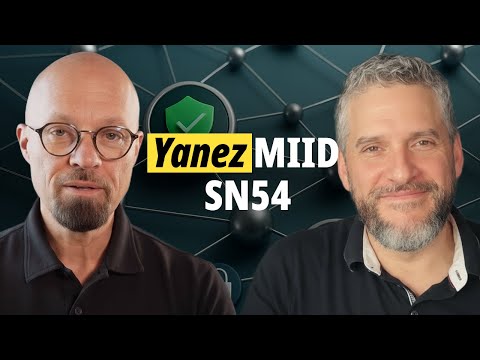
Siam Kidd, founder of DSV fund and chief strategy officer of Astrid Intelligence, discusses liquidity cycles, Bitcoin's future, Bittensor governance, and Astrid PLC's innovative approach to converting TradFi capital into Tao. He shares insights on subnet evaluation, the impact of TaoFlow, and his perspective on the current state of the crypto ecosystem.
Macro Liquidity Cycles and Bitcoin
Bittensor Governance and TaoFlow
Astrid PLC and Fiat-to-Tao Conversion
Key Takeaways:
For further insights and detailed discussions, watch the podcast: Link

This episode dives into the hidden economics of GPU scarcity—how AI and crypto are colliding over compute power, and what this means for investors.
Siam Kidd's Macroeconomic Outlook and BitTensor's Position
Siam Kidd, founder of DSV fund and Chief Strategy Officer of Astrid Intelligence, shares his current market perspective, noting a personal financial setback due to being "maxed long" on TAO during a recent price dip. He emphasizes that global liquidity cycles, driven by 5-6 year debt terms, are the primary macro driver, not Bitcoin's 4-year halving cycle, which he believes is becoming less predictable. Kidd highlights the "100% mathematical probability" of central banks printing more money due to 97% more debt than currency, with a significant US debt refinancing crunch expected in late 2025 to early 2026. He views recent market downturns as "coordinated FUD" (Fear, Uncertainty, Doubt) from entities like JPMorgan, designed to shake out leveraged traders while accumulating Bitcoin.
The Endgame of Nation-State Inflation and Social Credit Systems
Kidd posits that nation-states, viewed as "companies in the limit," are driven by policies from NGOs, think tanks, and organizations like the World Economic Forum and BlackRock. He cites ESG (Environmental, Social, and Governance) as a BlackRock-created narrative that benefits their investments and is now being pushed globally, leading to carbon credits, digital IDs, and social credit scores. Kidd expresses concern that Western nations are adopting models similar to China's social credit system, with the UK potentially serving as a testbed for digital IDs linked to carbon tracking and spending limits. He believes this is a 5-10 year timeline, emphasizing the need for disruptive political forces against bipartisan control.
BitTensor's Governance: The Benevolent Dictator Model
Kidd, a long-time student of governance, argues that throughout history, dictatorial or autocratic governance has been the norm, with democracy being a relatively new and often "fake" invention marred by crony capitalism and nepotism. He draws parallels between the collapse of empires (Roman to Vatican, British to accounting expertise) and the potential future of the US. For BitTensor, he asserts that the "best form of governance is a benign or benevolent dictator," likening it to a parent-child relationship. He identifies Const, BitTensor's founder, as this benevolent dictator, stating, "No one loves BitTensor more than Const." Kidd views BitTensor as a "decentralizing permissionless incentive protocol," with Const gradually releasing control.
DTO and the Subnet Mission vs. Early Revenue Dilemma
The DTO (Decentralized TAO Offering) mechanism allows people to vote with their money, but Kidd notes it has generated backlash. He clarifies his stance on revenue: while DSV focuses on revenue, he cautions against subnets chasing "fast early revenue at the detriment to their mission." He argues that subnets with "lofty goals" (e.g., Templar's distributed training models, Metanova's research) become "suboptimal in their pursuit of their mission" if they shoehorn products for quick revenue. He highlights that some research subnets are fortunate to have backing from entities like K (Const's entity) until they achieve their mission.
TaoFlow's Impact on Subnet Evaluation
Kidd states that TaoFlow, which penalizes subnets not achieving positive net TAO inflow, has "massively" changed his evaluation criteria. He believes TaoFlow is "forcing subnets... to be more short-term thinking," which he finds surprising and detrimental to many research-focused subnets. While 0% emissions don't affect alpha payouts to miners/validators, the pool's growth freezes. This pressure often compels subnet owners to quickly develop revenue-generating products to "appease net TAO inflow" and avoid falling down the ladder.
Astrid Intelligence PLC (Subnet 127) Vision and Funding
Siam Kidd, as Chief Strategy Officer (CSO) of Astrid Intelligence PLC, outlines an ambitious vision to raise $100 million. He clarifies that Astrid Intelligence PLC is an operating company, not an investment company, and its subnet (127) is the core technology. The innovative financial engineering involves a PLC owning a subnet, allowing its emissions to be treated as revenue (multiplied by 12 for forward-looking revenue) and the value of its alpha treasury to be used on the balance sheet for capital raising. This structure enabled Astrid to raise more capital in five days than DSV did in ten months. The primary goal is to "convert TradFi fiat into TAO," addressing the current difficulty of large-scale fiat-to-TAO conversions in the ecosystem.
Astrid's Funding Mechanism and Strategy
Astrid's strategy involves creating "paper value" within the PLC to raise multiples of that value. This includes leveraging owner key emissions (e.g., acquiring 10% of a subnet's owner key, generating 47,000 alpha/year from a single deal) and projecting forward-looking revenue. The digital alpha treasury, combined with the high APY (Annual Percentage Yield) of subnets, is intended to create a "money glitch" for capital raising. Kidd aims to raise £20-30 million (pounds) in January-February, demonstrating the model's viability to attract further investment.
Astrid's Liquidity Sync and Miner Dynamics
Astrid plans to establish a "Digital Alpha Treasury" as a liquidity sync, inspired by Metahash's concept. Miners or alpha holders can lock up their subnet alpha (e.g., $10,000 worth of "ridges" alpha) via a smart contract for 27 months. In return, they temporarily become a miner for Astrid and receive a discounted amount of Astrid's own alpha (e.g., $9,000 worth), which they can immediately sell without lockup. This mechanism aims to provide liquidity to subnet alpha holders without directly impacting their original subnet's chart. The speed of compensation depends on Astrid's alpha price and daily mining emissions.
Navigating Price Volatility and Buybacks
Kidd acknowledges the potential for a "slippery slope" if Astrid's alpha price drops, slowing miner compensation. He explains that the PLC's ability to raise significant capital allows for strategic deployment of TAO into subnets. Profits generated from these deployments (e.g., 20% OTC + 80% on-market buying leading to 2x price increases) will be used for Astrid alpha buybacks, mitigating sell-side pressure. He emphasizes Astrid's role as an "injective subnet," bringing new capital into BitTensor, which should increase the overall sum of subnets and average alpha prices.
Comparison with Frank Rizzo's DAT Strategy
Kidd differentiates Astrid's approach from Frank Rizzo's DAT (Decentralized Autonomous Treasury) strategy, which uses a NASDAQ-listed entity. Rizzo's model involves subnet owners locking up alpha in exchange for NASDAQ-listed shares with vesting programs, creating potential sell-side pressure on the public entity. Kidd believes Rizzo's model, as a pure DAT, faces challenges in raising capital compared to Astrid's operating company PLC structure. Astrid's subnet status provides an "umbilical cord" of emissions from BitTensor, which it aims to leverage as a "financial umbilical cord for BitTensor as a whole."
Operational Returns of Astrid
Kidd explains that Astrid's "operational returns" come from deploying TAO into other subnets. For example, investing 3,000 TAO into a subnet like Video (20% OTC, 80% on-market buying over months) is expected to significantly boost its chart (e.g., 2x higher). This makes the initial OTC element "wildly in profit." As the subnet grows with organic buy pressure, Astrid can slowly scale out of its position, retaining its principal and generating profit. This profit is then channeled into buybacks of Astrid's own alpha, reinforcing its token value.
DSV's Relationship with Lead Poet (Subnet 71)
Kidd openly declares Lead Poet (Subnet 71) as his "favorite subnet," highlighting it as DSV's first "properly incubated subnet." DSV provided funding (initial OPEX, on-market buying), helped with launch, and holds a 10% ownership stake, aligning for the long term. Lead Poet's product, focused on "really good lead generation," is seen as a "holy grail" for all businesses and potentially beneficial for every subnet. Kidd recounts the messy process of acquiring a subnet slot for Lead Poet, including being "front-run" due to leaked information.
DSV's Other Formalized Subnet Relationships and OTC Deals
DSV has several other formalized relationships with subnets, typically involving 5-10% ownership stakes that are often not perpetual. Kidd emphasizes avoiding "egregious" contracts where a single entity owns 20-50% of a subnet, which can disincentivize the core team. DSV's preferred OTC (Over-The-Counter) deal structure involves 20% OTC for the team's cash flow and 80% on-market buying, benefiting both the team and alpha holders by boosting emissions and price. DSV has completed around 30 such deals since June, each tailored to the specific subnet.
Selling Points for DSV and Deal Negotiation
Kidd attributes DSV's success in attracting subnet partnerships to transparency, integrity, and a commitment to "happy happy happy" outcomes for all parties involved (subnet owner, DSV, and alpha holders). He approaches negotiations from "first principles," aiming to find a middle ground between ideal outcomes for both sides. He notes that some teams use DSV to get written offers and then "shop around," which is a frustrating but common practice.
CryptoAI Day Events and Strategy
Kidd has hosted quarterly physical events for 13 years, including BitTensor-focused events for the past two years. His goal is to "increase the amount of fresh eyeballs and fresh capital" onto BitTensor, culminating in a large event in Austin, Texas, next September. He structures events with a single stage, no breakout rooms or exhibitions, to curate a "mental learning journey" for attendees. This includes "orange pilling" (educating about Bitcoin's value proposition), discussing future trends in AI, and showcasing subnets. Despite being "loss-making events," he continues them for community building and ecosystem growth.
Leo's Role (CTO) and Sunday Bar Connection
Leo serves as Astrid's CTO, leading a team of six developers and continuing to run trading algorithm competitions. He is also an advisor to Sunday Bar, but Kidd clarifies that this is a personal connection through a shared owner of multiple subnets (Tiger Alpha, Tiger Beta, Sunday Bar, Astrid), not a direct relationship between Astrid and Sunday Bar. Astrid has recently hired a full-time BitTensor developer, indicating a growing internal technical capacity.
Controversial Change for the BitTensor Ecosystem
Kidd suggests a controversial change: for Const, the founder, to reduce public interventions that might deter institutional investors. While acknowledging Const's indispensable role as the "benevolent dictator" who built the ecosystem, Kidd shares feedback from institutional investors and family offices. They perceive public disputes in Telegram groups or large, sudden TAO sales by the founder (e.g., 1,800 TAO of Ready AI, causing 0% emissions) as signs of an "immature ecosystem" and "negative vectors." Such actions create uncertainty, leading some large investors to sell off TAO. He emphasizes that while Const's actions have been vital, a more "mature" public image could attract more significant capital.
Advice for Allocating TAO into Subnets
For subnet owners, Kidd advises improving marketing and communication:
For DTO investors, Kidd notes that TaoFlow has fostered "short-termism." His "Game Theory Optimal" (GTO) advice is to:
Conclusion
The conversation underscores BitTensor's unique governance and the evolving financial engineering within its ecosystem. Investors and researchers should strategically evaluate subnets based on long-term mission alignment, monitor new TradFi integration models like Astrid PLC, and adapt investment strategies to TaoFlow's short-term incentives by targeting undervalued, low-liquidity subnets.