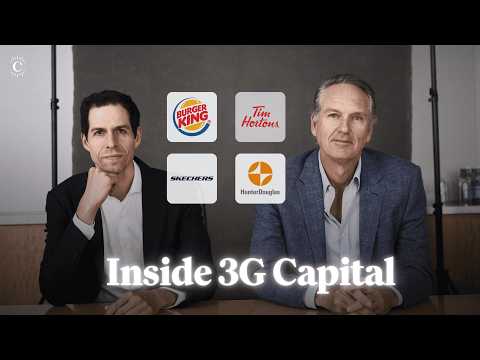
3G commits to one investment per fund, deploying significant house capital alongside partners. This singular focus drives an unparalleled rigor in due diligence and operational execution, because failure isn't an option—it's the only dish.
3G attracts top-tier talent by offering founder-like economics and accelerated responsibility. This creates a meritocracy where young leaders are given significant control and ownership earlier than traditional paths.
3G favors businesses with strong, direct customer relationships and physical assets, like Burger King or Hunter Douglas. These "atoms" businesses are inherently harder for new tech to disintermediate.
As capital markets become more efficient and valuations stretch, the edge shifts from financial engineering to deep operational expertise and a relentless focus on business quality.
Cultivate an owner-operator mindset throughout your organization, aligning incentives from the top down.
In the next 6-12 months, re-evaluate your investment criteria. Focus on businesses with clear customer relationships and robust, non-disruptable core offerings.
As market valuations stretch and technological disruption accelerates, the enduring value of well-moated, customer-centric businesses with strong physical components becomes clearer. 3G's focus on "harder to disrupt atoms" businesses, enhanced by technology, offers a resilient investment thesis.
Cultivate an owner-operator mindset, pushing decision-making closer to problems and aligning incentives with long-term success. Prioritize hiring ambitious young talent and empower them with responsibility, backed by strong mentorship.
In a world obsessed with speed and breadth, 3G Capital reminds us that deep, patient, operator-driven concentration in quality businesses, coupled with a fierce ownership culture, remains a powerful formula for outsized returns. This model builds enduring value, not just short-term gains.
In a market where digital disruption dominates headlines, 3G's success with physical, "atoms" businesses highlights that enduring value often lies in strong brands with direct customer relationships, where operational excellence and long-term thinking create defensible moats against technological fads.
Cultivate an "owner-operator" mindset in your investments and teams. Prioritize businesses with clear, simple value propositions and strong customer ties, then give young, ambitious talent significant ownership and autonomy to drive execution.
The next 6-12 months will reward investors and builders who resist the urge to chase every shiny new object. Instead, focus on fundamental business quality, deep operational involvement, and patient capital deployment in businesses that own their customer relationships. This disciplined approach, though counter-cultural, consistently compounds wealth.
As markets become more volatile and technology accelerates disruption, the traditional diversified portfolio approach faces increasing headwinds. 3G Capital's model signals a shift towards concentrated, operator-led bets on resilient, customer-owning brands with strong unit economics.
Identify businesses with deep moats, direct customer relationships, and long-term growth potential, then instill an owner-operator mindset throughout the organization, empowering young talent with significant equity and autonomy.
In a world of fleeting trends, focusing on fundamental business quality, operational excellence, and a long-term horizon offers a robust strategy for compounding capital, proving that sometimes, less truly is more.
3G commits to one investment per fund. This extreme concentration forces rigorous downside analysis and patience, ensuring capital is deployed only into truly exceptional opportunities.
Leaders are treated as shareholders, not just management. This alignment, often through outsized equity grants, drives decisions that prioritize the business's long-term health and value creation.
3G seeks businesses that own the relationship with their end customers. This direct connection provides a moat against disruption and disintermediation, as seen with brands like Burger King and Hunter Douglas.
The Macro Shift: As digital disruption accelerates, the value of businesses with inherent physical moats and direct customer relationships grows. 3G's focus on these "atoms" businesses, rather than "bits," positions them to capitalize on enduring consumer needs.
The Tactical Edge: Cultivate an owner-operator mindset in your ventures by aligning incentives deeply, empowering young talent, and relentlessly focusing on core business quality. This means prioritizing long-term value creation over short-term financial engineering.
The Bottom Line: In a world obsessed with speed and diversification, 3G Capital's patient, concentrated, and operator-driven model offers a powerful counter-narrative. For investors and builders, this means recognizing that deep, hands-on involvement in a few great businesses can still yield outsized returns, especially when others are chasing the next shiny object.
As technology accelerates disruption, businesses that own the direct customer relationship and operate in "atoms" industries become increasingly resilient.
Cultivate deep, long-term relationships with founders and owners of enduring businesses, positioning yourself as a patient, operator-led partner rather than a short-term financial buyer.
In an environment of stretched valuations and abundant capital, a disciplined, concentrated, and operator-driven approach to acquiring and growing high-quality, customer-owning businesses remains a powerful, albeit rare, path to outsized returns.
The AI infrastructure boom is transitioning from speculative buildouts to financially engineered, risk-managed investments, driven by the commodification of compute and memory.
Evaluate your compute procurement and data center buildout strategies through a financial lens, exploring futures contracts and residual value products to lock in costs and de-risk hardware investments.
The ability to quantify future compute demand and hardware value will be the differentiator for AI infrastructure players over the next 6-12 months, enabling smarter capital deployment and competitive advantage.
The demand for specialized "human alpha" in AI is intensifying, particularly for high-stakes problems where LLMs hit a performance ceiling. Platforms like Crunch are essential infrastructure for channeling this scarce human intelligence into decentralized networks.
Builders should integrate abstraction layers that simplify Web3 interaction for non-crypto native experts. This expands the talent pool and accelerates innovation by removing technical barriers to entry.
The future of decentralized AI hinges on effectively combining machine compute with unique human insight. Investing in platforms that bridge this gap will capture significant value as the "price of intelligence above benchmark" becomes increasingly transparent and monetizable.
The US is actively competing for crypto leadership, moving from a reactive, enforcement-first approach to proactive legislation and regulatory guidance. This strategic pivot aims to keep innovation and capital within American borders, positioning the US as a hub for future financial technology.
Monitor the progress of the Clarity Act and other market structure legislation in Congress. Focus on projects and protocols that align with the emerging regulatory framework, particularly those in DeFi and tokenization, as these areas stand to benefit most from increased certainty and institutional participation.
The next few years are critical for establishing durable crypto policy. A stable regulatory environment, coupled with strong political influence, will prevent future policy reversals. This period offers a unique opportunity for builders and investors to capitalize on a clearer path for onchain finance and technology.
The era of individual "superpowers" is here, where AI agents amplify personal expertise, allowing non-technical individuals to build and operate complex systems previously reserved for large teams. This democratizes high-skill output, shifting value from raw coding to strategic system design and prompt engineering.
Implement an agent-first workflow by setting up a personal Discord server with specialized AI sub-agents (e.g., "Saul Goodman" for legal, "Milhouse" for research). Train them with your data and integrate APIs for automated tasks like content generation or data analysis, reducing reliance on manual processes and external hires.
Over the next 6-12 months, the ability to effectively deploy and manage personal AI agents will be a critical differentiator. Those who master this will not only multiply their personal output but also gain a significant competitive advantage in content, trading, and online business, effectively becoming a one-person enterprise.
The convergence of legacy finance and DeFi is accelerating, driven by institutional demand for efficiency and new product capabilities, leading to a "Neo Finance" era where tokenization is the default for asset management.
Focus on infrastructure and protocols that facilitate institutional-grade tokenization and vault strategies, as these will capture significant value as traditional assets migrate on-chain.
The next 6-12 months will see institutions solidify their DeFi presence, making tokenized assets and vaults central to their strategies. Builders and investors must understand this shift to position themselves for the inevitable re-rating of financial infrastructure.
The Macro Shift: As crypto moves from niche tech to mainstream finance, it inherits the complex regulatory and criminal challenges of traditional systems, forcing a re-evaluation of its core principles like self-custody and transaction finality.
The Tactical Edge: Advocate for nuanced regulatory discussions that differentiate between legitimate innovation and outright fraud, while actively exploring privacy-preserving technologies like zero-knowledge proofs to mitigate real-world physical risks for users.
The Bottom Line: The industry must proactively address its vulnerabilities and engage constructively with regulators and the public. Ignoring these issues or retreating into insular arguments will only hinder crypto's long-term legitimacy and widespread adoption over the next 6-12 months.
The global economy is undergoing a dual transformation: a shift from lagging, survey-based economic data to real-time, granular insights (like Truflation's), and a speculative AI infrastructure build-out by tech giants.
Monitor Truflation's real-time inflation data and the balance sheets of MAG7 companies to identify early signs of market dislocation or mispriced assets.
The convergence of AI and blockchain will redefine economic measurement and payment rails, while massive AI infrastructure spending could create a new financial bubble.