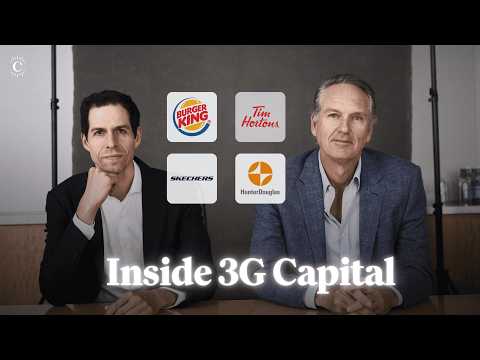
3G commits to one investment per fund, deploying significant house capital alongside partners. This singular focus drives an unparalleled rigor in due diligence and operational execution, because failure isn't an option—it's the only dish.
3G attracts top-tier talent by offering founder-like economics and accelerated responsibility. This creates a meritocracy where young leaders are given significant control and ownership earlier than traditional paths.
3G favors businesses with strong, direct customer relationships and physical assets, like Burger King or Hunter Douglas. These "atoms" businesses are inherently harder for new tech to disintermediate.
As capital markets become more efficient and valuations stretch, the edge shifts from financial engineering to deep operational expertise and a relentless focus on business quality.
Cultivate an owner-operator mindset throughout your organization, aligning incentives from the top down.
In the next 6-12 months, re-evaluate your investment criteria. Focus on businesses with clear customer relationships and robust, non-disruptable core offerings.
As market valuations stretch and technological disruption accelerates, the enduring value of well-moated, customer-centric businesses with strong physical components becomes clearer. 3G's focus on "harder to disrupt atoms" businesses, enhanced by technology, offers a resilient investment thesis.
Cultivate an owner-operator mindset, pushing decision-making closer to problems and aligning incentives with long-term success. Prioritize hiring ambitious young talent and empower them with responsibility, backed by strong mentorship.
In a world obsessed with speed and breadth, 3G Capital reminds us that deep, patient, operator-driven concentration in quality businesses, coupled with a fierce ownership culture, remains a powerful formula for outsized returns. This model builds enduring value, not just short-term gains.
In a market where digital disruption dominates headlines, 3G's success with physical, "atoms" businesses highlights that enduring value often lies in strong brands with direct customer relationships, where operational excellence and long-term thinking create defensible moats against technological fads.
Cultivate an "owner-operator" mindset in your investments and teams. Prioritize businesses with clear, simple value propositions and strong customer ties, then give young, ambitious talent significant ownership and autonomy to drive execution.
The next 6-12 months will reward investors and builders who resist the urge to chase every shiny new object. Instead, focus on fundamental business quality, deep operational involvement, and patient capital deployment in businesses that own their customer relationships. This disciplined approach, though counter-cultural, consistently compounds wealth.
As markets become more volatile and technology accelerates disruption, the traditional diversified portfolio approach faces increasing headwinds. 3G Capital's model signals a shift towards concentrated, operator-led bets on resilient, customer-owning brands with strong unit economics.
Identify businesses with deep moats, direct customer relationships, and long-term growth potential, then instill an owner-operator mindset throughout the organization, empowering young talent with significant equity and autonomy.
In a world of fleeting trends, focusing on fundamental business quality, operational excellence, and a long-term horizon offers a robust strategy for compounding capital, proving that sometimes, less truly is more.
3G commits to one investment per fund. This extreme concentration forces rigorous downside analysis and patience, ensuring capital is deployed only into truly exceptional opportunities.
Leaders are treated as shareholders, not just management. This alignment, often through outsized equity grants, drives decisions that prioritize the business's long-term health and value creation.
3G seeks businesses that own the relationship with their end customers. This direct connection provides a moat against disruption and disintermediation, as seen with brands like Burger King and Hunter Douglas.
The Macro Shift: As digital disruption accelerates, the value of businesses with inherent physical moats and direct customer relationships grows. 3G's focus on these "atoms" businesses, rather than "bits," positions them to capitalize on enduring consumer needs.
The Tactical Edge: Cultivate an owner-operator mindset in your ventures by aligning incentives deeply, empowering young talent, and relentlessly focusing on core business quality. This means prioritizing long-term value creation over short-term financial engineering.
The Bottom Line: In a world obsessed with speed and diversification, 3G Capital's patient, concentrated, and operator-driven model offers a powerful counter-narrative. For investors and builders, this means recognizing that deep, hands-on involvement in a few great businesses can still yield outsized returns, especially when others are chasing the next shiny object.
As technology accelerates disruption, businesses that own the direct customer relationship and operate in "atoms" industries become increasingly resilient.
Cultivate deep, long-term relationships with founders and owners of enduring businesses, positioning yourself as a patient, operator-led partner rather than a short-term financial buyer.
In an environment of stretched valuations and abundant capital, a disciplined, concentrated, and operator-driven approach to acquiring and growing high-quality, customer-owning businesses remains a powerful, albeit rare, path to outsized returns.
The AI infrastructure boom is transitioning from speculative buildouts to financially engineered, risk-managed investments, driven by the commodification of compute and memory.
Evaluate your compute procurement and data center buildout strategies through a financial lens, exploring futures contracts and residual value products to lock in costs and de-risk hardware investments.
The ability to quantify future compute demand and hardware value will be the differentiator for AI infrastructure players over the next 6-12 months, enabling smarter capital deployment and competitive advantage.
Rotation Imminent: Data suggests Bitcoin's strength is setting the stage for capital to flow into altcoins, particularly Ether, which is seen as "hated" and due for a rebound against Bitcoin.
Macro is Bullish (For Now): Continued fiscal spending and an anticipated stablecoin bill are significant tailwinds, though summer may bring some turbulence.
Strategic Allocation is Key: Focus on assets with strong fundamentals or high attention. Consider beta plays like "blue-chip" meme coins (Pepe for ETH, Bonk for SOL) for higher-risk, higher-reward exposure, but plan exits for speculative positions.
Dynamic Tao is High-Risk: Approach investments with extreme caution; the market is volatile, and significant capital loss is a tangible risk.
Embrace Unpredictable Innovation: Bittensor's core value lies in its capacity to generate unforeseen, groundbreaking solutions from a global, permissionless, and competitive talent pool.
Substrate Chain Decentralization is Critical: The successful decentralization of Bittensor's foundational layer is a paramount upcoming milestone for its long-term viability, security, and censorship resistance.
Global Takeover: Bitcoin treasury strategies are rapidly globalizing, creating new Bitcoin-proxy investment vehicles in numerous capital markets.
Investor Vigilance: While "Bitcoin plus" returns are alluring, investors must critically assess MNAV multiples and beware of highly leveraged companies lacking strong, transparent leadership.
Reverse Tokenization is Real: Crypto assets are increasingly entering traditional finance via these public companies, fundamentally changing institutional access and perception.
**L1s are Money, Not Stocks:** Stop trying to fit square pegs (L1s) into round holes (DCF models for companies). Their value accrues like money, through network effects and demand for their monetary properties.
**RSOV is Your New Lens:** Use RSOV to gauge the "stickiness" of capital in an L1 ecosystem. A growing RSOV suggests a strengthening monetary base and potentially a rising valuation floor.
**ETH's RSOV Story:** ETH, when viewed through the RSOV lens, appears undervalued relative to assets like Bitcoin, especially considering catalysts like EIP-4844 ("proto-danksharding") and the growth of its L2 ecosystem, which drives ETH's use as a store of value.
Aggressive Execution: The Ethereum Foundation is adopting a "winning" mindset, prioritizing product delivery, engineering excellence, and rapid scaling (e.g., 3x annual gas limit increases).
Deepening Capital Markets: Ethereum is solidifying its position as the primary settlement layer for RWAs and the burgeoning on-chain finance sector, attracting significant institutional interest.
Innovation Frontier: Expect new waves of innovation in NFTs (tied to RWAs and AI) and enhanced L2 interoperability, driven by advancements like real-time ZK proofs.