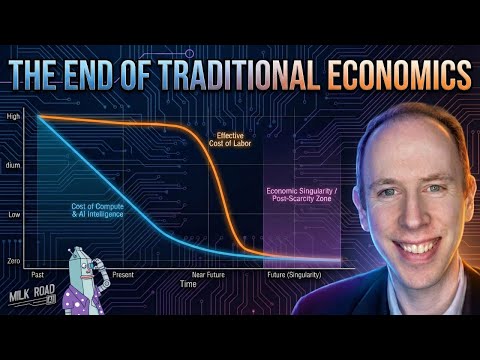
The Macro Shift: AI-driven hyperdeflation is colliding with the technical reality of autonomous AI agents creating their own crypto-backed economies, threatening a decoupling from human fiat systems.
The Tactical Edge: Investigate and build infrastructure that bridges human and AI economies, focusing on fiat-to-crypto rails that can accommodate agent-driven transactions to prevent a complete split.
The Bottom Line: The next 5-10 years will see an unprecedented economic transformation. Understanding AI's deflationary power and the emerging AI agent economy is critical for navigating a world where traditional economic models may no longer apply.
The time of practical AI agents is here, moving compute demand beyond pure GPU inference to a significant reliance on CPUs for coordination, data handling, and security.
Evaluate your agent deployment strategy now, prioritizing sandboxed environments (VPS, dedicated local servers) and exploring cost-optimized model routing to manage API expenses.
Prepare for a future where AI agents become integral to workflows, but recognize the hidden infrastructure costs and security implications, particularly the growing importance of CPU capacity and robust access controls.
The shift from "how" to "why" in AI agent capabilities creates a new, multi-trillion-dollar market for companies that can capture institutional decision logic.
Invest in or build agentic systems that are in the "right path" of business processes, actively capturing decision traces from unstructured data.
Hundreds of context graphs will be in production at scale within a year, defining a new "context graph stack." The winning companies will be those that master this flywheel, extracting value to accelerate automation and build deep, defensible moats.
The shift from linear, bottleneck-driven technological progress to a multi-layered, interconnected advancement model in AI has rendered traditional forecasting obsolete, forcing a re-evaluation of what "singularity" truly represents.
Prioritize adaptability: Invest in modular, composable AI infrastructure and tools that thrive in multi-layered, unpredictable environments, rather than betting on single-bottleneck solutions.
The inability to narrate AI's future means traditional roadmaps are obsolete; success hinges on navigating simultaneous, interconnected advancements and embracing the emergent.
The era of infrastructure-heavy tech deployment is over; AI's internet-native nature means immediate, widespread application. This shifts the competitive advantage from capital-intensive builds to rapid iteration and data leverage.
Invest in companies that are not just using AI, but are fundamentally rethinking their business models around AI's ability to collapse traditional cost structures and accelerate product development.
AI is a force multiplier for both individual opportunity and national power. Understanding its immediate deployability and the new rules of company building is crucial for investors and builders aiming to lead in the next wave of innovation over the next 12-24 months.
Unprecedented fiscal and monetary stimulus, coupled with a deregulatory environment, creates a powerful tailwind for financial assets and tech, driving a capital investment super cycle.
Investors should prioritize companies with proprietary data and GPU access, as these are the new moats in an AI-driven world where traditional software leads are eroding.
The convergence of a stimulative macro environment and AI's disruptive force means capital will flow to those who can scale, innovate, and navigate complex policy landscapes, making strategic positioning now critical for future relevance.
The macro trend of autonomous AI agents is shifting compute demand beyond GPUs, creating an unexpected CPU crunch and forcing a re-evaluation of on-premise inference and cost-optimized model routing for security and efficiency.
Investigate hybrid compute strategies, combining secure local environments (Mac Minis, home servers) with cloud-based LLMs, and explore multi-model API gateways like OpenRouter to optimize agent costs and performance.
AI agents are here, demanding a rethink of your compute stack and security protocols. Prepare for a future where CPU capacity, not just GPU, becomes a critical bottleneck, and strategic cost management for diverse AI models is non-negotiable for competitive advantage.
The move from general-purpose LLMs to specialized AI agents demands a new data architecture that captures the *why* of decisions, not just the *what*. This creates a new, defensible layer of institutional memory, moving value from raw model IP to proprietary decision intelligence.
Invest in or build agentic systems that are in the *orchestration path* of specific business processes. This allows for the organic capture of decision traces, forming a proprietary context graph that incumbents cannot easily replicate.
Over the next 12 months, the ability to build and extract value from context graphs will define the winners in the enterprise AI space, creating a new "context graph stack" that will be 10x more valuable than the modern data stack.
Appetite is Insatiable: Investor demand for any crypto-related exposure is immense, capable of pumping stocks like Circle's despite questionable financials.
Fundamentals Still (Should) Matter: Circle's low margins, high costs, and interest rate sensitivity paint a precarious picture, a "terrible company" according to one host, even if its stock moons.
Hype Cycle Peaks & Troughs: The current frenzy across crypto-linked stocks (Circle, potential Ripple IPO, Coinbase, MSTR) signals significant hype, which historically precedes market corrections.
Flipcash is betting that a hyper-fast, intuitive "digital cash" experience, leveraging Solana's speed and a novel L2, can carve out a unique niche in the crowded payments landscape.
The shift to USDC and a clever onboarding mechanism (pay for account, get instant credit) aims to overcome common crypto adoption hurdles related to volatility and empty wallets.
Solana's Speed is a Moat: Flipcash's core "instant cash" UX is explicitly tied to Solana's performance, highlighting the chain's capability for consumer-facing applications demanding high speed.
Political Winds Shift Crypto Sails: The Trump-Musk fallout underscores the urgency for clear crypto legislation, as policy can be derailed by high-level discord.
Stablecoin Showdown Looms: Circle's hot IPO masks a fiercely competitive future where big banks could disrupt incumbents by leveraging distribution and offering yield.
Q4 Top Signal? The flurry of crypto IPOs (Circle, potentially Gemini, Kraken) and soaring Bitcoin treasury adoption might signal a market peak approaching in Q4 2025 or Q1 2026.
Bitcoin is king: Expect Bitcoin to outperform traditional assets significantly; avoid fumbling this generational chance through common investor errors.
Evolve your strategy: The game has shifted from infrastructure hype and rapid trading to identifying and holding quality applications and tokens like Hyperliquid or Syrup with longer horizons.
Appetite meets fundamentals: While hype can drive initial pumps (e.g., Circle IPO), sustainable value lies in strong business models (Tether's organic growth) and clear token utility.
**IPO Appetite is Real (for Some):** Public markets are hungry for crypto, but primarily for clear narratives like stablecoins (see: Circle); broader adoption requires substantial revenue.
**VCs Get Flexible:** The smart money is adapting, ready to pounce on equity or tokens, depending on where the value (and exit) lies.
**On-Chain IPOs - The Next Speculative Playground?:** Imagine a world where early-stage crypto companies list on-chain, offering a more productive outlet for speculative capital than today's memecoin casino.
Regulatory Renaissance: The SEC's stance has softened, creating a more favorable U.S. environment for crypto; Ether's non-security status (for the scope of the past investigation) is a major win.
Ether as a Productive Treasury Asset: ESBET's strategy of acquiring and actively yielding Ether could set a new standard for corporate treasuries, showcasing Ether's utility beyond just holding.
The "Trust Commodity" Narrative: Expect a strong push to frame Ether's value around its ability to provide programmable trust and facilitate economic activity, with Lubin championing this.