The AI infrastructure boom is transitioning from speculative buildouts to financially engineered, risk-managed investments, driven by the commodification of compute and memory.
Explore futures and residual value products to de-risk your AI compute procurement or data center investments, securing predictable costs and monetizing hardware lifecycles.
Quantifying future compute demand and hardware value is no longer a luxury, it's a necessity. Over the next 6-12 months, those who integrate financial hedging into their AI strategy will gain a significant competitive advantage in capital allocation and operational efficiency.
Implement compute futures and residual value products to cap future costs or floor future revenue, significantly reducing exposure to spot market volatility and hardware obsolescence.
Ornn's residual value product allows data centers to sell GPUs years in advance, translating to lower financing costs for massive hardware investments.
Ornn's index tracks dynamic marketplace GPU pricing, empowering smaller buyers to avoid overpaying.
Data center operators and large compute buyers should explore Ornn's futures and residual value products to lock in costs, secure future revenue, and access more favorable financing terms.
The Macro Shift: As market complexity and technological disruption accelerate, traditional diversified investing faces increasing headwinds. 3G Capital's micro-level focus on deeply understanding and operating a single, well-moated business, combined with a long-term, owner-operator mindset, provides a robust counter-strategy to extract value where others see only risk.
The Tactical Edge: Cultivate an "owner's mindset" in your team, decentralizing "how" decisions while centralizing "what" goals. Prioritize hiring and promoting individuals who demonstrate exceptional drive and potential, even if they lack traditional tenure, and align their incentives directly with long-term business success.
The Bottom Line: In the next 6-12 months, focus on identifying businesses with strong, direct customer relationships and defensible physical assets. These "boring" businesses, when infused with an owner-operator culture and strategic tech adoption, offer a compelling path to outsized, enduring value, regardless of broader market volatility.
Integrate compute futures and residual value products into your financial planning. This will allow you to hedge against price volatility, secure better financing, and optimize hardware refresh cycles.
The AI compute market is transitioning from an opaque, ad-hoc system to a financially engineered commodity market. This shift will introduce unprecedented transparency and risk management tools, fundamentally altering investment and operational strategies for AI infrastructure.
The ability to quantify future compute demand and hardware value is no longer a luxury; it is a necessity. Over the next 6-12 months, those who adopt these financial instruments will gain a significant competitive advantage, building more resilient and profitable AI operations.
The Macro Shift: As digital disintermediation accelerates, businesses with strong direct-to-consumer relationships and physical moats become increasingly valuable. This counters the "software eats the world" narrative by highlighting the enduring power of tangible assets and customer loyalty.
The Tactical Edge: Cultivate an owner-operator mindset throughout your organization, aligning incentives deeply with long-term value creation. Prioritize hiring and empowering young talent, giving them significant responsibility early, and providing mentorship to maximize their success.
The Bottom Line: In a market where valuations are stretched and capital is abundant, 3G's disciplined, long-term approach to identifying and operating truly great businesses offers a powerful counter-narrative. Focus on enduring business quality and people-driven execution will be the ultimate differentiator for compounding capital over the next decade.
Singular Focus: 3G's model is one investment per fund, backed by significant house capital. This forces extreme patience and a rigorous downside analysis, ensuring capital preservation is paramount before seeking outsized returns.
Operator-Led: 3G partners are seasoned operators, having run large businesses themselves. This hands-on experience allows them to identify and implement operational improvements that pure financial investors might miss, directly impacting value creation.
Disruption Defense: In a tech-driven world, 3G prioritizes businesses that own the customer relationship and are less susceptible to disintermediation. This focus on "atoms" businesses with strong brands and physical components provides a moat against digital upheaval.
The Macro Shift: As digital disruption accelerates, the market increasingly undervalues "boring" businesses with strong physical moats and direct customer relationships. 3G Capital demonstrates that these enduring assets, when paired with intense operational rigor and long-term capital, can generate outsized returns.
The Tactical Edge: Identify businesses where the brand is significantly "bigger than the business" – meaning widespread recognition exists but operational inefficiencies or poor franchising have suppressed its true value. Then, apply an owner-operator model to fix core issues and expand globally.
The Bottom Line: In a world pursuing the next big tech wave, the real alpha might lie in patiently acquiring and meticulously operating established, non-disruptable businesses. Your roadmap should include a focused study of industries with strong customer ties and a focus on building an ownership-driven culture, rather than just seeking growth at all costs.
3G Capital commits to a single investment per fund, deploying significant internal capital alongside partners. This intense focus acknowledges the rarity of truly exceptional businesses and leaders, driving rigorous due diligence and a deep commitment to each asset.
3G instills an ownership culture where leaders act as shareholders, aligning incentives directly with the business's long-term success. This contrasts with traditional management structures, driving decisions that prioritize the company's best interests.
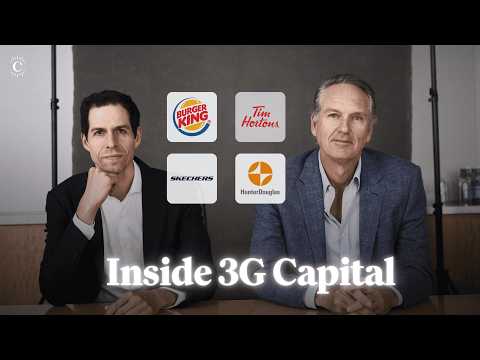
3G prioritizes businesses that own the direct relationship with their end customers, like Burger King or Hunter Douglas. This direct connection reduces disintermediation risk, making the business more resilient to technological shifts or retail power plays.
**Meme Wisely:** ETH's narrative power is potent, but sustainable value needs a bedrock of technological strength and real-world utility.
**Stablecoins are King:** This is the crypto sector attracting serious institutional capital and big tech attention; the growth runway is immense.
**Regulation is Warming:** Positive signals from the SEC on self-custody and staking offer tailwinds, potentially de-risking significant parts of the crypto ecosystem.
Regulatory Thaw: The SEC’s new leadership signals a more accommodating stance on crypto, potentially unlocking significant growth for DeFi in the US.
Market Structure Evolution: Tokenization is increasingly viewed as the key to modernizing capital markets, with on-chain IPOs and improved secondary market liquidity on the horizon.
Infrastructure is King: Acquisitions like Privy by Stripe highlight the race to build and control the foundational layers of the crypto economy, especially around wallets and stablecoins.
Solana's Next Act is Crucial: Current memecoin activity, while impressive, is viewed by institutions like Standard Chartered as less sustainable than diversified utility; a pivot to tokenized equities or social is key for long-term valuation.
Perception Battles Performance: Ethereum's established "trustworthiness" gives it an institutional edge, even if Solana offers superior tech for certain applications. Solana must overcome its "memecoin" image to attract serious TradFi.
Near-Term Headwinds for Solana Relative to Ethereum: Kendrick suggests Ethereum might outperform Solana in the near term (though both underperform Bitcoin) as Solana navigates its transition phase, while Ethereum benefits from incumbency in stablecoins and tokenized RWAs.
**Currency Cold War:** A "currency conflict" is unfolding, with the winner set to define the financial backbone of the next-gen internet and global commerce.
**Stablecoins vs. The State:** USD stablecoins are pitched as the West's best bet for the internet's future currency, directly competing with state-backed digital currencies like China's e-CNY.
**Agent-Powered Internet:** The dream is an internet where AI agents, fueled by ultra-low-cost stablecoin transactions, manage our digital lives, moving incentives away from human attention.
**Solve Real Friction:** The "last-mile" challenge—seamlessly converting stablecoins to local cash in emerging markets—remains the critical bottleneck and prime opportunity for stablecoin protocols.
**Moats are Real:** Overcoming established players like Tron requires more than just better tech or lower fees; it demands superior distribution and user migration strategies.
**Align Incentives:** Morpho's structural changes offer a compelling model for aligning team, investor, and token holder interests, potentially setting a new standard for Web3 projects.