Cultivate a diverse, long-term network, prioritizing relationships.
Seek "boring" businesses in high-demand, underserved markets, and invest in customer experience and product quality.
Future wealth creation for builders and investors demands a long-term, value-add mindset, leveraging partnerships and foundational improvements, not fleeting trends.
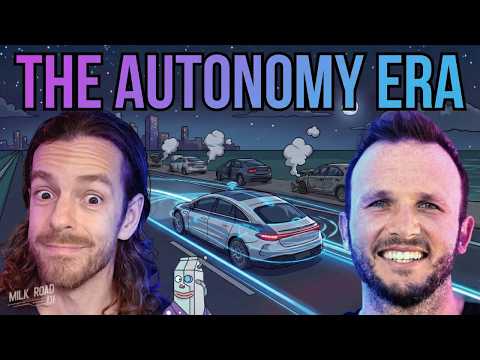
AI-driven automation and deflationary economics are converging with Tesla's proprietary neural networks and vast real-world data. This creates an unassailable moat in autonomous transportation and labor.
Monitor upcoming regulatory approvals for unsupervised FSD in key US states. This event will trigger the rollout of Tesla's robo-taxi network, fundamentally altering vehicle economics.
Tesla is not just a car company; it is a foundational AI and robotics platform. Its FSD and robo-taxi network, combined with the broader Musk ecosystem, position it to capture a multi-trillion dollar market in autonomous services and labor, driving massive deflation and investor upside over the next decade.
Tesla is an AI company, not a car manufacturer. This means its core product is autonomous intelligence, with cars serving as its initial deployment device.
Tesla's 8 million cars on the road constantly collect real-world driving data. This massive, proprietary dataset is an insurmountable moat, enabling its neural network AI to learn at a scale no competitor can match.
The convergence of Tesla, SpaceX, and XAI aims to create an abundance of cheap transportation and labor. This will drive massive deflation, making goods and services significantly more affordable globally.
The global economy is shifting from human-centric labor to AI-driven autonomous systems. Tesla's vertically integrated AI stack, from data to hardware, positions it as the architect of a deflationary future.
Evaluate Tesla not as an automotive stock, but as an AI and robotics platform with an unassailable data advantage. Consider FSD's Q2 rollout implications for direct investment and market disruption.
Tesla's unsupervised FSD and robo taxi network will unlock a new, massive revenue stream, potentially 10x current revenue by 2030, excluding humanoid robots. This re-rates Tesla as a multi-trillion dollar AI and robotics titan.
AI-driven automation, spearheaded by Tesla's vertical integration, will create unprecedented deflationary pressures across transportation and labor, redefining economic models and consumer behavior.
Monitor Q2 regulatory approvals for unsupervised FSD in key US states. This event will trigger the activation of Tesla's existing 8 million vehicle fleet into a revenue-generating network, repricing the company.
Tesla is not just a car company; it's a foundational AI platform. Its FSD lead, coupled with the impending robo taxi network and humanoid robots, positions it to capture a significant share of global transportation and labor markets, making it a critical long-term bet for investors and a bellwether for the AI economy.
Tesla is not a car company at all. It's an AI company. It's an autonomous company, autonomous robots company. And cars just happen to be one of the devices it's using to put the AI brain that it has into.
Tesla possesses an unparalleled dataset from 8 million cars, with 1 million actively using FSD. This massive, real-world driving data is impossible for competitors to replicate, creating an insurmountable lead in AI training.
Tesla owners will soon be able to deploy their cars as robo taxis, generating significant income. This transforms a depreciating asset into a revenue-generating one, incentivizing mass adoption and creating a new class of passive income.
AI-driven automation is converging with vertically integrated hardware and data ecosystems, creating winner-take-all dynamics in foundational industries.
Evaluate companies not by their current product category, but by their underlying AI and data moats. Tesla's FSD is a platform, not a feature.
Tesla's transition from carmaker to AI and robotics platform is not speculative; it is happening now.
The global economy is transitioning from human-centric labor and transportation to AI-driven autonomous systems. Tesla's vertical integration of hardware, software, data, and manufacturing positions it to capture this multi-trillion dollar change, driving unprecedented deflation.
Investors should recognize Tesla as an AI and robotics platform, not just an EV manufacturer. Consider the long-term implications of its FSD rollout and humanoid robot production, as these represent entirely new, high-margin revenue streams.
Tesla is on the cusp of activating unsupervised FSD and scaling robo-taxis, potentially within the next few quarters. This will reprice the company, not just on current earnings, but on the future value of global transportation, labor, and intelligence infrastructure.
AI-driven automation, spearheaded by Tesla's FSD and robotics, will create a deflationary economic environment by drastically reducing transportation and labor costs.
Evaluate Tesla not as an auto manufacturer, but as a vertically integrated AI and robotics platform. Its current valuation may not account for exponential revenue from FSD subscriptions and the robo-taxi network.
Tesla's strategic pivot to autonomous AI and robotics, with its data moat and impending unsupervised FSD, positions it to dominate multiple industries.
**Meme Wisely:** ETH's narrative power is potent, but sustainable value needs a bedrock of technological strength and real-world utility.
**Stablecoins are King:** This is the crypto sector attracting serious institutional capital and big tech attention; the growth runway is immense.
**Regulation is Warming:** Positive signals from the SEC on self-custody and staking offer tailwinds, potentially de-risking significant parts of the crypto ecosystem.
Regulatory Thaw: The SEC’s new leadership signals a more accommodating stance on crypto, potentially unlocking significant growth for DeFi in the US.
Market Structure Evolution: Tokenization is increasingly viewed as the key to modernizing capital markets, with on-chain IPOs and improved secondary market liquidity on the horizon.
Infrastructure is King: Acquisitions like Privy by Stripe highlight the race to build and control the foundational layers of the crypto economy, especially around wallets and stablecoins.
Solana's Next Act is Crucial: Current memecoin activity, while impressive, is viewed by institutions like Standard Chartered as less sustainable than diversified utility; a pivot to tokenized equities or social is key for long-term valuation.
Perception Battles Performance: Ethereum's established "trustworthiness" gives it an institutional edge, even if Solana offers superior tech for certain applications. Solana must overcome its "memecoin" image to attract serious TradFi.
Near-Term Headwinds for Solana Relative to Ethereum: Kendrick suggests Ethereum might outperform Solana in the near term (though both underperform Bitcoin) as Solana navigates its transition phase, while Ethereum benefits from incumbency in stablecoins and tokenized RWAs.
**Currency Cold War:** A "currency conflict" is unfolding, with the winner set to define the financial backbone of the next-gen internet and global commerce.
**Stablecoins vs. The State:** USD stablecoins are pitched as the West's best bet for the internet's future currency, directly competing with state-backed digital currencies like China's e-CNY.
**Agent-Powered Internet:** The dream is an internet where AI agents, fueled by ultra-low-cost stablecoin transactions, manage our digital lives, moving incentives away from human attention.
**Solve Real Friction:** The "last-mile" challenge—seamlessly converting stablecoins to local cash in emerging markets—remains the critical bottleneck and prime opportunity for stablecoin protocols.
**Moats are Real:** Overcoming established players like Tron requires more than just better tech or lower fees; it demands superior distribution and user migration strategies.
**Align Incentives:** Morpho's structural changes offer a compelling model for aligning team, investor, and token holder interests, potentially setting a new standard for Web3 projects.