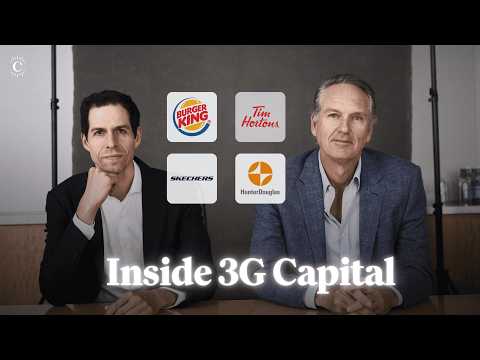
3G commits to one investment per fund, deploying significant internal capital alongside partners. This focus allows for rigorous downside analysis and patience, ensuring only truly exceptional businesses are acquired.
3G partners are seasoned operators who step into businesses, aligning incentives with ownership. This hands-on approach ensures decisions serve the business's long-term health, not just short-term management goals.
3G prioritizes businesses that directly own their customer relationships, like Burger King or Hunter Douglas. This direct connection reduces disintermediation risk from retailers or new technologies.
As capital markets become increasingly efficient and competitive, the edge moves from financial engineering to deep operational expertise and long-term, owner-aligned management.
Prioritize identifying and enabling high-potential individuals early in their careers, granting them significant responsibility and ownership.
Disciplined focus, patient relationship building, and an unwavering commitment to operational excellence in established, defensible businesses can still yield generational wealth.
The Macro Trend: In a world obsessed with digital disruption, 3G Capital's success with "atoms over bits" businesses highlights a strategic pivot: enduring value often resides in established brands with proprietary customer relationships, where operational excellence and long-term thinking create moats against fleeting tech trends.
The Tactical Edge: Identify businesses with strong, direct customer relationships and a clear path for operational improvement, even if they appear "boring." Prioritize deep, hands-on involvement to drive value, rather than relying solely on financial engineering.
The Bottom Line: The future of outsized returns may not be in chasing the next big tech wave, but in patiently acquiring and meticulously operating businesses that own their customer relationships, leveraging technology to enhance, not redefine, their core value. This strategy offers a more predictable, less volatile path to compounding capital.
The Macro Shift: In a world obsessed with digital disruption, 3G Capital's success highlights the enduring power of "hard" businesses with strong customer relationships. Their focus on foundational consumer brands, managed by operator-investors who prioritize long-term ownership and disciplined execution, offers a robust counter-narrative to the "bits over atoms" trend.
The Tactical Edge: Cultivate an extreme ownership culture by aligning incentives deeply, empowering young talent with real responsibility, and fostering a relentless bias for action.
The Bottom Line: For investors and builders, the lesson is clear: patience, deep operational involvement, and a fanatical focus on talent in defensible, "boring" businesses can yield extraordinary, long-term value, even in expensive markets.
Extreme Focus: 3G Capital commits to one investment per fund, deploying significant internal capital alongside partners. This singular focus forces rigorous downside analysis and patience, ensuring they only pursue truly exceptional opportunities.
Owner Operators: 3G partners are seasoned operators who step into businesses, aligning incentives with ownership. This means leaders act like shareholders, making decisions for the business's long-term health, not just short-term management goals.
Disruption Defense: 3G prioritizes businesses with strong customer relationships and physical components, making them less susceptible to digital disintermediation. They seek enduring brands like Hunter Douglas, where the sun will always rise and set, ensuring a consistent need for their product.
In an era of rapid technological change, businesses with strong, direct customer relationships and physical moats are increasingly valuable. 3G's focus on these "atoms" businesses, enhanced by strategic tech adoption, provides a blueprint for durable value creation.
Cultivate an ownership culture by aligning incentives deeply, empowering young talent with real responsibility, and prioritizing long-term value over short-term gains.
The future belongs to patient, operator-led investors who can identify and transform enduring businesses by focusing on fundamental quality, people, and strategic technological integration, rather than chasing fleeting trends.
3G Capital's model counters this by doubling down on "atoms" businesses with strong customer relationships and defensible positions, then applying rigorous operational excellence.
Cultivate an owner-operator mindset within your organization, even if you are not a private equity firm. Identify and back high-potential young talent with significant responsibility and aligned incentives, providing mentorship to maximize their success.
In a world obsessed with speed and diversification, 3G Capital proves that deep, patient, operator-led concentration on high-quality, defensible businesses, combined with a culture of ownership and meritocracy, remains a powerful engine for outsized value creation.
The era of celebrity endorsements is evolving into one of celebrity ownership, driven by a growing understanding of equity's compounding power and enabled by new technologies that lower the barrier to business creation.
Prioritize building a diverse, expert team and actively seek out "boring" businesses or underserved markets with clear, unmet demand.
The next 6-12 months will see an acceleration of talent leveraging their brand for equity stakes, particularly in tech-enabled ventures. Position yourself to either participate in these deals or build the tools that empower this new class of owner-operators.
**Standardized Scrutiny Arrives:** The Token Transparency Framework introduces a systematic, 18-criteria evaluation, offering a clear benchmark for assessing token projects beyond hype.
**Rewards & Repercussions:** By first celebrating transparent projects (like Jito and Jupiter) and then planning to rate less forthcoming ones, the framework aims to incentivize industry-wide improvements in disclosure.
**Investor Toolkit Boost:** This framework provides investors with a concrete tool for due diligence, moving towards a more informed and transparent crypto investment landscape.
CEXs Go Lean: Exchanges are increasingly opting for lighter on-chain footprints, prioritizing app development on existing chains over building new L1s/L2s, signaling a focus shift to direct user value.
Transparency is Non-Negotiable: The 0xResearch Token Transparency Framework highlights a critical industry need for standardized disclosures, aiming to build trust and attract serious capital by demystifying token projects.
Utility Drives Valuation: Projects like Kamino, despite strong fundamentals and growth, underscore that clear token utility and value accrual mechanisms are essential for market recognition and valuation.
Selective Bets Over Broad Sprees: Forget throwing darts; the crypto market now rewards surgical precision. Focus on projects with strong fundamentals and demonstrable traction, as "hyper dispersion" is the new norm.
Public Equities as a Crypto Proxy: With limited direct, high-quality crypto IPOs, existing listed entities like Circle and Coinbase are soaking up institutional and retail interest, mimicking "alt season" dynamics in traditional markets.
Pragmatism Pays: The industry is shedding ideological baggage. Successful projects will meet existing market needs, provide clear disclosures, and avoid outdated tokenomic "tricks." Prediction markets are an emerging utility to watch.
**Transparency is Now Table Stakes:** Projects neglecting robust disclosure standards, like those promoted by the new Token Transparency Framework, will face escalating investor scrutiny and skepticism.
**Public Markets: Crypto's Current Darling (But For How Long?):** Expect continued capital inflow and outperformance from regulated, publicly traded crypto entities before a potential, broader token market resurgence.
**Real Value is Built on Fundamentals & Community:** Platforms like Hyperliquid, showcasing operational efficiency, potent tokenomics, and community wealth creation, are forging lasting value that transcends fleeting market trends.
Stablecoin Surge: The GENIUS Act is set to unleash trillions in stablecoin value, positioning dollar-backed digital assets as a global financial linchpin and reinforcing US dollar networks.
ETF Explosion Imminent: Prepare for a diversified crypto ETF market in 2025, as assets like Solana and Dogecoin likely gain approval, testing the true depth of institutional appetite.
Super App Showdown: The battle for your financial future is on, with Coinbase and Robinhood racing to build all-in-one platforms blending traditional finance with on-chain crypto services.
**Revenue is King**: The "revenue meta" isn't a meme; it's the future. Invest in applications and protocols generating real cash flow.
**Solana's DeFi Gap is an Opportunity**: Solana needs robust, user-friendly DeFi, especially perps. Building best-in-class products here is a massive opportunity, even if not unseating current L2 leaders.
**IPOs & M&A Signal Maturation**: The success of Circle’s IPO and increasing M&A activity point to a maturing industry where equity value is re-emerging, offering alternative liquidity paths beyond token launches.