Demand for provably correct systems in hardware, software, and critical infrastructure creates a massive market for formal verification. AI scales these human-bottlenecked processes.
Investigate formal verification tools for high-stakes codebases or chip designs. Prioritize solutions combining probabilistic generation with deterministic proof for speed and reliability.
"Good enough" code is ending for critical applications. AI-driven formal verification is a commercial imperative, redefining development cycles and trust.
The macro shift: Geopolitical competition in AI is not just about raw model power; it is about who controls the foundational research and development platforms. Open models are the battleground for long-term national AI sovereignty.
The tactical edge: Invest in open model research and infrastructure, particularly in post-training environments and high-quality data generation. This builds a resilient, transparent AI ecosystem that can adapt and innovate independently.
The bottom line: The US must prioritize open model development now to secure its position as a global AI leader, foster domestic innovation, and provide accessible AI options for a diverse global user base over the next 6-12 months.
The convergence of AI and immersive computing is pushing towards a "HoloDeck" future. Roblox's vector-based data storage of 13 billion monthly hours provides unprecedented training data for agentic NPCs and real-time world generation, fundamentally changing how virtual worlds are built and experienced.
Invest in platforms that offer cloud-native, AI-accelerated creation tools and robust multiplayer synchronization. Prioritize those building on rich, proprietary 3D interaction data for superior AI agent training.
The future of digital interaction is 4D, photorealistic, and AI-driven. Companies with a clear, long-term vision paired with rapid, cloud-connected iteration will capture the next wave of virtual co-experience, making them prime targets for investment and partnership over the next 6-12 months.
The exponential reduction in the cost of intelligence is transforming AI from a mere tool into a "hyperobject" with quasi-human capabilities, forcing society to adapt from a scarcity-based operating system to one of intelligence abundance.
Cultivate "AI muscle" by actively experimenting with AI tools, understanding their capabilities and limitations, and pushing their boundaries. This hands-on engagement is the best inoculation against "AI psychosis" and prepares you for a world where AI is ubiquitous.
AI's rapid proliferation and increasing autonomy demand immediate, collective action from governments, companies, and individuals to establish clear boundaries and ensure human control. Ignoring this "fourth class" of being risks societal instability and the erosion of human agency over the next 6-12 months.
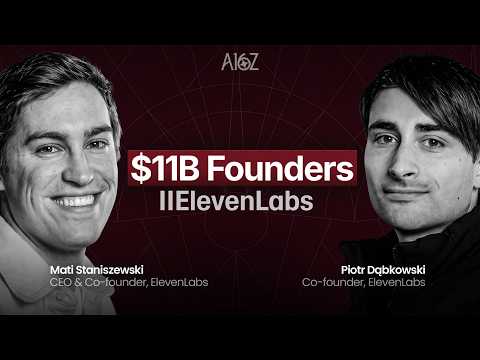
The computing paradigm is shifting from visual-centric to auditory-first, driven by AI's ability to process raw audio data for emotional depth and contextual understanding. This opens new frontiers for immersive experiences and global communication.
Invest in or build solutions that prioritize raw audio data processing and multimodal AI integration. Focus on applications where emotional nuance and natural interaction create a distinct user experience.
Voice AI, particularly with ElevenLabs' approach to emotional intelligence, is not just an incremental improvement; it is a foundational shift that will redefine human-computer interaction and unlock massive markets in education, entertainment, and global connectivity over the next 6-12 months.
AI's memory demands invert data center design, moving from storage-first to memory-first. High-speed networks and NVMe flash are now core memory tiers.
Fund software-defined memory solutions like WEKA's Axon and Augmented Memory Grid. These convert existing NVMe drives into high-performance context memory.
Persistent, rapid KV cache access through "Token Warehouses" will determine AI application and agent deployment profitability over the next 6-12 months.
AI is moving from opaque, data-driven systems to transparent, intentionally designed agents. This shift is driven by the need for reliability, safety, and the ability to extract novel insights from increasingly powerful models.
Invest in tools and research that provide granular control over AI internals, like Goodfire's platform. This enables precise customization, reduces unintended behaviors, and accelerates scientific discovery in critical domains.
The future of AI isn't just about bigger models; it's about smarter, more controllable ones. Understanding and directly influencing AI's "mind" will be a competitive differentiator and a prerequisite for deploying AI in high-stakes, real-world applications over the next 6-12 months.
The era of "good enough" probabilistic AI for critical systems is ending; the market demands provable correctness. Axiom Math's approach signals a return to formal methods, supercharged by AI, addressing the verification bottleneck in software and hardware.
Investigate formal verification tools for safety-critical code generation, hardware design, and legacy code migration. Prioritize solutions combining AI generation with deterministic proof for speed and certainty.
Formally verifying complex systems with AI will redefine trust in software and hardware. Companies integrating these capabilities gain a competitive advantage, reducing bugs, accelerating development, and meeting regulatory demands over the next 6-12 months.
The scaling laws seen in large language and video models are now extending to physical robotics. Internet-scale human video data, combined with humanoid morphology, is creating a new paradigm for robot generalization.
Invest in or build systems that prioritize multi-stage data pipelines, especially those incorporating diverse egocentric data. This approach is proving key to unlocking zero-shot capabilities in physical AI.
World models are not just a research curiosity; they are a practical tool for accelerating robot deployment. Their ability to generalize and act as learned simulators will redefine how robots are trained, tested, and ultimately integrated into our daily lives over the next 6-12 months.
TradFi Rails are the New On-Ramp: The hottest trade is no longer an altcoin but a stock that buys Bitcoin. Corporate treasury vehicles are the "new tokens," leveraging global equity markets for unparalleled distribution.
DeFi's UX Reckoning: Crypto’s open-source ethos inadvertently built the tools for Big Tech to create a superior user experience. Native protocols must now prove decentralization offers a real advantage or risk being out-competed by centralized giants.
Macro Liquidity Isn't a Cure-All: Don't bet on fiscal deficits to lift all boats. Current capital flows are pumping equities, not on-chain altcoins, creating a significant headwind for the long tail of the crypto market.
The New "Tokens" Are Stocks: The hottest play isn't an L1 token; it's publicly traded companies buying Bitcoin. These "treasury companies" offer crypto exposure through traditional brokerage accounts, tapping into the world's largest distribution networks.
DeFi's Lunch Is on the Menu: Big Tech is no longer just marketing. Firms like Robin Hood are coming for DeFi's profit pools, armed with superior UX and massive user bases. Native crypto apps must now prove they offer more than just a regulatory loophole.
Don't Fight the Flows: Rising government deficits are fueling asset inflation, but the money isn't flowing into altcoins. It's being channeled into equities and Bitcoin ETFs. Betting on a broad altcoin rally based on macro liquidity is a losing trade for now.
Equity is the new token. The most potent way to gain crypto exposure is shifting from on-chain tokens to owning the stock of companies that hold crypto, using TradFi rails for unmatched distribution.
DeFi's moat is evaporating. Native crypto protocols must now compete on user experience and genuine utility as Big Tech co-opts their open-source technology, backed by massive user bases and regulatory know-how.
Don't count on the money printer for your altcoins. Macro-level liquidity is not mechanically flowing down the risk curve into on-chain assets. The capital flows from fiscal expansion are primarily benefiting traditional equities, creating a major headwind for the broader altcoin market.
Stop Treating Crypto Like a Lotto Ticket. Apply fundamental personal finance rules. Your crypto portfolio needs a plan built on consistent saving and a clear understanding of your risk tolerance.
Buy Your Slice of America. Don’t short the real estate market by renting long-term. Owning your primary residence is a forced savings and investment vehicle that historically outpaces inflation.
Government Adoption is the Ultimate Bull Case. The most powerful tailwind for any asset class, including crypto, is government support. Regulatory clarity and institutional products (like ETFs) are signals that the asset is here to stay.
**TradFi Is the New DeFi.** The most compelling crypto plays are now publicly traded companies acquiring Bitcoin. These “treasury companies” are the new tokens, using traditional stock markets for distribution that on-chain protocols can only dream of.
**Brace for Big Tech's Invasion.** Robinhood and Stripe are coming for DeFi's profit margins. They are poised to dominate with superior UX and distribution, challenging the very premise of many decentralized applications.
**Capital Follows Boomers, Not the Blockchain.** Don't expect government money printing to pump your altcoin bags. New capital is flowing into equities via money market funds. The only crypto assets benefiting are those packaged for TradFi consumption, like Bitcoin ETFs and treasury stocks.
Tokens Are a Liability, Not an Asset: A public token is a "net negative" that subjects founders to constant market ridicule. It's a 24/7 public referendum on your work, unlike the comparatively insulated world of traditional startups.
The Era of Easy Capital Is Over: The days of raising $100M on a whitepaper are gone. Crypto fundraising now requires a level of traction and proof that is rapidly converging with the standards of traditional venture capital.
Founder Liquidity Is No Longer a Guarantee: The promise of quick financial freedom for founders is fading. The extreme volatility of crypto markets means paper wealth can disappear before it ever becomes life-changing.