The automotive industry is undergoing a significant architectural change, moving from fragmented, hardware-centric systems to vertically integrated, AI-powered software-defined vehicles. This demands re-platforming, making legacy automakers vulnerable.
Invest in or build companies controlling their full technology stack: custom silicon, sensor arrays, data collection, AI model training. Vertical integration is key to cost efficiency and rapid iteration for mass-market AI autonomy.
The next few years will see dramatic divergence. Companies mastering AI-driven autonomy and software-defined architectures, like Rivian with its R2, will capture significant market share by offering compelling, continuously improving vehicles at scale. Others face obsolescence.
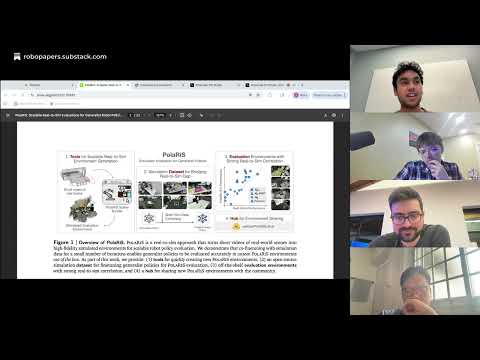
The robotics community is moving beyond task-specific benchmarks towards generalist policy evaluation, mirroring the LLM trend of testing off-the-shelf models on unseen tasks. This demands scalable, high-fidelity simulation tools that can quickly generate diverse test environments.
Builders and researchers should prioritize evaluation tools that offer strong real-to-sim correlation, even if it means a hybrid approach (like PolaRiS) over purely data-driven world models. Utilize real-to-sim environment generation (Gaussian splatting) and strategic sim data co-training to accelerate policy iteration.
PolaRiS offers a path to community-driven, crowdsourced robot benchmarks, making policy development faster and more robust. Expect a future where robot policies are evaluated across a broad suite of easily created, diverse simulated environments, pushing the boundaries of generalization and real-world applicability.
Generalist robot policies need robust, scalable evaluation. The shift is from bespoke, real-world-only testing to a hybrid real-to-sim approach that leverages modern 3D reconstruction and minimal sim data to create highly correlated, reproducible benchmarks.
Builders should adopt PolaRiS's real-to-sim environment generation and "sim co-training" methodology. This allows for rapid, cost-effective iteration on robot policies, ensuring that improvements in simulation translate directly to real-world gains.
Over the next 6-12 months, the ability to quickly and reliably evaluate robot policies in simulation will be a critical differentiator. PolaRiS provides the tools to build diverse, generalization-focused benchmarks, moving robotics closer to the rapid iteration cycles of other AI fields.
Tesla's core identity shifted from EV maker to autonomous AI and robotics. Its cars are devices for deploying its advanced AI brain; competitors miss this.
Tesla's 8 million cars collect real-world driving data. This massive dataset, combined with in-house AI processing, creates an unparalleled moat impossible for competitors to replicate.
This convergence creates an abundance of labor and transportation, driving down costs. Robo-taxis and humanoid robots automate tasks, making goods and services cheaper, even as Tesla's profitability soars.
Robotics is moving towards generalist policies that need broad, diverse evaluation. PolaRiS enables this by making it easy to create and share new, correlated benchmarks, cultivating a community-driven evaluation ecosystem similar to LLMs.
Adopt PolaRiS for rapid policy iteration on pick-and-place and articulated object tasks. Use its browser-based scene builder and existing assets to quickly create new evaluation environments, then fine-tune policies with a small amount of unrelated sim data to boost real-to-sim correlation.
Investing in tools like PolaRiS now means faster development cycles and more reliable policy improvements. This accelerates the path to robust, real-world robot deployment by providing a scalable, trustworthy intermediate testing ground.
PolaRiS enables a shift towards LLM-style generalization benchmarks, where models are tested on unseen environments and tasks, accelerating robot capabilities.
Use its browser-based scene builder and Gaussian splatting to quickly create diverse, real-world correlated evaluation environments, significantly reducing the cost and time of real robot testing.
Cheap, reliable robot policy evaluation in simulation, with strong real-world correlation, means faster development cycles, more robust generalist robots, and a path to crowdsourced, diverse benchmarks that will push the entire field forward.
AI is forcing a fundamental architectural change in automotive, moving from fragmented, rules-based systems to vertically integrated, neural network-powered platforms. This technical reality dictates market survival, favoring companies that control their entire software and hardware stack to build a continuous data flywheel.
Invest in or partner with companies demonstrating deep vertical integration in AI hardware and software for mobility. Prioritize those with a clear path to mass-market data collection and rapid iteration cycles.
Autonomy will be a must-have feature in cars within the next few years. Companies without a software-defined architecture and a vertically integrated AI stack will struggle to compete, creating a market share shift towards those few players who can deliver true self-driving at scale.
The automotive industry is undergoing a fundamental re-architecture, moving from hardware-centric, rules-based systems to software-defined, AI-powered platforms. This shift favors companies with deep vertical integration and proprietary data flywheels.
Invest in companies demonstrating full-stack control over their vehicle's software, hardware, and AI training data. This verticality is the moat against commoditization and the engine for rapid, continuous improvement.
Autonomy will be a non-negotiable feature by 2030, making software-defined vehicles the only viable path for mass-market automakers. Companies that fail to build or acquire this capability will face market irrelevance.
Tesla's core business is AI and autonomous robotics. This means its value comes from its software and data moat, not just vehicle sales.
Tesla is sunsetting Model S and X production to convert factories for humanoid robots. This signals a full commitment to autonomous devices beyond cars.
Unsupervised FSD is expected in select US states by Q2. This will enable cars to operate without human oversight, unlocking the robo-taxi network.
All Roads Lead to Debasement: Both political parties are now committed to a policy of fiscal dominance and financial repression. The goal is to inflate away the debt, which makes holding cash and traditional bonds a losing proposition.
Get Out on the Risk Frontier: The only rational response is to move capital into assets that can benefit from currency debasement and a manufactured asset boom. This means frontier tech, crypto, and other high-growth, high-risk assets.
The Social Contract is Breaking: These policies will blatantly exacerbate wealth inequality, fueling populist anger. The system is no longer a free market but a manipulated game, and the backlash will define the political landscape for the next decade.
**The Great Bifurcation:** Capital is rotating out of altcoins and into two main buckets: Bitcoin (channeled through treasury companies) and crypto-adjacent equities (COIN, HOOD). Don't mistake isolated pumps for a broad "alt season."
**Synthetics are the New Speculation:** The next wave of on-chain gambling will be on synthetic versions of real-world assets, from private company shares to public stocks, providing exposure without the complexity of ownership.
**Apps Over Chains:** The most valuable real estate in crypto is no longer the base layer but the application layer. Companies that build sticky, revenue-generating products with great UX—even if they just clip fees—are winning.
**Bet on a Thesis:** Coinbase is a pure-play bet on the entire global economy moving on-chain, positioning itself as the essential B2B infrastructure provider.
**Follow the Money:** Robinhood is a bet on demographics, strategically positioning itself to capture the next generation's financial life and inherit trillions in the great wealth transfer.
**The Next Frontier is On-Chain:** The new battleground is Layer 2. Coinbase’s established Base ecosystem will face a formidable challenge from Robinhood Chain, with tokenized stocks as the initial prize.
**Invisible Rails are the Endgame:** The winner isn't the platform that forces users to understand blockchain, but the one that makes it invisible. Mainstream adoption will arrive when consumers use stablecoins without even knowing it, powered by seamless wallet and card integrations.
**Wallets Are the New Financial Hub:** Wallets are transcending simple storage to become full-fledged financial platforms. The next wave of innovation will focus on embedding neobank-like features (direct deposits, bill pay) into non-custodial wallets.
**AI Will Run on Stablecoins:** The rise of autonomous AI agents executing commercial tasks will create massive demand for a programmable, internet-native currency. Stablecoins are the clear frontrunner to become the default payment rail for this new automated economy.
Exporting US Monetary Policy. Stablecoins are extending the US financial system's reach by creating a global on-ramp to dollar assets. Demand from emerging markets now directly impacts US Treasury yields.
The Repo Market is the Epicenter. The crucial arena for stablecoin reserves is shifting from T-bills to the reverse repo market. This creates a massive, structural demand for overnight lending against Treasury collateral.
A Permanent Weight on the Yield Curve. This constant, inelastic demand from stablecoin issuers will act as a permanent force suppressing Treasury funding rates, creating a powerful and lasting influence on the entire US yield curve.
Robinhood is the Blueprint. Its plan to launch tokenized assets on its own future Layer-2 is the new model for financial institutions, creating a direct challenge to the supremacy of existing public blockchains.
Become a Trader, Not a "Crypto Trader". The most successful investors will be those who treat crypto as one of several asset classes, moving capital opportunistically based on macro trends, political shifts, and emerging frontiers like prediction markets.
Politics Will Drive Your Portfolio. While both US political parties are expected to debase the dollar through spending, they present different risks. The Republican party is seen as bullish for risk assets via deregulation, while a progressive Democratic shift could introduce bearish headwinds through redistributionist policies.