The AI infrastructure buildout is moving from speculative intuition to data-driven financial modeling.
Model your data center's profitability and hardware depreciation with Ornn's indices and residual value products.
The ability to hedge compute costs and monetize future hardware value transforms AI infrastructure from a capital-intensive gamble into a predictable asset class.
The Tactical Edge: Evaluate your compute procurement strategy. Explore futures contracts for H100s or memory to cap your costs and gain predictability in a volatile market.
Profitability Mapping: Futures markets provide forward pricing for compute, allowing data centers to model profitability per chip, per hour, years in advance. This data informs investment decisions, from site selection to chip choice.
Reduced Financing Costs: By guaranteeing a future resale price for hardware, Ornn reduces the risk for lenders. This certainty translates to lower financing costs for data center operators, directly impacting their slim profit margins.
The Macro Shift: AI's digital intelligence now demands physical interaction, creating a "meatspace" layer where human presence becomes a programmable resource. This extends AI's reach beyond code into real-world operations, altering human-AI collaboration.
The Tactical Edge: Invest in platforms abstracting human-AI coordination into simple API calls, enabling AI agents to interact physically. Builders should explore specialized "human-as-a-service" micro-economies for AI-driven physical tasks.
The Bottom Line: AI as a direct employer of human physical labor signals a profound redefinition of work. Over the next 6-12 months, watch for rapid iteration in these "human API" platforms, as they will dictate how quickly AI moves from digital reasoning to tangible impact, opening new markets.
AI is concentrating market power. Companies that embed AI natively into their product and operations are achieving disproportionate growth and efficiency, accelerating the disruption cycle for incumbents.
Re-architect your product and engineering around AI-native tools and workflows. For investors, prioritize companies demonstrating high product engagement and efficiency (ARR per FTE) driven by core AI features, not just marketing spend.
The AI product cycle is just beginning, promising 10-15 years of disruption. Companies that master AI-driven change management and business model innovation will capture immense value, while others will struggle to compete.
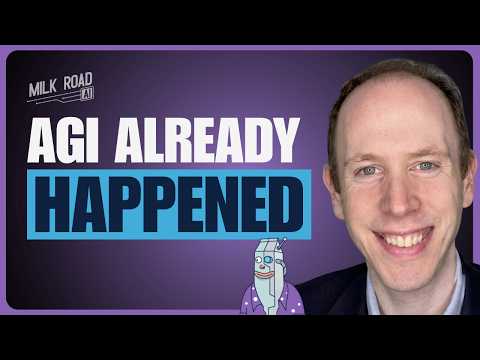
The rapid maturation of AI, particularly in vision, language, and action models, is fundamentally redefining "general intelligence" and accelerating the obsolescence of both physical and cognitive labor.
Investigate and build solutions around Universal Basic Services (UBS) and Universal Basic Equity (UBE) models, recognizing that traditional UBI is only a partial answer to the coming post-scarcity economy.
AGI is not a distant threat but a present reality, demanding immediate strategic adjustments in how we approach labor, economic policy, and human-AI coupling over the next 6-12 months.
AI model development is moving from a "generic foundation + specialized fine-tune" paradigm to one where core capabilities, like reasoning, are intentionally embedded during foundational pre-training. This means data curation for pre-training is becoming hyper-critical and specialized.
Invest in or build data pipelines that generate high-quality, domain-specific "thinking traces" for mid-training. This enables smaller, more efficient models to compete with larger, general-purpose ones on specific tasks.
The era of simply fine-tuning a massive foundation model for every task is ending. Success in AI will hinge on sophisticated, intentional data strategies that infuse desired capabilities directly into the model's core, driving a wave of specialized pre-training and more efficient, performant AI.
Geopolitical competition in AI is shifting from raw compute power to the strategic advantage gained through open-source collaboration, demanding a re-evaluation of national AI policy.
Invest in and build on open-source AI frameworks and models, leveraging community contributions to accelerate product development and research breakthroughs.
The next 6-12 months will define whether the US secures its long-term AI leadership by adopting open models, or risks falling behind nations that prioritize collaborative, transparent innovation.
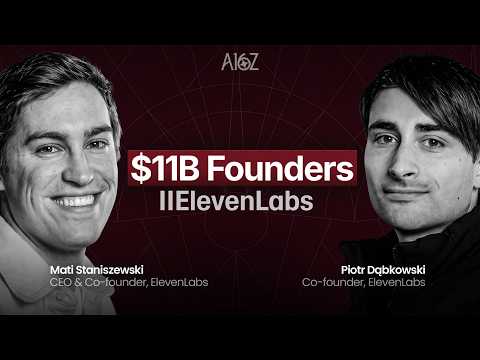
The move from generic, robotic text-to-speech to emotionally intelligent, context-aware synthetic voice is a fundamental redefinition of digital communication. This enables new forms of content creation and personalized interaction.
Builders should prioritize "emotional fidelity" in AI outputs, not just accuracy. Focus on models that capture nuance and context, as this is where true user engagement and differentiation lie.
Voice AI, exemplified by ElevenLabs, is moving beyond simple utility to become a foundational layer for immersive digital experiences. Understanding its technical depth and ethical implications is crucial for investors and builders looking to capitalize on the next wave of human-computer interaction.
The explosion of AI model complexity and scale is creating a critical technical bottleneck in data I/O, shifting the focus from raw compute power to efficient data delivery, making data infrastructure the new competitive battleground.
Prioritize data platforms that offer unified, high-performance access across hybrid cloud environments to eliminate GPU starvation and accelerate AI development cycles.
Investing in advanced "context memory" solutions now is not just an IT upgrade; it's a strategic imperative for any organization aiming to build, train, and deploy competitive AI models over the next 6-12 months.
All Roads Lead to Debasement: Both political parties are now committed to a policy of fiscal dominance and financial repression. The goal is to inflate away the debt, which makes holding cash and traditional bonds a losing proposition.
Get Out on the Risk Frontier: The only rational response is to move capital into assets that can benefit from currency debasement and a manufactured asset boom. This means frontier tech, crypto, and other high-growth, high-risk assets.
The Social Contract is Breaking: These policies will blatantly exacerbate wealth inequality, fueling populist anger. The system is no longer a free market but a manipulated game, and the backlash will define the political landscape for the next decade.
**The Great Bifurcation:** Capital is rotating out of altcoins and into two main buckets: Bitcoin (channeled through treasury companies) and crypto-adjacent equities (COIN, HOOD). Don't mistake isolated pumps for a broad "alt season."
**Synthetics are the New Speculation:** The next wave of on-chain gambling will be on synthetic versions of real-world assets, from private company shares to public stocks, providing exposure without the complexity of ownership.
**Apps Over Chains:** The most valuable real estate in crypto is no longer the base layer but the application layer. Companies that build sticky, revenue-generating products with great UX—even if they just clip fees—are winning.
**Bet on a Thesis:** Coinbase is a pure-play bet on the entire global economy moving on-chain, positioning itself as the essential B2B infrastructure provider.
**Follow the Money:** Robinhood is a bet on demographics, strategically positioning itself to capture the next generation's financial life and inherit trillions in the great wealth transfer.
**The Next Frontier is On-Chain:** The new battleground is Layer 2. Coinbase’s established Base ecosystem will face a formidable challenge from Robinhood Chain, with tokenized stocks as the initial prize.
**Invisible Rails are the Endgame:** The winner isn't the platform that forces users to understand blockchain, but the one that makes it invisible. Mainstream adoption will arrive when consumers use stablecoins without even knowing it, powered by seamless wallet and card integrations.
**Wallets Are the New Financial Hub:** Wallets are transcending simple storage to become full-fledged financial platforms. The next wave of innovation will focus on embedding neobank-like features (direct deposits, bill pay) into non-custodial wallets.
**AI Will Run on Stablecoins:** The rise of autonomous AI agents executing commercial tasks will create massive demand for a programmable, internet-native currency. Stablecoins are the clear frontrunner to become the default payment rail for this new automated economy.
Exporting US Monetary Policy. Stablecoins are extending the US financial system's reach by creating a global on-ramp to dollar assets. Demand from emerging markets now directly impacts US Treasury yields.
The Repo Market is the Epicenter. The crucial arena for stablecoin reserves is shifting from T-bills to the reverse repo market. This creates a massive, structural demand for overnight lending against Treasury collateral.
A Permanent Weight on the Yield Curve. This constant, inelastic demand from stablecoin issuers will act as a permanent force suppressing Treasury funding rates, creating a powerful and lasting influence on the entire US yield curve.
Robinhood is the Blueprint. Its plan to launch tokenized assets on its own future Layer-2 is the new model for financial institutions, creating a direct challenge to the supremacy of existing public blockchains.
Become a Trader, Not a "Crypto Trader". The most successful investors will be those who treat crypto as one of several asset classes, moving capital opportunistically based on macro trends, political shifts, and emerging frontiers like prediction markets.
Politics Will Drive Your Portfolio. While both US political parties are expected to debase the dollar through spending, they present different risks. The Republican party is seen as bullish for risk assets via deregulation, while a progressive Democratic shift could introduce bearish headwinds through redistributionist policies.