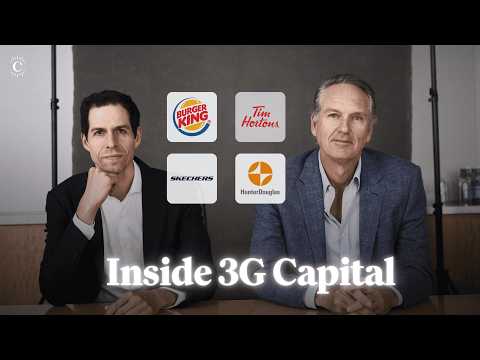
3G commits to one investment per fund, deploying significant house capital alongside partners. This singular focus drives an unparalleled rigor in due diligence and operational execution, because failure isn't an option—it's the only dish.
3G attracts top-tier talent by offering founder-like economics and accelerated responsibility. This creates a meritocracy where young leaders are given significant control and ownership earlier than traditional paths.
3G favors businesses with strong, direct customer relationships and physical assets, like Burger King or Hunter Douglas. These "atoms" businesses are inherently harder for new tech to disintermediate.
As capital markets become more efficient and valuations stretch, the edge shifts from financial engineering to deep operational expertise and a relentless focus on business quality.
Cultivate an owner-operator mindset throughout your organization, aligning incentives from the top down.
In the next 6-12 months, re-evaluate your investment criteria. Focus on businesses with clear customer relationships and robust, non-disruptable core offerings.
As market valuations stretch and technological disruption accelerates, the enduring value of well-moated, customer-centric businesses with strong physical components becomes clearer. 3G's focus on "harder to disrupt atoms" businesses, enhanced by technology, offers a resilient investment thesis.
Cultivate an owner-operator mindset, pushing decision-making closer to problems and aligning incentives with long-term success. Prioritize hiring ambitious young talent and empower them with responsibility, backed by strong mentorship.
In a world obsessed with speed and breadth, 3G Capital reminds us that deep, patient, operator-driven concentration in quality businesses, coupled with a fierce ownership culture, remains a powerful formula for outsized returns. This model builds enduring value, not just short-term gains.
In a market where digital disruption dominates headlines, 3G's success with physical, "atoms" businesses highlights that enduring value often lies in strong brands with direct customer relationships, where operational excellence and long-term thinking create defensible moats against technological fads.
Cultivate an "owner-operator" mindset in your investments and teams. Prioritize businesses with clear, simple value propositions and strong customer ties, then give young, ambitious talent significant ownership and autonomy to drive execution.
The next 6-12 months will reward investors and builders who resist the urge to chase every shiny new object. Instead, focus on fundamental business quality, deep operational involvement, and patient capital deployment in businesses that own their customer relationships. This disciplined approach, though counter-cultural, consistently compounds wealth.
As markets become more volatile and technology accelerates disruption, the traditional diversified portfolio approach faces increasing headwinds. 3G Capital's model signals a shift towards concentrated, operator-led bets on resilient, customer-owning brands with strong unit economics.
Identify businesses with deep moats, direct customer relationships, and long-term growth potential, then instill an owner-operator mindset throughout the organization, empowering young talent with significant equity and autonomy.
In a world of fleeting trends, focusing on fundamental business quality, operational excellence, and a long-term horizon offers a robust strategy for compounding capital, proving that sometimes, less truly is more.
3G commits to one investment per fund. This extreme concentration forces rigorous downside analysis and patience, ensuring capital is deployed only into truly exceptional opportunities.
Leaders are treated as shareholders, not just management. This alignment, often through outsized equity grants, drives decisions that prioritize the business's long-term health and value creation.
3G seeks businesses that own the relationship with their end customers. This direct connection provides a moat against disruption and disintermediation, as seen with brands like Burger King and Hunter Douglas.
The Macro Shift: As digital disruption accelerates, the value of businesses with inherent physical moats and direct customer relationships grows. 3G's focus on these "atoms" businesses, rather than "bits," positions them to capitalize on enduring consumer needs.
The Tactical Edge: Cultivate an owner-operator mindset in your ventures by aligning incentives deeply, empowering young talent, and relentlessly focusing on core business quality. This means prioritizing long-term value creation over short-term financial engineering.
The Bottom Line: In a world obsessed with speed and diversification, 3G Capital's patient, concentrated, and operator-driven model offers a powerful counter-narrative. For investors and builders, this means recognizing that deep, hands-on involvement in a few great businesses can still yield outsized returns, especially when others are chasing the next shiny object.
As technology accelerates disruption, businesses that own the direct customer relationship and operate in "atoms" industries become increasingly resilient.
Cultivate deep, long-term relationships with founders and owners of enduring businesses, positioning yourself as a patient, operator-led partner rather than a short-term financial buyer.
In an environment of stretched valuations and abundant capital, a disciplined, concentrated, and operator-driven approach to acquiring and growing high-quality, customer-owning businesses remains a powerful, albeit rare, path to outsized returns.
The AI infrastructure boom is transitioning from speculative buildouts to financially engineered, risk-managed investments, driven by the commodification of compute and memory.
Evaluate your compute procurement and data center buildout strategies through a financial lens, exploring futures contracts and residual value products to lock in costs and de-risk hardware investments.
The ability to quantify future compute demand and hardware value will be the differentiator for AI infrastructure players over the next 6-12 months, enabling smarter capital deployment and competitive advantage.
All Roads Lead to Debasement: Both political parties are now committed to a policy of fiscal dominance and financial repression. The goal is to inflate away the debt, which makes holding cash and traditional bonds a losing proposition.
Get Out on the Risk Frontier: The only rational response is to move capital into assets that can benefit from currency debasement and a manufactured asset boom. This means frontier tech, crypto, and other high-growth, high-risk assets.
The Social Contract is Breaking: These policies will blatantly exacerbate wealth inequality, fueling populist anger. The system is no longer a free market but a manipulated game, and the backlash will define the political landscape for the next decade.
**The Great Bifurcation:** Capital is rotating out of altcoins and into two main buckets: Bitcoin (channeled through treasury companies) and crypto-adjacent equities (COIN, HOOD). Don't mistake isolated pumps for a broad "alt season."
**Synthetics are the New Speculation:** The next wave of on-chain gambling will be on synthetic versions of real-world assets, from private company shares to public stocks, providing exposure without the complexity of ownership.
**Apps Over Chains:** The most valuable real estate in crypto is no longer the base layer but the application layer. Companies that build sticky, revenue-generating products with great UX—even if they just clip fees—are winning.
**Bet on a Thesis:** Coinbase is a pure-play bet on the entire global economy moving on-chain, positioning itself as the essential B2B infrastructure provider.
**Follow the Money:** Robinhood is a bet on demographics, strategically positioning itself to capture the next generation's financial life and inherit trillions in the great wealth transfer.
**The Next Frontier is On-Chain:** The new battleground is Layer 2. Coinbase’s established Base ecosystem will face a formidable challenge from Robinhood Chain, with tokenized stocks as the initial prize.
**Invisible Rails are the Endgame:** The winner isn't the platform that forces users to understand blockchain, but the one that makes it invisible. Mainstream adoption will arrive when consumers use stablecoins without even knowing it, powered by seamless wallet and card integrations.
**Wallets Are the New Financial Hub:** Wallets are transcending simple storage to become full-fledged financial platforms. The next wave of innovation will focus on embedding neobank-like features (direct deposits, bill pay) into non-custodial wallets.
**AI Will Run on Stablecoins:** The rise of autonomous AI agents executing commercial tasks will create massive demand for a programmable, internet-native currency. Stablecoins are the clear frontrunner to become the default payment rail for this new automated economy.
Exporting US Monetary Policy. Stablecoins are extending the US financial system's reach by creating a global on-ramp to dollar assets. Demand from emerging markets now directly impacts US Treasury yields.
The Repo Market is the Epicenter. The crucial arena for stablecoin reserves is shifting from T-bills to the reverse repo market. This creates a massive, structural demand for overnight lending against Treasury collateral.
A Permanent Weight on the Yield Curve. This constant, inelastic demand from stablecoin issuers will act as a permanent force suppressing Treasury funding rates, creating a powerful and lasting influence on the entire US yield curve.
Robinhood is the Blueprint. Its plan to launch tokenized assets on its own future Layer-2 is the new model for financial institutions, creating a direct challenge to the supremacy of existing public blockchains.
Become a Trader, Not a "Crypto Trader". The most successful investors will be those who treat crypto as one of several asset classes, moving capital opportunistically based on macro trends, political shifts, and emerging frontiers like prediction markets.
Politics Will Drive Your Portfolio. While both US political parties are expected to debase the dollar through spending, they present different risks. The Republican party is seen as bullish for risk assets via deregulation, while a progressive Democratic shift could introduce bearish headwinds through redistributionist policies.