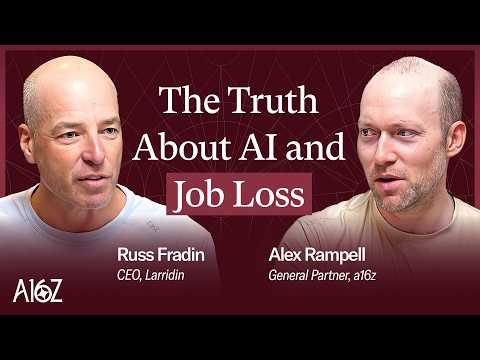
Measure Usage, Not Just Spend. The biggest failure in enterprise AI is tracking software purchases as a proxy for progress. The focus must shift to measuring actual tool usage correlated with output.
Solve for Fear, Not Features. Employee adoption hinges on psychological safety. The most powerful tools will fail if users are afraid of looking incompetent or getting fired for making a mistake.
Competition Drives Augmentation, Not Unemployment. The "AI will take our jobs" narrative is a red herring. Companies will reinvest AI-driven productivity gains to crush competitors, not just to cut headcount.
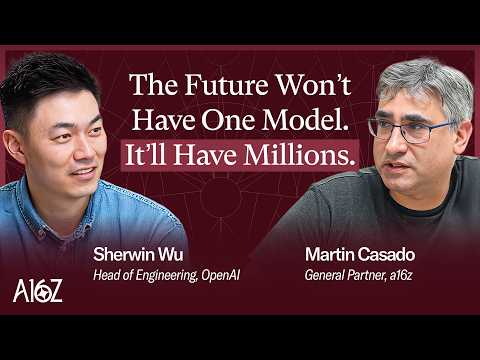
**The "One Model" Thesis Is Dead.** The future belongs to a portfolio of specialized models. This creates distinct opportunities for both foundational labs and companies that can leverage proprietary data to build best-in-class models for niche applications.
**Data Is the Ultimate Differentiator.** Reinforcement learning fine-tuning elevates proprietary data from a simple input for RAG systems to the core ingredient for building a defensible, state-of-the-art product.
**Agents Will Specialize.** The agent ecosystem is bifurcating into two primary types: open-ended, creative agents for knowledge work and deterministic, procedural agents designed for enterprise automation where reliability and adherence to standard operating procedures are critical.
Politics Will Trump Tech. Expect a policy pivot ahead of the 2024 election. The administration’s singular focus on AI stimulus is creating populist backlash, forcing a shift toward policies that support the broader labor market to secure votes.
The AI Trade Is Evolving. The "Mag 7" may soon become regulated utilities. The next wave of winners will be legacy companies that successfully integrate AI to boost margins and the overlooked players in the AI supply chain, such as power and commodity providers.
Prepare for a New Monetary Regime. The era of "QE Infinity" is ending. A post-Powell Fed is expected to move credit creation from its own balance sheet back to commercial banks, using deep rate cuts and deregulation to stimulate the economy.
AI Demand Is Not Cyclical; It's Infinite. Forget boom-and-bust. The mission to solve humanity's greatest problems—from disease to space travel—creates limitless demand for intelligence, underpinning a durable, multi-decade investment cycle.
Scrap GDP; Watch Profit Margins. The widening chasm between the astronomical profit margins of tech companies and the rest of the economy is the single most important macroeconomic signal today.
Bitcoin Is the Apex Predator of Moats. In a world where AI can replicate any business model, the only defensible moats are those built on time-tested belief and mathematical scarcity. Bitcoin is the emerging winner for the digital age.
AI's Physical Footprint is Astronomical: Individual AI data centers are now multi-billion dollar megaprojects, with construction timelines accelerating to as little as one year for a gigawatt-scale facility.
Power is a Solvable Problem, Not a Hard Cap: AI firms will pay whatever it takes to secure electricity, making power costs a secondary concern to the price of GPUs. The real constraint is getting chips, not watts.
Open-Source Intelligence Unveils All: By combining satellite imagery, public permits, and news reports, the physical expansion of the AI industry can be tracked in near real-time, providing unprecedented transparency.
AI Isn't a Bubble; It's a Buildout. The market is rational. Massive spending is backed by real revenue from inference. The true bottleneck is the speed at which capital can be deployed to build city-sized data centers.
Brace for Economic Whiplash. A sudden, AI-driven unemployment spike is the most likely trigger for massive government intervention. The political response will be swift, decisive, and potentially radical.
Superintelligence is a Hardware Problem. The path to 2045 runs through physical infrastructure. Progress is gated by the brute-force economics of building data centers, not a quest for a magical algorithm.
**Escape the Architecture Lottery.** The inertia behind Transformers is immense. A new model must be demonstrably superior across the board to justify a paradigm shift.
**Nature's Algorithms are the Next Frontier.** The CTM proves that biologically-inspired principles like neuron synchronization can unlock powerful capabilities like adaptive computation and better calibration naturally.
**Reasoning is Deeper Than Scaling.** The Sudoku Bench benchmark shows that current SOTA models cannot perform the creative, nuanced reasoning humans do. Brute-force scaling has hit a wall against truly complex problems.
Your Data is the New Oil, and You're Giving It Away. Every smart device, social media post, and email you create is a valuable asset used to build multi-billion dollar AI empires, yet you receive no compensation.
The Creator Economy is Facing an Existential Threat. The outcome of lawsuits like *NYT vs. OpenAI* will determine whether creative work remains intellectual property or becomes free raw material for AI, potentially decimating entire professions.
Reclaim Your Digital Sovereignty. Losing control of your data isn't just a privacy issue; it's a slide into "digital feudalism." The podcast champions decentralized technologies as a tool to break these data monopolies and reassert individual ownership.
AI's Debt Rally vs. Fed's Tight Grip. The AI boom is now fueled by credit markets, making it highly sensitive to the Fed's hawkish policy and rising real rates. An epic battle between tech momentum and macro gravity is brewing.
The Fed's Playbook Is Evolving. Forget immediate QE. The Fed is signaling a long-term plan to steepen the yield curve by offloading its long-duration assets. This strategy aims to ease pressure on "Main Street" while making financing more expensive for "Wall Street."
Crypto Is in a Historic Washout. On-chain and ETF flow data paint a picture of extreme capitulation. Both new and old hands are selling heavily, suggesting a major market reset is underway before the next cycle can truly begin.
The push for radical decentralization, as seen with Dynamic TAO's token transformation, inherently introduces market inefficiencies and bad actors, compelling communities to develop emergent, permissionless self-regulation mechanisms to achieve economic viability.
Design for resilience, not prevention; assume bad actors will exist in any truly permissionless system and build in mechanisms for community-led critique and adaptation.
The next 6-12 months will reward projects that embrace the full spectrum of permissionless market dynamics, understanding that robust, self-correcting communities are more valuable than perfectly sanitized, centrally controlled ones.
AI's cost-compression power is fundamentally altering software economics, shifting value from infrastructure providers to application builders and traditional businesses, while exposing the inherent instability of leveraged "synthetic" markets in crypto.
Re-evaluate portfolio allocations, considering a rotation towards traditional companies benefiting from AI's cost efficiencies and a long-term view on crypto projects focused on building replacement financial systems.
The current market volatility is a re-pricing of assets in an AI-first world. Understanding where value truly accrues and crypto's need for a new, disruptive narrative will be critical for navigating the next 6-12 months.
FTX's collapse highlighted the need for transparent, self-custodial exchanges. Bullet's design ensures all operations are auditable on-chain, giving users full control of their funds.
Market makers on Solana L1 faced adverse selection, where bots with faster connections could front-run their price updates. This led to consistent losses for liquidity providers.
Increased market maker confidence leads to deeper order books and tighter spreads. This directly benefits all traders with better pricing and less slippage.
The Macro Shift: TradFi's embrace of crypto rails, stablecoins, and tokenized assets is undeniable, driving a new era of "Neo Finance" where efficiency gains are captured by businesses, not always the underlying protocols' tokens.
The Tactical Edge: Prioritize projects with clear revenue models and token designs that actively reinvest or distribute value to holders, mimicking equity-like compounding. Look for teams with agile decision-making.
The Bottom Line: The next 6-12 months will see a continued repricing of crypto assets. Focus on applications and "crypto-enabled equity" that demonstrate real cash flow and a path to compounding value, rather than speculative infrastructure plays.
Decentralized AI evolves beyond simple compute, with Bittensor establishing a "proof of useful work" model. This incentivizes specialized intelligence and democratizes early-stage AI investment.
Research and allocate capital to Bittensor subnets with strong fundamentals and high staking yields (30-150% APY), outperforming TAO.
Bittensor's unique tokenomics and incentive layer position it as critical infrastructure for decentralized AI. This offers investors and builders a compelling opportunity to accrue value in a high-growth ecosystem.
Institutional capital is forcing a re-evaluation of crypto's core tenets, pushing for greater accountability and risk mitigation, particularly in Bitcoin's governance.
Prioritize investments in crypto projects demonstrating clear cash flows, real-world utility, and robust, responsive governance, rather than speculative tokens.
Bitcoin's future hinges on its ability to adapt to external pressures, especially the quantum threat. Investors should monitor how institutions influence this change, as the "boring", cash-generating parts of crypto and AI infrastructure are poised for growth.