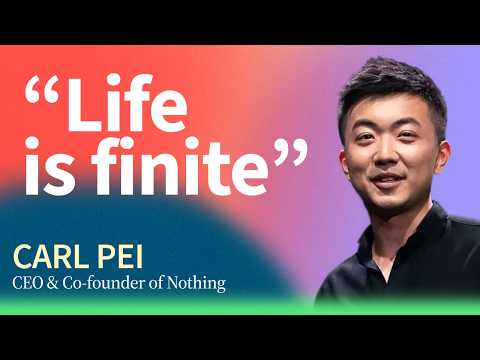
The Macro Shift: Infrastructure Invisibility. As core technologies become background noise, value moves from the pipes to the unique experiences built on top of them.
The Tactical Edge: Reject Mediocrity. Audit your product for average features and replace them with high-conviction improvements that competitors are too lazy to attempt.
The Bottom Line: Building is the only way to ensure the future happens. If you do not create the next version of reality, you are stuck living in an outdated vision.
The transition from hardware specs to emotional hardware where brand identity and OS-native AI become the primary moats.
Prioritize arbitrage opportunities in marketing by finding underpriced attention on platforms like TikTok before they become crowded.
Success in mature markets requires a Genghis Khan method: be a talent scout, stay open-minded to global supply chains, and use design to win the emotional battle for the consumer's pocket.
The transition from centralized cloud training to distributed local inference creates a massive demand for high-bandwidth storage and custom CPUs.
Audit your technical roadmap to prioritize local agentic workflows that reduce latency and data privacy risks.
The next 12 months will favor hardware that enables physical AI and local autonomy. Owning the compute stack is becoming a competitive necessity for builders who want to move faster than the cloud allows.
Intelligence is decoupling from scale. As reasoning becomes a commodity, the value moves from the size of the model to the proprietary nature of the training data.
Use TRL or Unsloth for single-GPU fine-tuning. Prioritize cleaning your instruction sets over increasing your training iterations.
The future belongs to those who own their data pipelines. If you can distill elite reasoning into a 350M parameter model, you win on latency, cost, and privacy.
Software maintenance is moving from a manual craft to an industrial process. As agents handle the toil of migrations and security, human engineers will focus entirely on high-level system design.
Batch by Dependency. Use the OpenHands SDK to visualize your codebase as a graph and deploy agents to solve the leaf nodes first.
Companies that master agent orchestration will clear their tech debt backlogs in weeks instead of years, creating a massive competitive advantage in product velocity.
The Call Option's Double Edge: The standard call-option deal is an elegant solution to crypto's volatility, but it becomes toxic when the loan is too large. An oversized option creates a "magnet effect" where the price gets pinned to the strike, killing healthy price discovery.
"Active Market Making" Is a Trap: Selling the future to pump the present is a fool's game. This structure leverages a project’s future token supply for a short-term price pump that almost always ends in a perp-driven death spiral, destroying credibility.
Launch Price Is Vanity, Momentum Is Sanity: The initial TGE price is an illusion driven by retail FOMO. Projects should focus on establishing a fair pre-launch price and using stabilization mechanisms to build sustained momentum, rather than chasing a fleeting, sky-high valuation on day one.
Stablecoin Infrastructure is the New Gold Rush: The Genius Act fired the starting gun. The most significant opportunities lie not in issuing stablecoins, but in building the ecosystem around them—from payment rails to wallet design and tokenized money market funds.
Narrative is the Ultimate Catalyst: ETH’s rally wasn’t driven by a tech breakthrough but by a potent cocktail of treasury-driven demand and a leadership refresh. In crypto, momentum creates its own demand.
The Great Convergence is Accelerating: With Coinbase in the S&P 500 and a wave of crypto IPOs, traditional capital can no longer sit on the sidelines. The primary battleground is now for public market mindshare.
We are in a high-risk, high-reward phase where liquidity is the primary driver. The cycle's ultimate peak remains uncertain and heavily dependent on macro-economic policy.
Brace for the Parabola. This is the late-stage bull market, where the most significant gains historically occur in short, violent bursts. Being out of the market means risking missing the entire cycle's payoff.
Rotation Is in Motion. Capital has started flowing from Bitcoin to Ethereum. The next domino to watch for is a pop in large-cap alts, which would confirm a full-blown alt season is underway.
**Stablecoins are now institutional grade.** The Genius Act provides a clear regulatory framework, unlocking enterprise adoption and integration into traditional payment rails. Expect a wave of innovation in stablecoin infrastructure.
**The future of DeFi is the next battleground.** While the Clarity Act offers key protections for developers, traditional finance incumbents are actively lobbying to limit DeFi's scope. The fight will be fierce in the Senate.
**Capital formation is being supercharged.** The Clarity Act’s new token sale exemption will legitimize and streamline ICO-style fundraising, providing a powerful new tool for founders to raise capital with crypto-native efficiency.
Proof-of-Human is Becoming Non-Negotiable. The internet is on a trajectory where >99% of activity will be AI-driven, making sybil-resistant "proof of human" a fundamental infrastructure layer, not a niche feature.
Hardware is the Moat. Worldcoin bets that a specialized, secure hardware device (the Orb) is the only method resilient enough against sophisticated AI to scale a global human network, a concept crypto pioneer Hal Finney foresaw.
A New GTM: Web3 Incentives, Web2 Integrations. Worldcoin’s strategy blends token airdrops to bootstrap its network (14M+ verified users) with integrations into mainstream apps (social, dating, gaming) to drive long-term, real-world utility.
**Fiscal, Not Fed:** This melt-up is fueled by government spending, not central bank easing. Expect momentum to push assets higher before a sharp, painful correction. Have your exit plan ready.
**Trade the Politics:** The cleanest narrative trade isn’t just Bitcoin; it’s politically reflexive “hated” coins (like XRP) that benefit from deregulation and have built-in, retail-heavy communities.
**Beware the Treasury Trap:** Publicly traded crypto treasury companies are an attention game designed to prey on retail liquidity. While you can dance while the music plays, know that the exit door is small.