The rise of autonomous AI agents will fundamentally reshape the app economy, rendering many single-purpose applications obsolete as agents integrate and automate tasks across systems. This forces companies to either become agent-facing APIs or risk irrelevance.
Cultivate "agent empathy" by understanding how models perceive codebases and problems. This skill, combined with a willingness to experiment and "play," is crucial for effectively guiding agents to build and refactor software.
The agentic AI era demands a shift from traditional programming to a builder mindset, where human creativity and strategic guidance become paramount. Investors should seek platforms enabling this shift, and builders must adapt to a world where natural language is the new code.
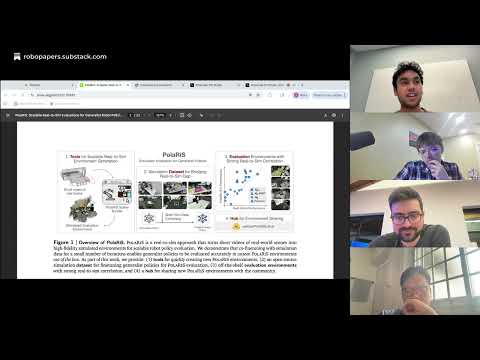
Robotics is moving towards generalist policies, demanding scalable, high-fidelity evaluation tools that mirror the real world, away from task-specific benchmarks.
Adopt PolaRiS for rapid policy iteration and generalization testing, especially for pick-and-place tasks, leveraging easy environment creation and proven real-to-sim correlation.
PolaRiS provides critical infrastructure for accelerating robot learning, enabling builders to quickly validate policies against real-world performance without prohibitive cost.
AI agents are transforming software development from a manual coding craft into an "agentic engineering" discipline, where human builders orchestrate and guide autonomous AI systems. This shift means the value moves from writing boilerplate code to designing agent-friendly architectures and providing high-level strategic direction.
Embrace agentic engineering by learning to "empathize" with AI models, understanding their context limitations, and guiding them with concise, clear prompts. Experiment with open-source agents like OpenClaw to build new tools or automate existing workflows, focusing on the what and why rather than the how.
Personal AI agents will commoditize many existing apps and services, forcing companies to either become agent-facing APIs or risk obsolescence. Investors should identify platforms and infrastructure that enable agent interoperability, while builders should focus on creating agent-native experiences and tools that augment human creativity, rather than replicating existing app functionality.
Robotics is moving beyond isolated tasks to generalist policies, demanding scalable, correlated evaluation methods. This mirrors the LLM world's need for diverse, generalization-focused benchmarks.
Utilize PolaRiS's open-source tools and Hugging Face hub to quickly create and share new evaluation environments. This crowdsourcing approach accelerates community-wide progress in robot policy development.
Investing in tools like PolaRiS that bridge the real-sim gap with high-fidelity visuals and minimal sim co-training is crucial. This enables faster policy iteration and more reliable real-world deployment for the next generation of generalist robots.
The macro shift: Generalist robot policies need generalist evaluation. The shift is from hand-crafted, task-specific sim environments to easily generated, real-world-correlated simulations that test zero-shot generalization, mirroring the rapid benchmark development in LLMs. This allows for a holistic understanding of policy capabilities across diverse, unseen scenarios.
The tactical edge: Adopt PolaRiS for rapid policy iteration. Builders should use its browser-based scene builder and Gaussian Splatting to quickly create new, diverse evaluation environments from real-world scans, then fine-tune policies with small, unrelated sim data to achieve high real-to-sim correlation. This accelerates development cycles and reduces costly real-world testing.
The future of robotics hinges on scalable, trustworthy evaluation. PolaRiS provides a critical tool today to bridge the sim-to-real gap, enabling faster, more reliable development of generalist robot policies. Expect a community-driven explosion of benchmarks, pushing robot capabilities faster than ever over the next 6-12 months.
The robotics community needs to move beyond task-specific benchmarks with provided training data towards a diverse suite of generalization-focused evaluations, mirroring the LLM ecosystem. PolaRiS provides the tools to crowdsource and rapidly deploy these new benchmarks, fostering a more holistic understanding of robot policy capabilities.
For robot policy developers, prioritize tools like PolaRiS that offer high real-to-sim correlation with minimal setup. Leverage its browser-based scene builder and the "visual vaccination" co-training method to quickly iterate on policies for pick-and-place and articulated object tasks, then validate on real hardware.
Scalable, correlated simulation is the missing piece for accelerating generalist robot AI. Over the next 6-12 months, the adoption of tools like PolaRiS will enable faster policy iteration, more robust benchmarking, and ultimately, a quicker path to deploying capable robots in diverse, unstructured environments.
The robotics community is moving from hand-crafted, task-specific simulations to generalist policies that demand scalable, real-world correlated evaluation. PolaRiS enables this by making it cheap and easy to create diverse, high-fidelity sim environments from real scans, allowing for generalization testing akin to LLM benchmarks.
Implement PolaRiS for rapid policy iteration. Use its real-to-sim environment generation and minimal, unrelated sim data co-training to quickly validate robot policies against real-world performance, reducing costly physical robot time.
PolaRiS offers a critical infrastructure upgrade for robot AI development. By providing a fast, reproducible, and highly correlated simulation environment, it allows builders to iterate on generalist robot policies at software speed, significantly de-risking and accelerating the path to real-world deployment and broader robot capabilities over the next 6-12 months.
The drive for generalist robot policies demands scalable, reliable evaluation. PolaRiS pushes robotics toward the community-driven, diverse benchmarking common in LLMs, accelerating the path to truly capable robots.
Adopt PolaRiS for rapid policy iteration and generalization testing. Leverage its easy environment creation and proven real-to-sim correlation to quickly validate new robot behaviors before costly real-world deployment.
PolaRiS is a critical tool for any team building robot policies. It cuts evaluation costs, speeds up development, and provides a trustworthy signal for real-world performance, making it a must-have for your robotics roadmap over the next 6-12 months.
Builders should prioritize hybrid real-to-sim evaluation tools like PolaRiS for rapid policy iteration.
Use minimal, out-of-domain sim data to align policies to the simulation environment, ensuring your sim results accurately predict real-world performance.
Investing in tools that democratize benchmark creation and ensure strong real-to-sim correlation will accelerate robot policy development.
**Treasury Companies Are A Double-Edged Sword.** They are creating massive buy-side pressure now but pose a systemic risk. Their weak debt covenants could turn a market dip into a liquidation cascade.
**Market Structure Over Fundamentals (For Now).** ETH’s surge exemplifies this trend. Despite weak fundamentals, its powerful technical breakout and role as the next asset for treasury buyers are driving its outperformance.
**Watch the NAV Premium.** The key health metric is the premium-to-NAV on these treasury companies. As long as investors pay $2 for $1 of crypto, the mania continues. A flip to a discount is the canary in the coal mine.
The Cycle is Dead, Long Live the Cycle: The old four-year, retail-driven crypto cycle is over. We're in an institutionally-led "gigachad bull run" that will last through 2026 and push the market cap above $10 trillion, pending regulatory clarity.
Narrative is the Ultimate Metric: Chains that focus on philosophical purity and solving real-world problems (Bitcoin, Cardano) build more resilient communities and long-term value than those chasing fleeting metrics like TPS and TVL.
Bitcoin's Next Chapter will be Written on Cardano: As Bitcoin matures into a yield-bearing asset, its massive capital base will seek returns elsewhere. Cardano’s UTXO model and upcoming interoperability features are designed to capture this flow, positioning it as Bitcoin’s de facto yield layer.
The Dollar's "Gold Moment" is Here. The dollar is decoupling from its traditional anchor (rate differentials) just as gold decoupled from real yields, signaling a permanent regime shift driven by geopolitics, not just economics.
The "Dollar Smile" Has Inverted. The dollar is no longer a reliable risk-off hedge. Its positive correlation with equities means it now falls during market stress—a fundamental rewiring for asset allocators.
The Devaluation Trade is a Trap (For Now). While the long-term bearish case for the dollar is clear, the trade is dangerously crowded. Expect markets to test this one-sided positioning with a painful bounce before the ultimate decline resumes.
**The Real Cycle Indicator:** Forget price targets. The bull market's health is directly tied to the premium-to-NAV on crypto treasury vehicles. When those premiums collapse, the party is over.
**L1s Are Dead Money:** The dominant thesis is a massive market re-rating where capital flees overvalued L1 infrastructure and concentrates into Bitcoin and a handful of cash-flow-positive applications.
**Stablecoins Aren't a Commodity:** The moats are deep. New issuers will struggle to compete with Tether's liquidity network effects and Ethena's structural yield advantage, making it a bear market for new stablecoin startups.
Content is the New Capital: The Base App transforms every post into a tradable asset. This makes content creation a direct form of capital formation, rewarding creators for attention in a way that’s native to the internet of value.
The Rise of the Native Creator: The biggest winners on Base won't be Web2 transplants, but new creators who master the platform's unique blend of content and commerce. The strategy is to find and elevate undiscovered talent from every vertical.
From Algorithm to Free Market: Base is trading the black box of social media algorithms for the transparent chaos of a free market. The central experiment is whether market-based incentives can build a healthier, more aligned social network.
**ETH is the New Institutional Primitive.** The "ETH Treasury" model is a new unlock, leveraging ETH's native yield to create a self-financing acquisition engine that is attracting billions in institutional capital.
**The Floodgates Are Open.** The Genius Bill and explosive ETF inflows are not just bullish signals; they are structural shifts that are unleashing a torrent of capital and legitimizing the asset class for mainstream finance.
**Risk is Ramping.** The excitement is palpable, but so is the risk. The treasury meta feels like a potential bubble, and legal threats against core DeFi and infrastructure remain a significant overhang. Buyer beware.