The automotive industry is undergoing a significant architectural change, moving from fragmented, hardware-centric systems to vertically integrated, AI-powered software-defined vehicles. This demands re-platforming, making legacy automakers vulnerable.
Invest in or build companies controlling their full technology stack: custom silicon, sensor arrays, data collection, AI model training. Vertical integration is key to cost efficiency and rapid iteration for mass-market AI autonomy.
The next few years will see dramatic divergence. Companies mastering AI-driven autonomy and software-defined architectures, like Rivian with its R2, will capture significant market share by offering compelling, continuously improving vehicles at scale. Others face obsolescence.
The robotics community is moving beyond task-specific benchmarks towards generalist policy evaluation, mirroring the LLM trend of testing off-the-shelf models on unseen tasks. This demands scalable, high-fidelity simulation tools that can quickly generate diverse test environments.
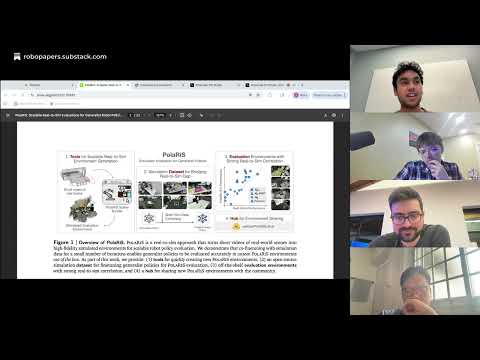
Builders and researchers should prioritize evaluation tools that offer strong real-to-sim correlation, even if it means a hybrid approach (like PolaRiS) over purely data-driven world models. Utilize real-to-sim environment generation (Gaussian splatting) and strategic sim data co-training to accelerate policy iteration.
PolaRiS offers a path to community-driven, crowdsourced robot benchmarks, making policy development faster and more robust. Expect a future where robot policies are evaluated across a broad suite of easily created, diverse simulated environments, pushing the boundaries of generalization and real-world applicability.
Generalist robot policies need robust, scalable evaluation. The shift is from bespoke, real-world-only testing to a hybrid real-to-sim approach that leverages modern 3D reconstruction and minimal sim data to create highly correlated, reproducible benchmarks.
Builders should adopt PolaRiS's real-to-sim environment generation and "sim co-training" methodology. This allows for rapid, cost-effective iteration on robot policies, ensuring that improvements in simulation translate directly to real-world gains.
Over the next 6-12 months, the ability to quickly and reliably evaluate robot policies in simulation will be a critical differentiator. PolaRiS provides the tools to build diverse, generalization-focused benchmarks, moving robotics closer to the rapid iteration cycles of other AI fields.
Tesla's core identity shifted from EV maker to autonomous AI and robotics. Its cars are devices for deploying its advanced AI brain; competitors miss this.
Tesla's 8 million cars collect real-world driving data. This massive dataset, combined with in-house AI processing, creates an unparalleled moat impossible for competitors to replicate.
This convergence creates an abundance of labor and transportation, driving down costs. Robo-taxis and humanoid robots automate tasks, making goods and services cheaper, even as Tesla's profitability soars.
Robotics is moving towards generalist policies that need broad, diverse evaluation. PolaRiS enables this by making it easy to create and share new, correlated benchmarks, cultivating a community-driven evaluation ecosystem similar to LLMs.
Adopt PolaRiS for rapid policy iteration on pick-and-place and articulated object tasks. Use its browser-based scene builder and existing assets to quickly create new evaluation environments, then fine-tune policies with a small amount of unrelated sim data to boost real-to-sim correlation.
Investing in tools like PolaRiS now means faster development cycles and more reliable policy improvements. This accelerates the path to robust, real-world robot deployment by providing a scalable, trustworthy intermediate testing ground.
PolaRiS enables a shift towards LLM-style generalization benchmarks, where models are tested on unseen environments and tasks, accelerating robot capabilities.
Use its browser-based scene builder and Gaussian splatting to quickly create diverse, real-world correlated evaluation environments, significantly reducing the cost and time of real robot testing.
Cheap, reliable robot policy evaluation in simulation, with strong real-world correlation, means faster development cycles, more robust generalist robots, and a path to crowdsourced, diverse benchmarks that will push the entire field forward.
AI is forcing a fundamental architectural change in automotive, moving from fragmented, rules-based systems to vertically integrated, neural network-powered platforms. This technical reality dictates market survival, favoring companies that control their entire software and hardware stack to build a continuous data flywheel.
Invest in or partner with companies demonstrating deep vertical integration in AI hardware and software for mobility. Prioritize those with a clear path to mass-market data collection and rapid iteration cycles.
Autonomy will be a must-have feature in cars within the next few years. Companies without a software-defined architecture and a vertically integrated AI stack will struggle to compete, creating a market share shift towards those few players who can deliver true self-driving at scale.
The automotive industry is undergoing a fundamental re-architecture, moving from hardware-centric, rules-based systems to software-defined, AI-powered platforms. This shift favors companies with deep vertical integration and proprietary data flywheels.
Invest in companies demonstrating full-stack control over their vehicle's software, hardware, and AI training data. This verticality is the moat against commoditization and the engine for rapid, continuous improvement.
Autonomy will be a non-negotiable feature by 2030, making software-defined vehicles the only viable path for mass-market automakers. Companies that fail to build or acquire this capability will face market irrelevance.
Tesla's core business is AI and autonomous robotics. This means its value comes from its software and data moat, not just vehicle sales.
Tesla is sunsetting Model S and X production to convert factories for humanoid robots. This signals a full commitment to autonomous devices beyond cars.
Unsupervised FSD is expected in select US states by Q2. This will enable cars to operate without human oversight, unlocking the robo-taxi network.
Crypto Is America's Counter-Offensive. The U.S. is betting on privately-issued, regulated stablecoins—not a government-backed digital dollar—to maintain its edge in global payments. This strategy mirrors how it co-opted the offshore Eurodollar market in the 1970s to expand the dollar’s influence.
The Rise of Parallel Systems. The weaponization of the dollar is forcing countries like China to build their own financial infrastructure (e.g., the M-Bridge platform). This guarantees a future where nations have multiple payment networks to choose from, eroding the U.S.’s unique leverage.
Sanctions Are Not a Free Lunch. While a powerful alternative to military conflict, economic sanctions must be used judiciously. Overusing them risks dulling their impact and ultimately dismantling the very system that grants the U.S. its power.
ETH's Narrative Is Its Near-Term Weapon. ETH's strength lies in a story simple enough for a "dumb banker": massive market cap, 80%+ stablecoin dominance, and the perceived success of its L2s. This makes it an easier buy for TradFi, even if the value accrual thesis is murky.
Solana Is Playing The Long Game. Solana is betting that superior tech will ultimately win. Its focus isn't on the current TradFi narrative but on building the infrastructure for future "internet capital markets," a strategy that requires patience.
Stablecoin Liquidity Is a Vanity Metric. Billions in stablecoins on platforms like Aave don't automatically translate to productive economic activity. The primary use case remains on-chain speculation, challenging the idea that massive liquidity is an end in itself.
Ditch the Beta, Pick Your Alts: The days of everything moving in unison are fading. Idiosyncratic returns are back, rewarding investors who can identify projects with strong, sustainable tokenomics.
Beware the Treasury Treadmill: The crypto treasury model is not an "infinite money glitch." Expect premiums to compress and consolidation to begin as the market becomes saturated and the ability to raise capital at a premium wanes.
Tokenization is the Next Frontier: The real institutional play is the rise of "internet capital markets." The tokenization of money market funds by giants like BNY and Goldman will create new, regulated avenues for investment and yield generation on-chain.
Price Action Is the Best Marketing. ETH’s bullish chart has single-handedly revived interest, breaking a long-term downtrend against BTC and forcing even skeptics to reconsider. The technicals are now undeniably strong.
ETH Is Wall Street’s High-Beta Darling. New institutional money, looking for 5-10x returns and limited to what’s available in brokerage accounts, is flowing into ETH as the logical next step down the risk curve from Bitcoin.
Trade Your Conviction. Don't chase a rally you don't understand. Entering a trade based on technicals without a fundamental framework is a recipe for selling the lows when volatility hits. For some, leveraged Bitcoin remains a more coherent trade.
Crypto as a Political Countermeasure: For Hoskinson, blockchain is the practical tool to enforce the sound money and transparent governance that the US government has abandoned.
The Federal Reserve Is a Core Target: He identifies the Federal Reserve's unchecked power over the monetary supply as a central flaw in the current system, positioning decentralized currencies as a direct challenge to its authority.
A Mission, Not a Job: His daily engagement isn't for financial gain but is driven by the conviction that the fight for a more honest and accountable system is far from over.
Tech Over Hype: Solana’s long-term bet is on fundamental technology. Upgrades like Jito’s BAM are designed to create a superior on-chain environment for sophisticated finance, even if it means losing short-term narrative battles to ETH.
The Institutional Gap: Ethereum is currently winning the institutional game with simple, powerful stories around stablecoins and treasury assets. Solana needs a clearer, more accessible pitch beyond raw performance to compete for this capital.
Performance is Non-Negotiable: The Solana ecosystem is doubling down on its high-throughput thesis. Expect a continued push for more blockspace and faster finality, even if it makes running a validator more exclusive. The trade-off is deemed worth it to bring global-scale finance on-chain.