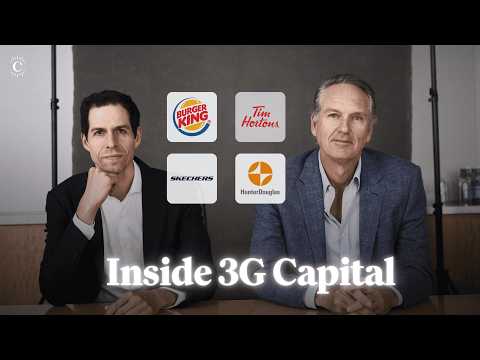
As markets become more complex and tech-driven, the ability to identify and deeply operate businesses with enduring customer relationships becomes a critical differentiator. 3G's model shows that concentration on "forever businesses" with strong brands and operational upside can outperform broad diversification.
Cultivate an owner-operator mindset within your organization, pushing decision-making closer to the problem and aligning incentives with long-term value creation. Prioritize hiring and empowering high-potential talent early, providing mentorship to maximize their success.
In a world obsessed with speed and scale, 3G Capital's patient, concentrated, and operationally intensive approach to investing in high-quality, customer-owning businesses offers a powerful blueprint for compounding capital and building lasting value over the next decade.
The Macro Shift: Celebrity and athlete capital is migrating from transactional endorsements to strategic equity investments, driven by a desire for long-term wealth creation and direct ownership. This trend is amplified by AI and blockchain tools, which enable individuals to build high-value enterprises with leaner teams.
The Tactical Edge: Cultivate a robust, diverse network by actively engaging with dealmakers, even in "boring" settings. Prioritize equity-based opportunities in overlooked markets or early-stage, foundational technologies with clear demand.
The Bottom Line: The next 6-12 months will see increased convergence of brand power, strategic capital, and advanced tech. Investors and founders who embrace long-term vision, smart partnerships, and a willingness to invest in "unsexy" but essential sectors will capture disproportionate value.
The celebrity-as-investor model, driven by equity over endorsements, is mainstream, creating new avenues for capital and brand influence in high-growth ventures.
Cultivate diverse mentors and partners, prioritize long-term relationships, and seek "boring" businesses in underserved markets with clear demand.
Success in the next 6-12 months hinges on strategic investment in capital and relationships, using AI for efficiency, and building teams that execute on sustained growth.
The era of celebrity endorsements is yielding to a new paradigm where high-profile individuals become active equity investors and brand builders, leveraging their influence for long-term capital appreciation rather than short-term cash.
Cultivate a diverse network of experts and mentors, prioritizing relationships over immediate transactions, and be prepared to invest your own capital to secure high-potential, often "boring," opportunities.
Future wealth creation hinges on strategic partnerships, a willingness to invest in overlooked markets, and a deep understanding of equity's power.
The convergence of celebrity influence, patient capital, and technological advancements (AI, blockchain) is creating a new class of asset owners and builders. This evolution prioritizes long-term equity and strategic value-add over transactional endorsements, fundamentally altering how wealth is created and distributed.
Cultivate a "dealmaker's rolodex" by consistently networking and seeking out mentors. Prioritize investments in businesses that address clear, underserved market demands, even if they appear "boring," and always be ready to put capital to work for equity.
The future of high-growth investing lies in understanding that "boring" can be brilliant, partnerships amplify potential, and a winning mindset applies equally to sports and startups. Position your capital and network to capture value from these enduring principles, especially as AI accelerates business creation and efficiency.
The traditional athlete-endorsement model is giving way to an equity-driven, ownership-first approach. This reflects a broader economic trend where brand power translates directly into capital formation and long-term asset appreciation, particularly in sports and tech.
Cultivate a "give-first" network by consistently seeking out and engaging with top-tier dealmakers and founders, even when immediate returns are not apparent. Prioritize early, strategic investments in "boring" or overlooked sectors with high demand, and be prepared to commit capital and expertise.
The convergence of athlete-investors, tech innovation (AI/blockchain), and appreciating asset classes (sports teams) creates a fertile ground for exponential wealth creation. Position yourself to participate in this shift by building a smart team, embracing long-term equity plays, and identifying high-demand, underserved markets.
The convergence of celebrity capital, AI-driven efficiency, and insatiable demand for sports content creates fertile ground. New ventures can scale faster with smaller teams and benefit from high-profile, strategic investors.
Prioritize long-term equity over short-term cash, cultivate a diverse network, and invest heavily in core product and customer experience.
Success hinges on identifying overlooked markets, building expert teams, and adopting strategic partnerships beyond mere capital.
Follow the Flows. Ethereum's rally is a direct result of capital firehoses from new treasury companies. This isn't a narrative trade; it's a structural buying pressure that creates its own momentum.
Yield is Widening. As TradFi rates fall, on-chain credit yields are set to expand. The widening spread between traditional and decentralized finance will be a powerful magnet for capital.
The Treasury Gold Rush Has Begun. The explosion of new treasury companies is a land grab for asset accumulation. The real game will be fought on operational efficiency, yield generation, and brand dominance, leading to inevitable consolidation.
ETH is the bellwether for risk. Its current rally is the starting gun for an "ETH alt season." Use ETH's strength as a barometer for when to be aggressive with altcoin allocations.
Buy breakouts, not bottoms. The most profitable strategy is to wait for assets to break their downtrend, then ride the reflexive narrative loop. Aave (AAVE) and Aerodrome (AERO) are prime examples of this setup.
Aerodrome is a conviction play. With superior tokenomics, a dominant position on Base, and a direct pipeline to Coinbase's retail army, Aerodrome has a clear path to becoming a breakout star of this cycle.
Privacy as a Feature, Not a Product. The next major user-facing push will be to embed privacy tools directly into mainstream wallets, shifting privacy from a niche cypherpunk concern to a default user experience.
Scale L1, Anchor L2s. The roadmap focuses on a strong L1 as the ultimate settlement and asset-issuance layer. This keeps the sprawling L2 ecosystem economically aligned and prevents fragmentation by making the L1 indispensable.
ETH is the Economic Glue. A strong ETH is essential for coordinating incentives across the ecosystem. It is the core economic asset that aligns the Foundation, L2s, DeFi apps, and users, preventing the community from fracturing.
**Platform, Not Phones.** Success for Solana Mobile isn't another phone sale; it's getting another manufacturer to adopt its platform. The end goal is to be the crypto equivalent of Android—a foundational layer for a world of hardware.
**Go Global or Go Home.** The US is a sideshow. The real action is in the wildly diverse international market, where hundreds of device makers are looking for a competitive edge. This is where Solana Mobile plans to win.
**Ecosystem as the Engine.** The strategy hinges on empowering the ecosystem to "go nuts." If the core team has to scale massively, it’s a sign of failure. True success is when hardware builders and dApp developers drive the platform’s growth organically.
Specialization Over Generalization. For demanding use cases like exchanges, purpose-built rollups have a massive edge over L1s. They can be hyper-optimized for a single function without being constrained by the needs of a diverse ecosystem.
Performance Is the Product. Sub-10-millisecond finality isn't a vanity metric; it's the fundamental requirement to bring serious financial markets and liquidity on-chain. Sovereign is making on-chain performance competitive with centralized finance.
Revenue Before Token. In a direct rejection of the "launch-and-pray" model, Sovereign is building a sustainable business via a revenue-share on its core technology. The team has no plans for a token until a clear, long-term value accrual mechanism exists.
The Scale is Real: At $28 trillion in annual volume, stablecoins have already surpassed Visa and Mastercard combined, proving the infrastructure is ready for primetime.
B2B is the Killer App: The most powerful immediate use case isn't speculation, but something far more practical: B2B payments. The efficiency gains are too large for corporate treasurers to ignore.
TradFi is Scrambling: Wall Street has moved from dismissal to active investigation. Sell-side analysts are now quantifying the threat stablecoins pose to legacy payment networks, signaling a major paradigm shift.