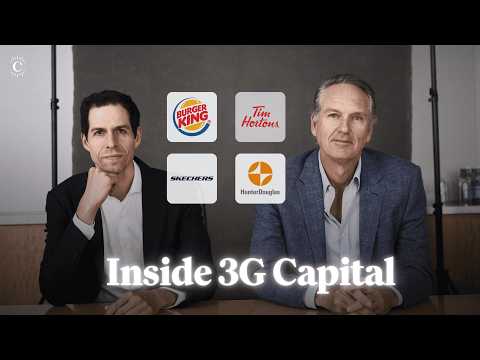
3G commits to one investment per fund, deploying significant internal capital alongside partners. This focus allows for rigorous downside analysis and patience, ensuring only truly exceptional businesses are acquired.
3G partners are seasoned operators who step into businesses, aligning incentives with ownership. This hands-on approach ensures decisions serve the business's long-term health, not just short-term management goals.
3G prioritizes businesses that directly own their customer relationships, like Burger King or Hunter Douglas. This direct connection reduces disintermediation risk from retailers or new technologies.
As capital markets become increasingly efficient and competitive, the edge moves from financial engineering to deep operational expertise and long-term, owner-aligned management.
Prioritize identifying and enabling high-potential individuals early in their careers, granting them significant responsibility and ownership.
Disciplined focus, patient relationship building, and an unwavering commitment to operational excellence in established, defensible businesses can still yield generational wealth.
The Macro Trend: In a world obsessed with digital disruption, 3G Capital's success with "atoms over bits" businesses highlights a strategic pivot: enduring value often resides in established brands with proprietary customer relationships, where operational excellence and long-term thinking create moats against fleeting tech trends.
The Tactical Edge: Identify businesses with strong, direct customer relationships and a clear path for operational improvement, even if they appear "boring." Prioritize deep, hands-on involvement to drive value, rather than relying solely on financial engineering.
The Bottom Line: The future of outsized returns may not be in chasing the next big tech wave, but in patiently acquiring and meticulously operating businesses that own their customer relationships, leveraging technology to enhance, not redefine, their core value. This strategy offers a more predictable, less volatile path to compounding capital.
The Macro Shift: In a world obsessed with digital disruption, 3G Capital's success highlights the enduring power of "hard" businesses with strong customer relationships. Their focus on foundational consumer brands, managed by operator-investors who prioritize long-term ownership and disciplined execution, offers a robust counter-narrative to the "bits over atoms" trend.
The Tactical Edge: Cultivate an extreme ownership culture by aligning incentives deeply, empowering young talent with real responsibility, and fostering a relentless bias for action.
The Bottom Line: For investors and builders, the lesson is clear: patience, deep operational involvement, and a fanatical focus on talent in defensible, "boring" businesses can yield extraordinary, long-term value, even in expensive markets.
Extreme Focus: 3G Capital commits to one investment per fund, deploying significant internal capital alongside partners. This singular focus forces rigorous downside analysis and patience, ensuring they only pursue truly exceptional opportunities.
Owner Operators: 3G partners are seasoned operators who step into businesses, aligning incentives with ownership. This means leaders act like shareholders, making decisions for the business's long-term health, not just short-term management goals.
Disruption Defense: 3G prioritizes businesses with strong customer relationships and physical components, making them less susceptible to digital disintermediation. They seek enduring brands like Hunter Douglas, where the sun will always rise and set, ensuring a consistent need for their product.
In an era of rapid technological change, businesses with strong, direct customer relationships and physical moats are increasingly valuable. 3G's focus on these "atoms" businesses, enhanced by strategic tech adoption, provides a blueprint for durable value creation.
Cultivate an ownership culture by aligning incentives deeply, empowering young talent with real responsibility, and prioritizing long-term value over short-term gains.
The future belongs to patient, operator-led investors who can identify and transform enduring businesses by focusing on fundamental quality, people, and strategic technological integration, rather than chasing fleeting trends.
3G Capital's model counters this by doubling down on "atoms" businesses with strong customer relationships and defensible positions, then applying rigorous operational excellence.
Cultivate an owner-operator mindset within your organization, even if you are not a private equity firm. Identify and back high-potential young talent with significant responsibility and aligned incentives, providing mentorship to maximize their success.
In a world obsessed with speed and diversification, 3G Capital proves that deep, patient, operator-led concentration on high-quality, defensible businesses, combined with a culture of ownership and meritocracy, remains a powerful engine for outsized value creation.
The era of celebrity endorsements is evolving into one of celebrity ownership, driven by a growing understanding of equity's compounding power and enabled by new technologies that lower the barrier to business creation.
Prioritize building a diverse, expert team and actively seek out "boring" businesses or underserved markets with clear, unmet demand.
The next 6-12 months will see an acceleration of talent leveraging their brand for equity stakes, particularly in tech-enabled ventures. Position yourself to either participate in these deals or build the tools that empower this new class of owner-operators.
Follow the Flows. Ethereum's rally is a direct result of capital firehoses from new treasury companies. This isn't a narrative trade; it's a structural buying pressure that creates its own momentum.
Yield is Widening. As TradFi rates fall, on-chain credit yields are set to expand. The widening spread between traditional and decentralized finance will be a powerful magnet for capital.
The Treasury Gold Rush Has Begun. The explosion of new treasury companies is a land grab for asset accumulation. The real game will be fought on operational efficiency, yield generation, and brand dominance, leading to inevitable consolidation.
ETH is the bellwether for risk. Its current rally is the starting gun for an "ETH alt season." Use ETH's strength as a barometer for when to be aggressive with altcoin allocations.
Buy breakouts, not bottoms. The most profitable strategy is to wait for assets to break their downtrend, then ride the reflexive narrative loop. Aave (AAVE) and Aerodrome (AERO) are prime examples of this setup.
Aerodrome is a conviction play. With superior tokenomics, a dominant position on Base, and a direct pipeline to Coinbase's retail army, Aerodrome has a clear path to becoming a breakout star of this cycle.
Privacy as a Feature, Not a Product. The next major user-facing push will be to embed privacy tools directly into mainstream wallets, shifting privacy from a niche cypherpunk concern to a default user experience.
Scale L1, Anchor L2s. The roadmap focuses on a strong L1 as the ultimate settlement and asset-issuance layer. This keeps the sprawling L2 ecosystem economically aligned and prevents fragmentation by making the L1 indispensable.
ETH is the Economic Glue. A strong ETH is essential for coordinating incentives across the ecosystem. It is the core economic asset that aligns the Foundation, L2s, DeFi apps, and users, preventing the community from fracturing.
**Platform, Not Phones.** Success for Solana Mobile isn't another phone sale; it's getting another manufacturer to adopt its platform. The end goal is to be the crypto equivalent of Android—a foundational layer for a world of hardware.
**Go Global or Go Home.** The US is a sideshow. The real action is in the wildly diverse international market, where hundreds of device makers are looking for a competitive edge. This is where Solana Mobile plans to win.
**Ecosystem as the Engine.** The strategy hinges on empowering the ecosystem to "go nuts." If the core team has to scale massively, it’s a sign of failure. True success is when hardware builders and dApp developers drive the platform’s growth organically.
Specialization Over Generalization. For demanding use cases like exchanges, purpose-built rollups have a massive edge over L1s. They can be hyper-optimized for a single function without being constrained by the needs of a diverse ecosystem.
Performance Is the Product. Sub-10-millisecond finality isn't a vanity metric; it's the fundamental requirement to bring serious financial markets and liquidity on-chain. Sovereign is making on-chain performance competitive with centralized finance.
Revenue Before Token. In a direct rejection of the "launch-and-pray" model, Sovereign is building a sustainable business via a revenue-share on its core technology. The team has no plans for a token until a clear, long-term value accrual mechanism exists.
The Scale is Real: At $28 trillion in annual volume, stablecoins have already surpassed Visa and Mastercard combined, proving the infrastructure is ready for primetime.
B2B is the Killer App: The most powerful immediate use case isn't speculation, but something far more practical: B2B payments. The efficiency gains are too large for corporate treasurers to ignore.
TradFi is Scrambling: Wall Street has moved from dismissal to active investigation. Sell-side analysts are now quantifying the threat stablecoins pose to legacy payment networks, signaling a major paradigm shift.