The AI revolution in biology is moving from prediction to generation, enabling the de novo design of molecules with specific functions. This shift, driven by specialized architectures and open-source efforts, is fundamentally changing how new drugs and biological tools are discovered.
Invest in platforms that productize complex AI models with robust, real-world validation. For builders, focus on user experience and infrastructure that abstracts away computational complexity, making advanced tools accessible to domain experts.
The ability to reliably design novel proteins and small molecules will unlock unprecedented speed and efficiency in drug discovery over the next 6-12 months. Companies that can bridge the gap between cutting-edge AI models and practical, validated lab results will capture significant value.
AI in biology is rapidly transitioning from predictive analytics to generative design, demanding specialized models that integrate complex biophysical priors and robust, real-world experimental validation to move from theoretical predictions to tangible, novel molecules.
Builders and investors should prioritize platforms that not only offer state-of-the-art generative models but also provide scalable infrastructure, intuitive interfaces, and a commitment to open-source development and rigorous experimental validation, lowering the barrier for scientific innovation.
The ability to design new proteins and small molecules with AI is no longer science fiction; it's a rapidly maturing field. Companies that can effectively bridge the gap between cutting-edge AI research and practical, validated tools will capture significant value in the accelerating race for new therapeutics and biotechnologies.
The AI industry is moving from a focus on raw model size to a sophisticated interplay of frontier research, efficient distillation, and specialized hardware. This means the "best" model isn't just the biggest, but the one optimized for its specific deployment context, driven by energy efficiency and latency.
Prioritize investments in hardware and software architectures that enable extreme low-latency inference and multimodal processing. For builders, this means designing systems that can leverage both powerful frontier models for complex tasks and highly optimized "flash" models for ubiquitous, real-time applications.
The next 6-12 months will see a continued acceleration in AI capabilities, driven by a relentless focus on making models faster, cheaper, and more context-aware. Companies that excel at distilling cutting-edge AI into deployable, low-latency solutions will capture significant market share and redefine user expectations.
The AI industry is consolidating around unified, multimodal general models, moving past the era of highly specialized, single-task AI. This means foundational models will increasingly serve as the base for all applications, with specialized knowledge integrated via retrieval or modular training.
Invest in low-latency AI infrastructure and model architectures. The future of AI interaction hinges on near-instantaneous responses, enabling complex, multi-turn reasoning and agentic workflows that are currently bottlenecked by speed and cost.
The race for AI dominance is a full-stack game: superior hardware, efficient model architectures, and smart deployment strategies are inseparable. Companies that master this co-evolution will capture the next wave of AI-driven productivity and user experience.
The open-source AI movement is democratizing advanced scientific tools, particularly in generative biology, forcing a re-evaluation of proprietary models' long-term impact on innovation.
Builders and investors should prioritize platforms that combine cutting-edge open-source models with robust, scalable infrastructure and extensive experimental validation.
The future of drug discovery will be driven by accessible, validated generative AI platforms that empower a broad scientific community, rather than relying on a few closed, black-box solutions. This means faster iteration, lower costs, and a higher probability of discovering novel therapeutics in the next 6-12 months.
Prioritize low-latency AI interactions and invest in tools that enable precise, multimodal prompting.
The relentless pursuit of AI capability is increasingly tied to the energy efficiency of data movement, driving a co-evolution of model architectures and specialized hardware.
The next 6-12 months will see a significant acceleration in personalized AI experiences and a continued push for ultra-low latency models, making crisp communication with AI a competitive advantage.
The rise of autonomous AI agents is fundamentally reconfiguring the digital economy, transforming traditional software applications into agent-addressable services and democratizing building by lowering the technical bar for creation.
Invest in platforms and tools that prioritize agent-friendly APIs and open-source collaboration, as these will capture the next wave of digital value creation.
Personal AI agents are not just tools; they are a new operating system layer that will redefine how we interact with technology and each other. Understanding this shift is critical for navigating the next 6-12 months of rapid innovation and market disruption.
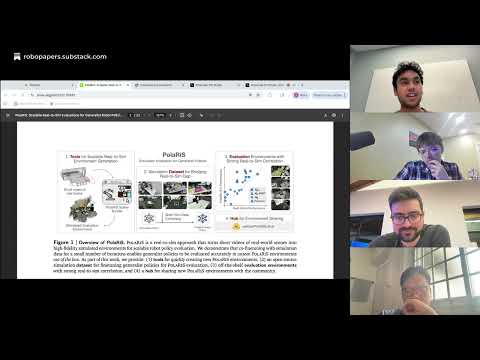
Adopt PolaRiS for policy iteration. Builders should use its browser-based scene builder and Gaussian splatting pipeline to quickly create new, diverse evaluation environments from real-world scans.
Integrate minimal, unrelated sim data into policy training to dramatically boost real-to-sim correlation, allowing for faster, cheaper development cycles before costly real-world deployment.
PolaRiS shifts the focus from hand-crafted, task-specific simulations to scalable, real-world-correlated benchmarks, enabling rapid iteration and generalization testing previously impossible in robotics.
Agentic AI is changing software from discrete applications to an integrated, conversational operating layer, making human intent the primary interface for complex tasks.
Invest in or build platforms that prioritize agent-friendly APIs and open-source collaboration, as these will capture the next wave of user interaction and value generation.
The future of computing is agent-centric; understanding and adapting to this paradigm change is crucial for staying relevant in the quickly evolving tech landscape over the next 6-12 months.
Structure Over Speed: In the DAT gold rush, avoid the shells. Reverse takeovers are fraught with hidden liabilities; cleaner de-novo SPACs are built for long-term institutional trust and better financing.
Stick to the Winners: The DAT market will consolidate. Bet on pure-play vehicles for top-tier, liquid assets like ETH, as "Frankenstein" and illiquid-token DATs are destined for M&A or failure.
Distribution is Destiny: In the payments war, Stripe’s direct ownership of millions of merchants gives it a crushing advantage over Circle’s middleware approach. Owning the customer is the only moat that matters.
Incoming Institutional Tsunami: An estimated $1.5 billion in institutional capital is poised to enter the ecosystem in the next six months, which could single-handedly 5x the price due to limited exchange liquidity.
The Subnet Demand Spiral: The core mechanics of registering and participating in subnets create a flywheel effect where ecosystem growth directly translates into increased demand and reduced circulating supply for $TAO.
The Halving Supply Shock: A December halving will slash new $TAO emissions by 50%, tightening supply just as multiple demand vectors are peaking, creating a potentially explosive supply-demand imbalance.
**Right vs. Rich:** Stop trying to be right; focus on being profitable. Buy things you think are stupid if you believe the market will value them. The best trades often feel viscerally wrong.
**Master the Modes:** The market operates in two modes. In "Easy Mode," go hard on early trends with concentrated size. In "Hard Mode," your only job is capital preservation. Hit the sell button and wait.
**De-Risk Like a Pro:** When you feel like a genius and start looking at houses, it's time to cash out. Aggressively take 80%+ off the table to lock in your life-changing gains and protect your mental health. Opportunity is constant; your capital is not.
Mission Over Markets: Phantom will only consider an IPO if it directly serves its primary mission of bringing crypto mainstream. The decision is strategic, not reactive to market trends or a desire for validation.
Discipline by Default: The company operates with the financial and operational rigor of a public entity, modeling itself after Coinbase, without taking on the regulatory burdens of an actual IPO.
Complexity is a Cost: Avoiding the operational complexity of a public listing is a competitive advantage, enabling the team to allocate 100% of its resources toward building the business.
Bet on the ETH Ecosystem. The bounce off cycle lows signals the start of an ETH-centric alt season. Look for opportunities within its ecosystem, as rising ETH prices create positive feedback loops for its native DeFi protocols.
Aerodrome is a Top Pick on Base. AERO presents a compelling investment case due to its superior tokenomics, strong product-market fit on Base, lack of VC overhang, and recent technical breakout. It is positioned to capture massive value as Base grows.
On-Chain Adoption Will Come Through CEXs. The most significant long-term catalyst is the seamless integration of on-chain ecosystems into centralized exchanges. This makes Base-native projects the primary beneficiaries of the next wave of retail adoption, driven by Coinbase.
The conversation has shifted from "Can we build this?" to "How do we grow this?" Founders are now focused on shipping products, forging partnerships, and hiring talent, signaling a decisive move from infrastructure to business execution.
Regulation is focusing on code, not conduct. The move to a "control-based" decentralization framework means what matters is how technically neutral your system is, not who is in your Slack channel.
With scaling solved, UX is the new bottleneck. The industry has moved past the gas wars; the next great challenge is creating intuitive user experiences through better wallet design and key management.