The automotive industry is undergoing a significant architectural change, moving from fragmented, hardware-centric systems to vertically integrated, AI-powered software-defined vehicles. This demands re-platforming, making legacy automakers vulnerable.
Invest in or build companies controlling their full technology stack: custom silicon, sensor arrays, data collection, AI model training. Vertical integration is key to cost efficiency and rapid iteration for mass-market AI autonomy.
The next few years will see dramatic divergence. Companies mastering AI-driven autonomy and software-defined architectures, like Rivian with its R2, will capture significant market share by offering compelling, continuously improving vehicles at scale. Others face obsolescence.
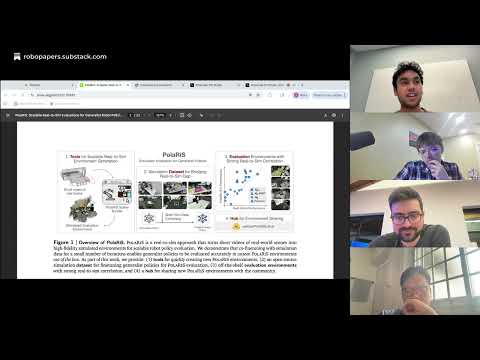
The robotics community is moving beyond task-specific benchmarks towards generalist policy evaluation, mirroring the LLM trend of testing off-the-shelf models on unseen tasks. This demands scalable, high-fidelity simulation tools that can quickly generate diverse test environments.
Builders and researchers should prioritize evaluation tools that offer strong real-to-sim correlation, even if it means a hybrid approach (like PolaRiS) over purely data-driven world models. Utilize real-to-sim environment generation (Gaussian splatting) and strategic sim data co-training to accelerate policy iteration.
PolaRiS offers a path to community-driven, crowdsourced robot benchmarks, making policy development faster and more robust. Expect a future where robot policies are evaluated across a broad suite of easily created, diverse simulated environments, pushing the boundaries of generalization and real-world applicability.
Generalist robot policies need robust, scalable evaluation. The shift is from bespoke, real-world-only testing to a hybrid real-to-sim approach that leverages modern 3D reconstruction and minimal sim data to create highly correlated, reproducible benchmarks.
Builders should adopt PolaRiS's real-to-sim environment generation and "sim co-training" methodology. This allows for rapid, cost-effective iteration on robot policies, ensuring that improvements in simulation translate directly to real-world gains.
Over the next 6-12 months, the ability to quickly and reliably evaluate robot policies in simulation will be a critical differentiator. PolaRiS provides the tools to build diverse, generalization-focused benchmarks, moving robotics closer to the rapid iteration cycles of other AI fields.
Tesla's core identity shifted from EV maker to autonomous AI and robotics. Its cars are devices for deploying its advanced AI brain; competitors miss this.
Tesla's 8 million cars collect real-world driving data. This massive dataset, combined with in-house AI processing, creates an unparalleled moat impossible for competitors to replicate.
This convergence creates an abundance of labor and transportation, driving down costs. Robo-taxis and humanoid robots automate tasks, making goods and services cheaper, even as Tesla's profitability soars.
Robotics is moving towards generalist policies that need broad, diverse evaluation. PolaRiS enables this by making it easy to create and share new, correlated benchmarks, cultivating a community-driven evaluation ecosystem similar to LLMs.
Adopt PolaRiS for rapid policy iteration on pick-and-place and articulated object tasks. Use its browser-based scene builder and existing assets to quickly create new evaluation environments, then fine-tune policies with a small amount of unrelated sim data to boost real-to-sim correlation.
Investing in tools like PolaRiS now means faster development cycles and more reliable policy improvements. This accelerates the path to robust, real-world robot deployment by providing a scalable, trustworthy intermediate testing ground.
PolaRiS enables a shift towards LLM-style generalization benchmarks, where models are tested on unseen environments and tasks, accelerating robot capabilities.
Use its browser-based scene builder and Gaussian splatting to quickly create diverse, real-world correlated evaluation environments, significantly reducing the cost and time of real robot testing.
Cheap, reliable robot policy evaluation in simulation, with strong real-world correlation, means faster development cycles, more robust generalist robots, and a path to crowdsourced, diverse benchmarks that will push the entire field forward.
AI is forcing a fundamental architectural change in automotive, moving from fragmented, rules-based systems to vertically integrated, neural network-powered platforms. This technical reality dictates market survival, favoring companies that control their entire software and hardware stack to build a continuous data flywheel.
Invest in or partner with companies demonstrating deep vertical integration in AI hardware and software for mobility. Prioritize those with a clear path to mass-market data collection and rapid iteration cycles.
Autonomy will be a must-have feature in cars within the next few years. Companies without a software-defined architecture and a vertically integrated AI stack will struggle to compete, creating a market share shift towards those few players who can deliver true self-driving at scale.
The automotive industry is undergoing a fundamental re-architecture, moving from hardware-centric, rules-based systems to software-defined, AI-powered platforms. This shift favors companies with deep vertical integration and proprietary data flywheels.
Invest in companies demonstrating full-stack control over their vehicle's software, hardware, and AI training data. This verticality is the moat against commoditization and the engine for rapid, continuous improvement.
Autonomy will be a non-negotiable feature by 2030, making software-defined vehicles the only viable path for mass-market automakers. Companies that fail to build or acquire this capability will face market irrelevance.
Tesla's core business is AI and autonomous robotics. This means its value comes from its software and data moat, not just vehicle sales.
Tesla is sunsetting Model S and X production to convert factories for humanoid robots. This signals a full commitment to autonomous devices beyond cars.
Unsupervised FSD is expected in select US states by Q2. This will enable cars to operate without human oversight, unlocking the robo-taxi network.
**Value is a Function of Time:** Bitcoin's greatest asset is its 15-year track record. Lasting value isn't about technology alone; it's about a powerful story that withstands the test of time, creating an insulated brand.
**Self-Custody is the Premise:** The entire value proposition of crypto hinges on eliminating counterparty risk. Compromising on self-custody and security for the sake of convenience is a recurring mistake that "always blows up."
**Adoption Will Be Abstracted:** The future of crypto for the masses is one where the complexity is hidden. Centralized user experiences will run on decentralized rails, delivering the benefits of crypto (lower fees, faster settlement) without the unforgiving user experience.
**Stop Gambling, Start Engineering.** The biggest edge isn’t in predicting price but in finding and exploiting structural market inefficiencies. Focus on trades where you can control or heavily influence the outcome, like RFV plays or creating self-fulfilling prophecies in prediction markets.
**Become the Casino.** The crypto market is filled with speculation. By providing liquidity, farming yields, and taking the other side of gamblers (e.g., selling Pendle PTs), you can generate consistent, lower-risk returns. Farmers, on average, outperform directional traders over the long term.
**Alpha Lives in the Weeds.** The most significant opportunities aren’t on the front page of Twitter. They’re buried in obscure Discord servers, complex protocol mechanics (like Aerodrome’s bribes), and emerging platforms with low capital efficiency like Polymarket.
Private Markets Are the New Public: The real unlock for tokenization isn't just 24/7 stock trading—it's bringing high-growth private companies to retail investors, with or without the company's blessing.
The Great Convergence Is Here: The line between a crypto exchange and a stock brokerage is disappearing. Robinhood and its competitors are converging on a single "financial super app" model where all assets live in one place.
Regulation Has Created a Paradox: The current system allows unlimited speculation on assets with zero fundamental value (memecoins) but blocks access to premier private equity. Robinhood is betting this logic won't hold.
Embrace the Friction: The current difficulty of investing in Bittensor subnets is a feature, not a bug. It’s the moat that has suppressed valuations, creating an opportunity akin to buying Bitcoin on Mt. Gox before Coinbase existed.
A 3-6 Month Catalyst Window: The development of bridges and institutional infrastructure is the primary catalyst. This window represents the final moments to gain exposure before capital can flow in easily, likely re-rating the entire ecosystem.
Think Startups, Not Just Tokens: Evaluate subnets like early-stage companies. Use resources like the *Revenue Search* podcast to analyze financials and projects like Shush (AI inference), Score (AI vision), and Quantum (public quantum computing) as real, venture-style bets.
**Don't Panic Sell.** The current market dip is a sign of a healthy "wall of worry," not a cycle top. Historical on-chain indicators show there is significant room to run.
**Follow the Smart Money.** Institutions are aggressively buying this dip. The real capital from pensions and sovereign wealth funds is still on the sidelines, waiting to enter.
**The Fed is Turning Bullish.** A key Federal Reserve official is now openly advocating for crypto adoption within the regulatory apparatus, signaling a major long-term shift in the US.
**The Dollar Isn't Being Debased; It's Deflationary.** The market is not pricing in inflation or debasement. Instead, key indicators like the interest rate swap market are emphatically signaling a future of much lower interest rates for much longer, which is characteristic of deflationary pressure and a strong dollar.
**Asset Booms Are a Symptom, Not a Solution.** Rising stock and crypto prices are not evidence of a healthy economy or money printing. They reflect a K-shaped recovery where capital flees into financial assets as a hedge against systemic fragility, while the real economy for labor remains stagnant.
**The Contrarian Play Is Long Bonds.** If the global system is starved for safe, liquid collateral and headed toward a deflationary recession, the best-performing assets will be long-duration U.S. Treasuries. Snyder’s advice is the polar opposite of the typical crypto portfolio: be long bonds.