The rise of autonomous AI agents will fundamentally reshape the app economy, rendering many single-purpose applications obsolete as agents integrate and automate tasks across systems. This forces companies to either become agent-facing APIs or risk irrelevance.
Cultivate "agent empathy" by understanding how models perceive codebases and problems. This skill, combined with a willingness to experiment and "play," is crucial for effectively guiding agents to build and refactor software.
The agentic AI era demands a shift from traditional programming to a builder mindset, where human creativity and strategic guidance become paramount. Investors should seek platforms enabling this shift, and builders must adapt to a world where natural language is the new code.
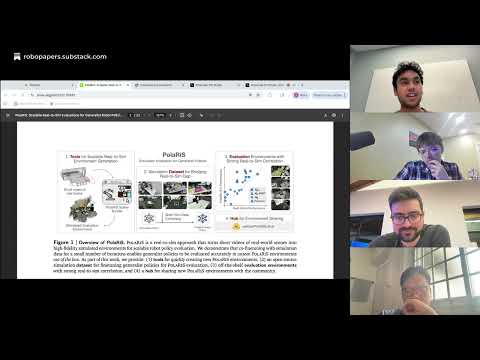
Robotics is moving towards generalist policies, demanding scalable, high-fidelity evaluation tools that mirror the real world, away from task-specific benchmarks.
Adopt PolaRiS for rapid policy iteration and generalization testing, especially for pick-and-place tasks, leveraging easy environment creation and proven real-to-sim correlation.
PolaRiS provides critical infrastructure for accelerating robot learning, enabling builders to quickly validate policies against real-world performance without prohibitive cost.
AI agents are transforming software development from a manual coding craft into an "agentic engineering" discipline, where human builders orchestrate and guide autonomous AI systems. This shift means the value moves from writing boilerplate code to designing agent-friendly architectures and providing high-level strategic direction.
Embrace agentic engineering by learning to "empathize" with AI models, understanding their context limitations, and guiding them with concise, clear prompts. Experiment with open-source agents like OpenClaw to build new tools or automate existing workflows, focusing on the what and why rather than the how.
Personal AI agents will commoditize many existing apps and services, forcing companies to either become agent-facing APIs or risk obsolescence. Investors should identify platforms and infrastructure that enable agent interoperability, while builders should focus on creating agent-native experiences and tools that augment human creativity, rather than replicating existing app functionality.
Robotics is moving beyond isolated tasks to generalist policies, demanding scalable, correlated evaluation methods. This mirrors the LLM world's need for diverse, generalization-focused benchmarks.
Utilize PolaRiS's open-source tools and Hugging Face hub to quickly create and share new evaluation environments. This crowdsourcing approach accelerates community-wide progress in robot policy development.
Investing in tools like PolaRiS that bridge the real-sim gap with high-fidelity visuals and minimal sim co-training is crucial. This enables faster policy iteration and more reliable real-world deployment for the next generation of generalist robots.
The macro shift: Generalist robot policies need generalist evaluation. The shift is from hand-crafted, task-specific sim environments to easily generated, real-world-correlated simulations that test zero-shot generalization, mirroring the rapid benchmark development in LLMs. This allows for a holistic understanding of policy capabilities across diverse, unseen scenarios.
The tactical edge: Adopt PolaRiS for rapid policy iteration. Builders should use its browser-based scene builder and Gaussian Splatting to quickly create new, diverse evaluation environments from real-world scans, then fine-tune policies with small, unrelated sim data to achieve high real-to-sim correlation. This accelerates development cycles and reduces costly real-world testing.
The future of robotics hinges on scalable, trustworthy evaluation. PolaRiS provides a critical tool today to bridge the sim-to-real gap, enabling faster, more reliable development of generalist robot policies. Expect a community-driven explosion of benchmarks, pushing robot capabilities faster than ever over the next 6-12 months.
The robotics community needs to move beyond task-specific benchmarks with provided training data towards a diverse suite of generalization-focused evaluations, mirroring the LLM ecosystem. PolaRiS provides the tools to crowdsource and rapidly deploy these new benchmarks, fostering a more holistic understanding of robot policy capabilities.
For robot policy developers, prioritize tools like PolaRiS that offer high real-to-sim correlation with minimal setup. Leverage its browser-based scene builder and the "visual vaccination" co-training method to quickly iterate on policies for pick-and-place and articulated object tasks, then validate on real hardware.
Scalable, correlated simulation is the missing piece for accelerating generalist robot AI. Over the next 6-12 months, the adoption of tools like PolaRiS will enable faster policy iteration, more robust benchmarking, and ultimately, a quicker path to deploying capable robots in diverse, unstructured environments.
The robotics community is moving from hand-crafted, task-specific simulations to generalist policies that demand scalable, real-world correlated evaluation. PolaRiS enables this by making it cheap and easy to create diverse, high-fidelity sim environments from real scans, allowing for generalization testing akin to LLM benchmarks.
Implement PolaRiS for rapid policy iteration. Use its real-to-sim environment generation and minimal, unrelated sim data co-training to quickly validate robot policies against real-world performance, reducing costly physical robot time.
PolaRiS offers a critical infrastructure upgrade for robot AI development. By providing a fast, reproducible, and highly correlated simulation environment, it allows builders to iterate on generalist robot policies at software speed, significantly de-risking and accelerating the path to real-world deployment and broader robot capabilities over the next 6-12 months.
The drive for generalist robot policies demands scalable, reliable evaluation. PolaRiS pushes robotics toward the community-driven, diverse benchmarking common in LLMs, accelerating the path to truly capable robots.
Adopt PolaRiS for rapid policy iteration and generalization testing. Leverage its easy environment creation and proven real-to-sim correlation to quickly validate new robot behaviors before costly real-world deployment.
PolaRiS is a critical tool for any team building robot policies. It cuts evaluation costs, speeds up development, and provides a trustworthy signal for real-world performance, making it a must-have for your robotics roadmap over the next 6-12 months.
Builders should prioritize hybrid real-to-sim evaluation tools like PolaRiS for rapid policy iteration.
Use minimal, out-of-domain sim data to align policies to the simulation environment, ensuring your sim results accurately predict real-world performance.
Investing in tools that democratize benchmark creation and ensure strong real-to-sim correlation will accelerate robot policy development.
**Value is a Function of Time:** Bitcoin's greatest asset is its 15-year track record. Lasting value isn't about technology alone; it's about a powerful story that withstands the test of time, creating an insulated brand.
**Self-Custody is the Premise:** The entire value proposition of crypto hinges on eliminating counterparty risk. Compromising on self-custody and security for the sake of convenience is a recurring mistake that "always blows up."
**Adoption Will Be Abstracted:** The future of crypto for the masses is one where the complexity is hidden. Centralized user experiences will run on decentralized rails, delivering the benefits of crypto (lower fees, faster settlement) without the unforgiving user experience.
**Stop Gambling, Start Engineering.** The biggest edge isn’t in predicting price but in finding and exploiting structural market inefficiencies. Focus on trades where you can control or heavily influence the outcome, like RFV plays or creating self-fulfilling prophecies in prediction markets.
**Become the Casino.** The crypto market is filled with speculation. By providing liquidity, farming yields, and taking the other side of gamblers (e.g., selling Pendle PTs), you can generate consistent, lower-risk returns. Farmers, on average, outperform directional traders over the long term.
**Alpha Lives in the Weeds.** The most significant opportunities aren’t on the front page of Twitter. They’re buried in obscure Discord servers, complex protocol mechanics (like Aerodrome’s bribes), and emerging platforms with low capital efficiency like Polymarket.
Private Markets Are the New Public: The real unlock for tokenization isn't just 24/7 stock trading—it's bringing high-growth private companies to retail investors, with or without the company's blessing.
The Great Convergence Is Here: The line between a crypto exchange and a stock brokerage is disappearing. Robinhood and its competitors are converging on a single "financial super app" model where all assets live in one place.
Regulation Has Created a Paradox: The current system allows unlimited speculation on assets with zero fundamental value (memecoins) but blocks access to premier private equity. Robinhood is betting this logic won't hold.
Embrace the Friction: The current difficulty of investing in Bittensor subnets is a feature, not a bug. It’s the moat that has suppressed valuations, creating an opportunity akin to buying Bitcoin on Mt. Gox before Coinbase existed.
A 3-6 Month Catalyst Window: The development of bridges and institutional infrastructure is the primary catalyst. This window represents the final moments to gain exposure before capital can flow in easily, likely re-rating the entire ecosystem.
Think Startups, Not Just Tokens: Evaluate subnets like early-stage companies. Use resources like the *Revenue Search* podcast to analyze financials and projects like Shush (AI inference), Score (AI vision), and Quantum (public quantum computing) as real, venture-style bets.
**Don't Panic Sell.** The current market dip is a sign of a healthy "wall of worry," not a cycle top. Historical on-chain indicators show there is significant room to run.
**Follow the Smart Money.** Institutions are aggressively buying this dip. The real capital from pensions and sovereign wealth funds is still on the sidelines, waiting to enter.
**The Fed is Turning Bullish.** A key Federal Reserve official is now openly advocating for crypto adoption within the regulatory apparatus, signaling a major long-term shift in the US.
**The Dollar Isn't Being Debased; It's Deflationary.** The market is not pricing in inflation or debasement. Instead, key indicators like the interest rate swap market are emphatically signaling a future of much lower interest rates for much longer, which is characteristic of deflationary pressure and a strong dollar.
**Asset Booms Are a Symptom, Not a Solution.** Rising stock and crypto prices are not evidence of a healthy economy or money printing. They reflect a K-shaped recovery where capital flees into financial assets as a hedge against systemic fragility, while the real economy for labor remains stagnant.
**The Contrarian Play Is Long Bonds.** If the global system is starved for safe, liquid collateral and headed toward a deflationary recession, the best-performing assets will be long-duration U.S. Treasuries. Snyder’s advice is the polar opposite of the typical crypto portfolio: be long bonds.