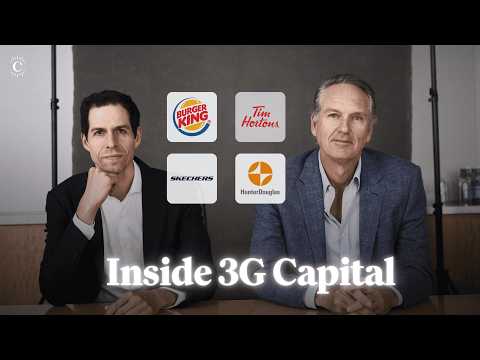
3G commits to one investment per fund, deploying significant house capital alongside partners. This singular focus drives an unparalleled rigor in due diligence and operational execution, because failure isn't an option—it's the only dish.
3G attracts top-tier talent by offering founder-like economics and accelerated responsibility. This creates a meritocracy where young leaders are given significant control and ownership earlier than traditional paths.
3G favors businesses with strong, direct customer relationships and physical assets, like Burger King or Hunter Douglas. These "atoms" businesses are inherently harder for new tech to disintermediate.
As capital markets become more efficient and valuations stretch, the edge shifts from financial engineering to deep operational expertise and a relentless focus on business quality.
Cultivate an owner-operator mindset throughout your organization, aligning incentives from the top down.
In the next 6-12 months, re-evaluate your investment criteria. Focus on businesses with clear customer relationships and robust, non-disruptable core offerings.
As market valuations stretch and technological disruption accelerates, the enduring value of well-moated, customer-centric businesses with strong physical components becomes clearer. 3G's focus on "harder to disrupt atoms" businesses, enhanced by technology, offers a resilient investment thesis.
Cultivate an owner-operator mindset, pushing decision-making closer to problems and aligning incentives with long-term success. Prioritize hiring ambitious young talent and empower them with responsibility, backed by strong mentorship.
In a world obsessed with speed and breadth, 3G Capital reminds us that deep, patient, operator-driven concentration in quality businesses, coupled with a fierce ownership culture, remains a powerful formula for outsized returns. This model builds enduring value, not just short-term gains.
In a market where digital disruption dominates headlines, 3G's success with physical, "atoms" businesses highlights that enduring value often lies in strong brands with direct customer relationships, where operational excellence and long-term thinking create defensible moats against technological fads.
Cultivate an "owner-operator" mindset in your investments and teams. Prioritize businesses with clear, simple value propositions and strong customer ties, then give young, ambitious talent significant ownership and autonomy to drive execution.
The next 6-12 months will reward investors and builders who resist the urge to chase every shiny new object. Instead, focus on fundamental business quality, deep operational involvement, and patient capital deployment in businesses that own their customer relationships. This disciplined approach, though counter-cultural, consistently compounds wealth.
As markets become more volatile and technology accelerates disruption, the traditional diversified portfolio approach faces increasing headwinds. 3G Capital's model signals a shift towards concentrated, operator-led bets on resilient, customer-owning brands with strong unit economics.
Identify businesses with deep moats, direct customer relationships, and long-term growth potential, then instill an owner-operator mindset throughout the organization, empowering young talent with significant equity and autonomy.
In a world of fleeting trends, focusing on fundamental business quality, operational excellence, and a long-term horizon offers a robust strategy for compounding capital, proving that sometimes, less truly is more.
3G commits to one investment per fund. This extreme concentration forces rigorous downside analysis and patience, ensuring capital is deployed only into truly exceptional opportunities.
Leaders are treated as shareholders, not just management. This alignment, often through outsized equity grants, drives decisions that prioritize the business's long-term health and value creation.
3G seeks businesses that own the relationship with their end customers. This direct connection provides a moat against disruption and disintermediation, as seen with brands like Burger King and Hunter Douglas.
The Macro Shift: As digital disruption accelerates, the value of businesses with inherent physical moats and direct customer relationships grows. 3G's focus on these "atoms" businesses, rather than "bits," positions them to capitalize on enduring consumer needs.
The Tactical Edge: Cultivate an owner-operator mindset in your ventures by aligning incentives deeply, empowering young talent, and relentlessly focusing on core business quality. This means prioritizing long-term value creation over short-term financial engineering.
The Bottom Line: In a world obsessed with speed and diversification, 3G Capital's patient, concentrated, and operator-driven model offers a powerful counter-narrative. For investors and builders, this means recognizing that deep, hands-on involvement in a few great businesses can still yield outsized returns, especially when others are chasing the next shiny object.
As technology accelerates disruption, businesses that own the direct customer relationship and operate in "atoms" industries become increasingly resilient.
Cultivate deep, long-term relationships with founders and owners of enduring businesses, positioning yourself as a patient, operator-led partner rather than a short-term financial buyer.
In an environment of stretched valuations and abundant capital, a disciplined, concentrated, and operator-driven approach to acquiring and growing high-quality, customer-owning businesses remains a powerful, albeit rare, path to outsized returns.
The AI infrastructure boom is transitioning from speculative buildouts to financially engineered, risk-managed investments, driven by the commodification of compute and memory.
Evaluate your compute procurement and data center buildout strategies through a financial lens, exploring futures contracts and residual value products to lock in costs and de-risk hardware investments.
The ability to quantify future compute demand and hardware value will be the differentiator for AI infrastructure players over the next 6-12 months, enabling smarter capital deployment and competitive advantage.
**Gold's rally is fundamentally driven.** Falling rates and central bank de-dollarization are creating a powerful tailwind for the precious metal, signaling a major shift in global asset allocation.
**Bitcoin is riding gold's coattails.** As the "digital gold" narrative strengthens, a rising gold price is perceived as a bullish leading indicator for BTC, with investors watching the BTC/Gold market cap ratio as a key metric.
**Your past market experiences are blinding you.** Investors must actively identify and challenge their "childhood curses"—biases formed during previous market cycles—to capitalize on new trends.
**The 10-Minute Rule:** If you’re not in a memecoin launch within the first 10 minutes, you are the exit liquidity. The game is rigged by snipers with privileged information.
**Deception is the Default:** Insiders use sophisticated tactics like one-sided LPs to hide their selling, making it crucial for investors to look beyond simple price charts.
**Self-Policing is the Only Way:** Don't wait for regulators. The crypto community must build its own systems of accountability to expose and sideline repeat offenders.
**Fiscal Is King.** The government, not the Fed, is in the driver's seat. Higher interest rates are now stimulative, as higher interest payments on government debt inject more cash directly into the private sector.
**The Market Is The Economy.** Passive flows have rewired capital allocation, turning the stock market into an automated utility that concentrates wealth in mega-cap companies, making traditional valuation metrics less relevant.
**Invest in Scarcity.** In a world of unlimited fiat currency and financially repressed bond yields, assets with a fixed supply, such as gold and crypto, become critical portfolio components, while traditional fixed income loses its appeal.
Fade the Crowd. Widespread retail despair is a signal of an underexposed market, creating a powerful contrarian buying opportunity.
Macro Is the Driver. Pro-crypto deregulation and future rate cuts are the real forces to watch, not short-term price action.
Alpha Demands Work. The era of easy altcoin gains is over. The new "wealth hack" is to develop deep expertise by embedding yourself in a project's ecosystem.
**Incentives Define the Game:** Arjun’s 10-year compensation plan isn't just a detail; it’s a strategy. It forces long-term thinking and aligns the entire organization around monumental growth targets, a stark contrast to the short-term focus of many public companies.
**Win the "Meaty Middle":** While competitors fight over retail users or institutional whales, Kraken is cornering the market of professional traders. This overlooked segment is the engine of global liquidity and the key to building a durable, high-volume exchange.
**On-Chain IPOs Are Coming:** The future of capital markets is global, on-chain, and permissionless. Traditional companies are already looking to bypass Wall Street for venues like Kraken, signaling a fundamental shift in how businesses access capital.
**The 2:1 Rule for Valuing ETH:** The simplest institutional valuation model correlates ETH's market cap to the value it secures. For every $2 in assets (stablecoins, RWAs) on Ethereum, ETH's value historically grows by $1, providing a clear framework for its future potential.
**Productive Assets Win:** Ether’s ability to generate yield through staking makes it a fundamentally superior treasury reserve asset compared to non-productive alternatives. This allows companies like Sharplink (ESBET) to generate revenue, compound holdings, and attract public market multiples.
**Tokenization Unlocks Trillions:** The shift to on-chain, atomically settled assets will free up tens of trillions in capital currently locked in settlement risk, counterparty risk, and collateral management, creating an overwhelming incentive for institutional adoption on secure networks like Ethereum.