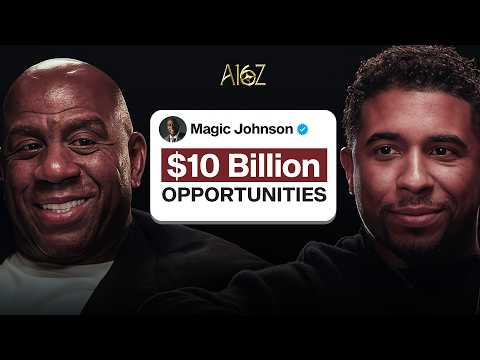
The shift from celebrity endorsements to equity-driven business ownership is accelerating. This is fueled by increased access to capital, sophisticated deal-making networks, and the ability of AI and blockchain tools to enable smaller teams to build billion-dollar companies, fundamentally changing how personal brands translate into lasting enterprise value.
Cultivate a diverse, expert team that can challenge your assumptions and execute your vision, allowing you to scale beyond your individual capacity. Prioritize long-term equity plays and strategic partnerships over short-term cash, even if it means investing in "boring" businesses with consistent growth.
The next 6-12 months will see an explosion of "creator-led" ventures leveraging AI for efficiency and market penetration. Understanding Magic Johnson's blueprint for strategic partnerships, long-term asset appreciation (especially in sports), and disciplined investment in underserved markets provides a high-signal roadmap for identifying and participating in these high-growth opportunities.
The Macro Shift: Celebrity capital is moving from passive endorsements to active equity ownership, mirroring a broader market trend where brand power translates directly into venture influence. This shift is accelerated by AI and blockchain tools, allowing individuals to build and scale businesses with unprecedented efficiency, making strategic capital more potent.
The Tactical Edge: Cultivate "boring" businesses in underserved markets. Magic Johnson's success in urban pharmacies and early-stage sports teams demonstrates that high demand in overlooked sectors, combined with strategic investment in customer experience and analytics, yields outsized returns.
The Bottom Line: The future of wealth creation hinges on long-term equity plays, strategic partnerships, and a willingness to invest in overlooked markets and cutting-edge tech like AI. For investors, this means prioritizing value-add capital and patient growth; for builders, it means leveraging new tools to create businesses that address real, unmet demand.
The field is moving from predicting existing biological structures to generating novel ones, driven by open-source AI models. This transforms biology from an observational science into a design-first engineering discipline, where computational power and accessible tools dictate the pace of innovation.
Invest in platforms that abstract away the computational complexity of molecular design, offering robust, validated generative AI tools and scalable infrastructure. This allows scientists to focus on therapeutic hypotheses, not GPU management, accelerating time to experimental validation.
The next wave of biological breakthroughs will come from those who can rapidly iterate on designed molecules, not just discovered ones. Access to powerful, user-friendly generative AI platforms like Boltz Lab will be a critical differentiator for biotech and pharma in the near future.
Prioritize low-latency, multi-turn interaction models for agentic workflows. Invest in prompt engineering as a core skill, treating it as advanced executive communication to precisely guide AI agents.
The AI industry is moving beyond raw model size as the sole metric of progress. The true frontier is now defined by the efficiency of capability delivery—how quickly, affordably, and contextually a model can perform complex tasks for a user, driven by hardware-software co-design and intelligent data management.
The next 6-12 months will see a bifurcation in AI development: hyper-specialized, low-latency "flash" models for ubiquitous, agent-driven tasks, and ultra-capable "pro" models for deep reasoning, with hardware co-design and multimodal data integration being the key differentiators for sustained competitive advantage.
The shift from transactional endorsements to equity-driven ownership for public figures is accelerating, driven by soaring asset valuations in sports and entertainment, and amplified by new tech that allows for more direct brand building and value creation. This means the "celebrity investor" is no longer a novelty but a strategic force, demanding a different approach to deal flow and value add.
Cultivate a diverse, expert team that can challenge your assumptions and vet opportunities, especially in unfamiliar sectors. Prioritize long-term equity plays over short-term cash, and actively seek out "boring" businesses with consistent growth potential, as these often hide outsized returns.
The future of wealth creation for founders and investors lies in understanding that relationships are capital, equity is king, and a "win-at-all-costs" mentality must extend beyond your core expertise into every business venture. Position yourself to identify and participate in deals that leverage both established industries (like sports) and emerging tech (like AI), recognizing that early entry and strategic partnerships are paramount for exponential growth.
The athlete-investor archetype, pioneered by Magic Johnson, signals a broader trend where personal brand and strategic capital disrupt traditional investment. This shift is accelerated by AI and blockchain, enabling individuals to build billion-dollar enterprises.
Cultivate a "give-first" network by consistently adding value to relationships. Attend industry events early to maximize quality time with key decision-makers.
Long-term wealth creation hinges on disciplined equity ownership, investing in "boring" but essential sectors, and assembling an expert team. This framework is crucial for navigating tech opportunities over the next 6-12 months.
The era of celebrity endorsements is giving way to direct equity ownership and entrepreneurial ventures, as high-profile individuals increasingly seek to build lasting business empires rather than just collect checks. This trend is amplified by new technologies like AI, which lower the barrier to entry for creating and scaling businesses.
Cultivate a powerful network by consistently showing up early to meetings and prioritizing long-term relationships over immediate transactions. Actively seek out "boring" businesses or underserved markets with high demand, as these often yield consistent, outsized returns.
Success in the next 6-12 months hinges on a "win-first" mentality, strategic team building, and a willingness to invest capital into core value drivers. Embrace partnerships and leverage your unique "added value" beyond just capital to secure the best deals and accelerate growth in a rapidly evolving tech and business landscape.
The Macro Shift: Celebrity capital is moving from transactional endorsements to strategic equity ownership, mirroring a broader trend where individuals, powered by AI and blockchain tools, can build high-value companies with leaner teams, making strategic capital more impactful than ever.
The Tactical Edge: Cultivate a network of mentors and partners, prioritize equity in "boring" but high-demand sectors, and be prepared to invest significant capital into improving core product and customer experience.
The era of celebrity endorsements is giving way to a new reality where personal brand power is directly converted into equity ownership and enterprise building, accelerated by accessible tech like AI for rapid business creation.
Cultivate a diverse network through consistent, intentional engagement, and prioritize investments in demand-driven, "boring" businesses that offer long-term growth and opportunities for strategic value addition.
Success in the next decade demands a "win-at-all-costs" mindset, a willingness to invest in operational excellence (including AI and analytics), and a strategic shift from short-term gains to long-term equity and partnership.
Profit, Don't HODL. The current market is a trader’s paradise, not an investor’s dream. The strategy is to ride the seasonal Q4 pump and exit by January, refusing to get caught in another brutal bear cycle.
Fade the Old, Farm the New. Capital is mercenary, flowing from established tokens to the next hot airdrop farm or launch. The relentless hunt for volatility means older coins are treated as exit liquidity for the next shiny object.
Unlocks Are the Silent Killer. Before investing, map out the token unlock schedule. Even fundamentally sound projects with strong revenue face a massive gravitational pull on their price from insider and team unlocks.
**Stablecoins Are Rebranding Crypto.** The FinTech industry is adopting stablecoin technology not as a niche crypto asset, but as the foundational layer for "FinTech 3.0," poised to overhaul global payments.
**The EVM Is The New COBOL.** Specialized payments chains are standardizing the EVM as the backend for modern finance, creating high-throughput, compliant on-ramps that will bring trillions in TradFi volume on-chain.
**Payments Are Just The Beginning.** Once the world rebuilds its payments infrastructure on stablecoins, the floodgates will open for the complete tokenization of all financial assets, forever blurring the line between crypto and finance.
Onchain Rails Create New Economies. By digitizing physical assets on high-performance chains like Solana, you eliminate friction around custody, settlement, and global access, unlocking novel business models like the Gotcha Machine.
Real-World Logistics Are the Ultimate Moat. While anyone can build a smart contract, Collector Crypt’s defensibility comes from its physical supply chain—dealer relationships and automated acquisition tools that secure inventory below market price.
Novel Oracles Unlock the Next Wave of DeFi. The future of onchain finance depends on reliably pricing illiquid, real-world assets. Developing proprietary oracles, like Collector Crypt’s, is the first step to building DeFi for everything.
**De-Risk Your Alts.** Crypto is showing significant weakness by failing to rally with equities. Ethereum's lower high is a major red flag for the altcoin market; it's time to reduce leverage and concentrate into Bitcoin or cash.
**Hunt for Value in TradFi.** Traditional markets are offering powerful narrative-driven plays with crypto-like upside. Focus on assets like Tesla (robotics), Robinhood (gambling culture), and commodities like uranium (energy independence).
**Fade the ETF Narrative.** The institutional "sugar high" from ETFs is wearing off as the front-running trade becomes crowded and inflows wane. The market needs a new, more durable catalyst to move higher.
Subnets are becoming more complex. The introduction of sub-subnets will allow for more sophisticated, multi-faceted incentive mechanisms within a single subnet, effectively turning them into "mixtures of experts."
Performance is now paramount. Subnet deregistration creates a "perform or perish" dynamic. Underperforming subnets risk being automatically removed, with their assets returned to token holders as TAO.
Decentralization is on the horizon. The shift to Proof-of-Stake and a formal on-chain governance structure are actively being developed, marking a deliberate move toward placing control in the hands of the community.
Recessions Are Canceled, Inflation Is Not: Perpetual government stimulus will prevent deep downturns, but it locks in higher inflation. Plan for a ~3% floor and a market that swings between boom and stagflation.
The US Super Cycle Is Over: After a historic 15-year run, US market dominance has peaked. The next decade’s alpha will be found in undervalued international markets benefiting from a weakening dollar.
Build a Debasement-Proof Portfolio: Ditch long-duration bonds. Hold cash for opportunity, stay invested in global equities, and overweight hard assets like gold and crypto to preserve purchasing power.