The Macro Shift: Celebrity capital is moving from transactional endorsements to strategic equity investments, driven by a desire for long-term wealth creation and the recognition that personal brand power can significantly accelerate startup growth.
The Tactical Edge: Cultivate a diverse network of mentors and partners, prioritizing those who bring complementary expertise and can challenge your assumptions.
The Bottom Line: The future of wealth creation for high-profile individuals and savvy investors lies in strategic, long-term equity plays, supported by strong teams and a willingness to partner.
AI agents with system-level access are shifting the core value proposition of software from discrete applications to fluid, context-aware personal assistants.
Cultivate "agent empathy" by learning to guide AI models effectively, understanding their limitations, and designing projects for agent-first navigation.
The rise of autonomous agents will redefine software's purpose and value.
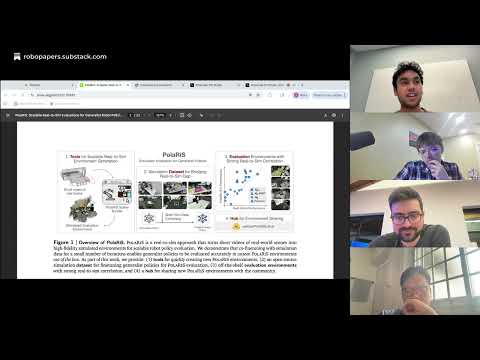
Adopt PolaRiS for rapid policy iteration. Leverage its real-to-sim environment generation and minimal sim data co-training to quickly validate robot policies in diverse, unseen environments before committing to expensive real-world deployments.
The era of generalist robot policies demands a new paradigm for evaluation. The shift is from bespoke, real-world testing to scalable, high-fidelity sim-to-real correlation, enabling faster iteration and broader generalization testing.
Reliable sim-to-real evaluation is the missing link for accelerating robot AI. PolaRiS offers a pragmatic, community-driven path to unlock faster development cycles and more robust generalist robot policies over the next 6-12 months.
Generalist robot policies demand evaluation that tests true generalization across diverse, unseen environments. The shift is from hand-tuned, task-specific benchmarks to scalable, community-driven evaluation suites that can keep pace with rapidly improving model capabilities. This requires tools that make environment creation cheap and ensure real-world predictive power.
Adopt PolaRiS for rapid, correlated policy iteration. Builders should leverage its real-to-sim environment generation (Gaussian splatting for scenes, generative models for objects) and the "sim co-training" trick to quickly validate policy improvements against real-world performance, especially for pick-and-place tasks. Contribute new environments to the Polaris Hub to expand the collective benchmark.
The future of robotics hinges on fast, reliable evaluation. PolaRiS offers a pragmatic, immediate solution to accelerate policy development by providing high-fidelity, correlated sim environments. Over the next 6-12 months, expect this hybrid approach to become a standard for iterating on generalist robot policies, while fully learned world models continue to improve for more complex, deformable tasks.
The push for generalist robot policies demands scalable, trustworthy evaluation. PolaRiS democratizes high-fidelity sim evaluation, moving robotics closer to rapid iteration cycles seen in other AI fields.
Builders should explore PolaRiS's open-source tools and pre-trained checkpoints to quickly test policies in diverse, real-world-correlated environments. Prioritize visual fidelity and use small, unrelated sim data for alignment.
Rapid, reliable sim evaluation with strong real-world correlation is a significant advancement. This tool enables faster policy iteration, broader generalization, and community-driven benchmarking, setting the stage for the next generation of robot capabilities.
Generalist robot policies demand community-driven, scalable evaluation, mirroring LLM benchmarking. PolaRiS provides the technical foundation by making high-fidelity, correlated sim environments accessible.
Adopt PolaRiS for rapid policy iteration. Use its browser-based scene builder and Gaussian splatting for quick environment creation, incorporating minimal, unrelated sim co-training data for strong real-world correlation.
PolaRiS accelerates robot development with a reliable, scalable simulation tool. This means faster iteration, more robust policies, and a clearer path to real-world deployment for your robot applications over the next 6-12 months.
The era of generalist robot policies demands evaluation tools that can keep pace with rapid development and broad generalization. PolaRiS pushes robotics toward the LLM benchmark paradigm, where models are tested on unseen environments and tasks, rather than being trained on specific benchmarks.
For builders, leverage PolaRiS's browser-based scene builder and Gaussian splatting pipeline to quickly create diverse, high-fidelity evaluation environments from real-world scans. This enables faster policy iteration and more reliable real-world deployment.
PolaRiS offers a pragmatic, scalable path to more effective robot policy development. By providing a tool that makes sim performance a reliable predictor of real-world success, it accelerates the journey from lab to real-world application, especially for pick-and-place tasks, and sets the stage for community-driven benchmarking.
Celebrity capital is evolving from passive endorsements to active, strategic equity investment, transforming athletes and entertainers into powerful venture partners who bring more than just money to the table.
Prioritize building a diverse, expert team that can challenge your assumptions and vet opportunities, especially when entering new sectors like AI or overlooked geographic markets.
Long-term thinking, a willingness to invest in growth, and a focus on strategic partnerships are non-negotiable for building lasting wealth and influence in both traditional and emerging industries over the next 6-12 months.
Profit, Don't HODL. The current market is a trader’s paradise, not an investor’s dream. The strategy is to ride the seasonal Q4 pump and exit by January, refusing to get caught in another brutal bear cycle.
Fade the Old, Farm the New. Capital is mercenary, flowing from established tokens to the next hot airdrop farm or launch. The relentless hunt for volatility means older coins are treated as exit liquidity for the next shiny object.
Unlocks Are the Silent Killer. Before investing, map out the token unlock schedule. Even fundamentally sound projects with strong revenue face a massive gravitational pull on their price from insider and team unlocks.
**Stablecoins Are Rebranding Crypto.** The FinTech industry is adopting stablecoin technology not as a niche crypto asset, but as the foundational layer for "FinTech 3.0," poised to overhaul global payments.
**The EVM Is The New COBOL.** Specialized payments chains are standardizing the EVM as the backend for modern finance, creating high-throughput, compliant on-ramps that will bring trillions in TradFi volume on-chain.
**Payments Are Just The Beginning.** Once the world rebuilds its payments infrastructure on stablecoins, the floodgates will open for the complete tokenization of all financial assets, forever blurring the line between crypto and finance.
Onchain Rails Create New Economies. By digitizing physical assets on high-performance chains like Solana, you eliminate friction around custody, settlement, and global access, unlocking novel business models like the Gotcha Machine.
Real-World Logistics Are the Ultimate Moat. While anyone can build a smart contract, Collector Crypt’s defensibility comes from its physical supply chain—dealer relationships and automated acquisition tools that secure inventory below market price.
Novel Oracles Unlock the Next Wave of DeFi. The future of onchain finance depends on reliably pricing illiquid, real-world assets. Developing proprietary oracles, like Collector Crypt’s, is the first step to building DeFi for everything.
**De-Risk Your Alts.** Crypto is showing significant weakness by failing to rally with equities. Ethereum's lower high is a major red flag for the altcoin market; it's time to reduce leverage and concentrate into Bitcoin or cash.
**Hunt for Value in TradFi.** Traditional markets are offering powerful narrative-driven plays with crypto-like upside. Focus on assets like Tesla (robotics), Robinhood (gambling culture), and commodities like uranium (energy independence).
**Fade the ETF Narrative.** The institutional "sugar high" from ETFs is wearing off as the front-running trade becomes crowded and inflows wane. The market needs a new, more durable catalyst to move higher.
Subnets are becoming more complex. The introduction of sub-subnets will allow for more sophisticated, multi-faceted incentive mechanisms within a single subnet, effectively turning them into "mixtures of experts."
Performance is now paramount. Subnet deregistration creates a "perform or perish" dynamic. Underperforming subnets risk being automatically removed, with their assets returned to token holders as TAO.
Decentralization is on the horizon. The shift to Proof-of-Stake and a formal on-chain governance structure are actively being developed, marking a deliberate move toward placing control in the hands of the community.
Recessions Are Canceled, Inflation Is Not: Perpetual government stimulus will prevent deep downturns, but it locks in higher inflation. Plan for a ~3% floor and a market that swings between boom and stagflation.
The US Super Cycle Is Over: After a historic 15-year run, US market dominance has peaked. The next decade’s alpha will be found in undervalued international markets benefiting from a weakening dollar.
Build a Debasement-Proof Portfolio: Ditch long-duration bonds. Hold cash for opportunity, stay invested in global equities, and overweight hard assets like gold and crypto to preserve purchasing power.