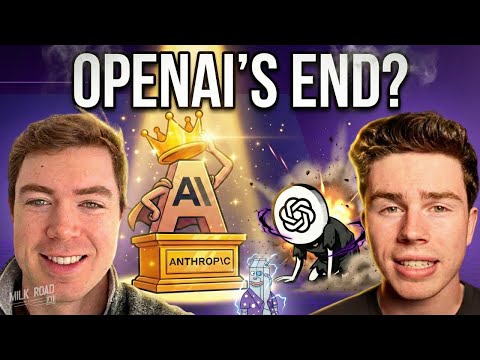
Trillion-dollar AI compute investments create market divergence: immediate monetization (Meta) is rewarded, while slower conversion (Microsoft) faces skepticism, as geopolitical tensions rise over open-source model parity.
Prioritize AI models balancing raw intelligence with superior user experience and collaborative features, as developer loyalty and enterprise adoption increasingly hinge on usability.
The AI landscape is rapidly reordering. Investors and builders must assess monetization pathways, geopolitical implications, and AI's social contract over the next 6-12 months.
The Macro Trend: The transition from opaque scaling to verifiable reasoning.
The Tactical Edge: Audit your models for brittleness by testing them on edge cases that require first principles logic rather than historical data.
The Bottom Line: The next winners in AI will not have the biggest models but the most verifiable ones. If you cannot prove how a model reached a conclusion, you cannot trust it in production.
The transition from more data to better thinking via inference-time compute. Reasoning is becoming a post-training capability rather than a pre-training byproduct.
Use AI for anti-gravity coding to automate bug fixes and data visualization. Treat the model as a passive aura that buffs the productivity of every senior engineer.
AGI will not be a collection of narrow tools but a single model that reasons its way through any domain. The gap between closed labs and open source is widening as these reasoning tricks compound.
The transition from static LLMs to interactive world models marks the move from AI as a tool to AI as a persistent environment.
Monitor the Hugging Face release of the 2B model to build custom image-to-experience wrappers for niche training or spatial entertainment.
Local world models will become the primary interface for spatial computing within the next year, making high-end local compute more valuable than cloud-based streaming.
The Strategic Pivot: The transition from "Understanding-First" science to "Prediction-First" engineering. We are building artifacts that work perfectly but remain theoretically opaque.
The Tactical Edge: Audit your AI stack for "Leaky Abstractions." Don't assume a model's reasoning capabilities in one domain will hold when the underlying causal structure changes.
AGI isn't just an engineering milestone; it's a philosophical wager. If the brain isn't a computer, we are building a very powerful helicopter, not a synthetic human.
The pivot from "Understanding-First" science to "Prediction-First" engineering creates massive technical liability in our models.
Audit your AI implementations for "Leaky Abstractions" where the model fails to account for physical edge cases.
High-performance automation is not the same as sentient reasoning. Builders who recognize this distinction will avoid the cultural illusion of inevitable AGI.
The transition from deterministic software to agentic networks. Companies are moving from rigid workflows to fluid systems that plan and execute autonomously.
Build an internal LLM gateway early. Centralizing model routing and cost monitoring allows you to swap providers as the model horse race changes without refactoring your product.
AI is not just a feature but a fundamental restructuring of the corporate cost center. Efficiency gains allow a static headcount of 300 engineers to support a business growing 5x.
The shift from centralized AI development to decentralized, incentive-driven networks like Bittensor demands a rigorous focus on economic mechanism design. The core challenge is translating a desired AI capability into a quantifiable, ungameable benchmark that ensures genuine progress, not just benchmark-specific optimization.
Prioritize benchmark design and transparency. Builders should immediately define a precise, copy-resistant, and low-variance benchmark, then launch on mainnet quickly with open-source validator code.
Over the next 6-12 months, the subnets that win will be those that master incentive alignment through robust, transparent benchmarking and rapid, mainnet-first iteration. Investors should look for subnets demonstrating clear auditability and a willingness to confront and fix miner exploits openly, as these indicate long-term viability and genuine progress towards their stated AI goals.
The industry is undergoing a forced re-alignment, moving from a broad "world computer" vision to a focused "financial utility machine" reality. This means capital and talent are increasingly flowing to projects that deliver tangible financial value and robust infrastructure.
Prioritize projects building core financial primitives, robust L1/L2 infrastructure, or those leveraging AI for financial automation. Investigate prediction market platforms and their regulatory positioning, as they represent a proven, high-growth revenue stream.
The current market downturn is a cleansing fire, forcing crypto to shed non-viable narratives and double down on its core strength: programmable finance. Success will accrue to those who build for financial utility and AI-driven users, not just human consumers.
The pursuit of optimal market microstructure is driving a wedge between L1s and specialized execution environments, forcing L1s like Solana to either adapt their core protocol or risk losing high-value DeFi activity to custom solutions.
Monitor Solana's validator stake distribution for Jito's BAM and Harmonic, as increasing adoption of MEV-mitigating clients will directly impact onchain trading profitability and the viability of sophisticated DeFi applications.
Solana's ability to scale throughput and implement protocol-enforced MEV solutions will determine if it can reclaim its position as the preferred L1 for high-frequency DeFi, or if specialized applications will continue to build off-chain, fragmenting the ecosystem.