AI is transforming software development from manual coding to agent orchestration, making "building" accessible to anyone with an idea and language. This fundamentally reconfigures the value of traditional programming skills and the entire app economy.
Invest in or build tools that prioritize agent-friendly APIs and CLI interfaces over traditional graphical user interfaces. Future value will accrue to services that seamlessly integrate into an agent's workflow, not just human-facing apps.
Personal AI agents are not just a new tool; they are a new operating system. Expect rapid shifts in user behavior and market demand, favoring platforms and services that empower autonomous AI, making now the time to adapt or be left behind.
AI agents are moving beyond language to autonomous action, fundamentally altering how software is built and consumed. This shift gives individuals the power to create complex systems with natural language, but also demands a new level of security awareness and critical thinking from users.
Embrace agentic engineering by focusing on clear communication and context provision rather than rigid coding. Experiment with open-source agents like OpenClaw to understand their capabilities and limitations firsthand.
The future of software is agent-centric. Investors should eye companies building agent-facing APIs or infrastructure, while builders must adapt their skills to "lead" AI teams. Ignoring this shift means missing the next wave of digital transformation.
The digital world moves from discrete apps to an integrated, agent-orchestrated OS, shifting value to platforms enabling seamless agent interaction.
Builders must pivot to "agentic engineering," focusing on guiding and designing systems for AI agents, mastering prompt engineering and CLI-based tool integration.
Personal AI agents will reshape software and productivity over the next 6-12 months. Investors should back agent infrastructure/API-first services; developers must embrace agent collaboration.
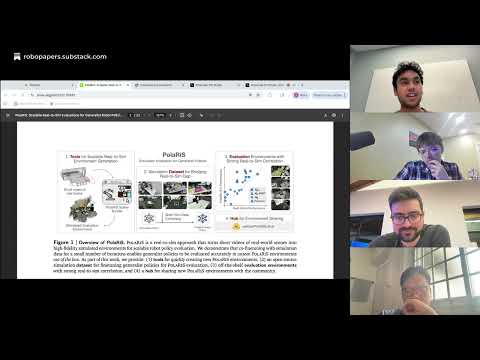
The push for generalist robot policies, akin to foundation models in other AI domains, demands evaluation tools that scale and generalize. PolaRiS directly addresses this by providing a framework for creating diverse, real-world correlated benchmarks, moving robotics beyond task-specific, overfitting evaluations towards true zero-shot generalization testing.
Implement PolaRiS's real-to-sim environment generation and "sim co-training" methodology. This allows for rapid, cost-effective iteration on robot policies with high confidence that improvements in simulation will translate to real-world gains, significantly accelerating development cycles.
For builders and investors, PolaRiS represents a critical infrastructure upgrade for robotics. It de-risks policy development by providing a reliable, scalable testing ground, making the path to deployable, generalist robots faster and more capital-efficient over the next 6-12 months.
The era of "agentic engineering" is here, moving software creation from explicit, line-by-line coding to high-level guidance of autonomous AI agents.
Experiment with agentic workflows now. Set up a local OpenClaw instance, even with free models, and use it to automate tedious tasks or prototype ideas.
Personal AI agents with system-level access are not just productivity tools; they are a new operating system layer that will consume and redefine existing applications.
Invest in companies demonstrating deep vertical integration in AI, custom silicon, and software-defined vehicle architectures. Prioritize those building proprietary data flywheels from large, active fleets.
The automotive industry is undergoing a fundamental re-architecture, moving from hardware-centric, domain-based systems to software-defined, AI-powered platforms. This shift will consolidate market power among vertically integrated players who control their data, compute, and software stack.
Autonomy will be a must-have feature by 2030, akin to airbags today. Companies without a robust, in-house, neural-net-based autonomy strategy and a software-defined architecture will struggle to compete at scale, leading to significant market share shifts in the coming years.
The shift from explicit coding to agentic orchestration means human creativity moves up the stack. Instead of writing every line, builders define intent, guide agents, and curate outcomes, making software creation more accessible and focused on problem-solving.
Invest in understanding agent-native design patterns. Prioritize building CLI-first tools and services that expose clear, composable interfaces, as these will be the foundational blocks for the next generation of AI-driven applications, making your products "agent-friendly" and future-proof.
Personal AI agents are not just productivity tools; they are a new operating system layer. Over the next 6-12 months, expect a rapid re-evaluation of traditional app value, a surge in agent-first infrastructure, and a critical need for robust, user-centric security frameworks as AI moves from language to action, directly impacting your digital strategy and investment thesis.
The rise of autonomous AI agents with system-level access is fundamentally reshaping the software landscape, moving value from traditional app interfaces to underlying APIs and data, and making building accessible for non-programmers.
Invest in infrastructure and tooling that facilitates agent-to-agent communication and robust CLI-based skill development, as this will be the new battleground for software functionality and integration.
The next 6-12 months will see increased adoption of agentic workflows, compelling companies to re-evaluate their product strategies towards API-first designs and human-centric "delight" to stay relevant as AI agents handle most functional tasks.
Hard Assets Are The Only Exit. Governments must monetize their staggering debt, making monetary inflation hedges like gold and crypto essential. Gold’s recent surge is the canary in the coal mine, signaling a major catch-up move for Bitcoin is imminent.
Forget the Trade War; Watch the Capital War. The real global conflict is financial. The US is building its future on digital dollars (stablecoins), while China is anchoring its system to gold. This divergence will define capital flows for the next decade.
The Bitcoin 4-Year Cycle Is Dead. Treat Bitcoin as a global macro asset driven by liquidity and its relationship with gold. Its recent price consolidation is a sign of distribution from old hands to new institutional players, setting the stage for its next major move.
Utility Trumps Scarcity: The most valuable crypto asset will be the one powering the most economic activity, not simply the one with the most predictable supply.
Solana’s Technical Roadmap is Key: A future state with multiple concurrent block producers will give Solana a decisive advantage in censorship resistance and performance over its rivals.
Bet on SOL to Flip BTC: Samani’s core investment thesis is that as Solana’s real-world adoption becomes undeniable over the next decade, SOL is positioned to become the world’s number one crypto asset.
Consolidation is Coming: The recent retail wipeout will likely funnel capital into higher-quality assets, with Bitcoin positioned to front-run altcoins in a reversal of typical bull market cycles.
Reframe Debasement as Purification: The simultaneous rise of gold and Bitcoin isn't just a hedge; it's a fundamental repricing of value and a cleansing of a broken financial system, driven by geopolitical strategy.
DATs are Not ETFs: Digital Asset Treasuries offer an active approach to crypto exposure, with smaller players uniquely positioned to capture on-chain alpha that is impossible for mega-holders to access.
**The Game Has Changed.** Stop trying to win by spot-buying overvalued altcoins in a market dominated by insiders. The real, sustainable edge is found on-chain through airdrop farming, which allows you to acquire tokens at a low cost basis and sell them to market hype.
**Become an All-Weather Farmer.** Structure your portfolio defensively. A 50%+ stablecoin allocation is not being sidelined; it's a dry powder reserve that allows you to farm, hedge, and survive while others get wiped out. Your upside comes from farming, not from being 100% long.
**Airdrops Are Your Asymmetric Bet.** Treat airdrop points as a call option on the entire crypto market. This allows you to stay risk-off with a large stablecoin position while retaining explosive upside potential if the market runs, creating a win-win scenario.
The Crash Was Technical, Not Existential: This wasn't another Luna. It was a liquidity-driven cascade originating from centralized exchanges that wiped out leveraged retail, while DeFi infrastructure proved its mettle. The fundamental bull case remains intact.
Bitcoin is a Different Animal: The stark performance divergence between a resilient Bitcoin and collapsing altcoins is the clearest signal yet that BTC now plays in a different, institutionalized league. The speculative fervor in "useless alts" is dead for the foreseeable future.
Institutions Are Buying the Debasement Story, Not the Dip: Professional investors, insulated by ETFs, completely missed the weekend's volatility. Their focus is unchanged: allocating more capital (now 3-5%) to the "purification trade" as a hedge against unstoppable fiat debasement.
Supply Shock Imminent: Corporate ETH accumulation is happening faster and with greater relative market impact than Bitcoin's history, creating a coiled spring for price.
The Stage is Set: Profit-taking from old holders is complete, hype has died down, and leverage has been wiped out. The path of least resistance for ETH is now up.
Follow the Smart Money: ETH is not just a crypto play; it's a macro-correlated, high-beta bet endorsed by some of the world's sharpest investors.