Demand for provably correct systems in hardware, software, and critical infrastructure creates a massive market for formal verification. AI scales these human-bottlenecked processes.
Investigate formal verification tools for high-stakes codebases or chip designs. Prioritize solutions combining probabilistic generation with deterministic proof for speed and reliability.
"Good enough" code is ending for critical applications. AI-driven formal verification is a commercial imperative, redefining development cycles and trust.
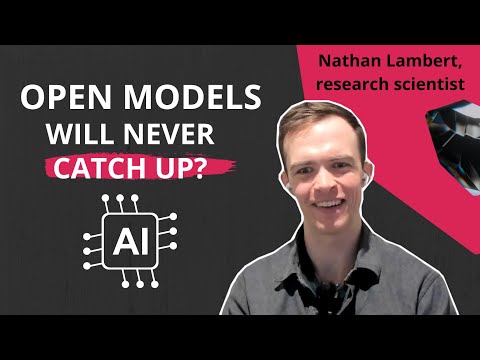
The macro shift: Geopolitical competition in AI is not just about raw model power; it is about who controls the foundational research and development platforms. Open models are the battleground for long-term national AI sovereignty.
The tactical edge: Invest in open model research and infrastructure, particularly in post-training environments and high-quality data generation. This builds a resilient, transparent AI ecosystem that can adapt and innovate independently.
The bottom line: The US must prioritize open model development now to secure its position as a global AI leader, foster domestic innovation, and provide accessible AI options for a diverse global user base over the next 6-12 months.
The convergence of AI and immersive computing is pushing towards a "HoloDeck" future. Roblox's vector-based data storage of 13 billion monthly hours provides unprecedented training data for agentic NPCs and real-time world generation, fundamentally changing how virtual worlds are built and experienced.
Invest in platforms that offer cloud-native, AI-accelerated creation tools and robust multiplayer synchronization. Prioritize those building on rich, proprietary 3D interaction data for superior AI agent training.
The future of digital interaction is 4D, photorealistic, and AI-driven. Companies with a clear, long-term vision paired with rapid, cloud-connected iteration will capture the next wave of virtual co-experience, making them prime targets for investment and partnership over the next 6-12 months.
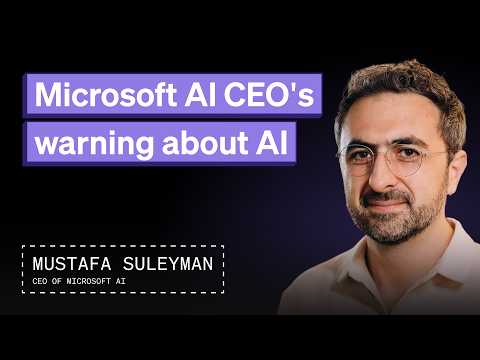
The exponential reduction in the cost of intelligence is transforming AI from a mere tool into a "hyperobject" with quasi-human capabilities, forcing society to adapt from a scarcity-based operating system to one of intelligence abundance.
Cultivate "AI muscle" by actively experimenting with AI tools, understanding their capabilities and limitations, and pushing their boundaries. This hands-on engagement is the best inoculation against "AI psychosis" and prepares you for a world where AI is ubiquitous.
AI's rapid proliferation and increasing autonomy demand immediate, collective action from governments, companies, and individuals to establish clear boundaries and ensure human control. Ignoring this "fourth class" of being risks societal instability and the erosion of human agency over the next 6-12 months.
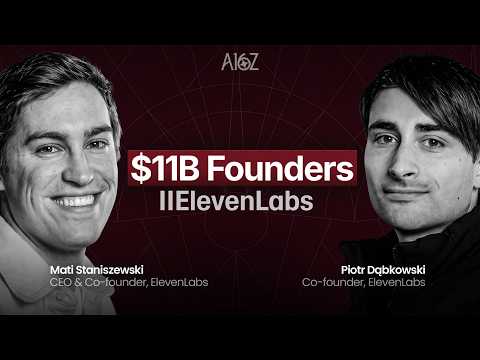
The computing paradigm is shifting from visual-centric to auditory-first, driven by AI's ability to process raw audio data for emotional depth and contextual understanding. This opens new frontiers for immersive experiences and global communication.
Invest in or build solutions that prioritize raw audio data processing and multimodal AI integration. Focus on applications where emotional nuance and natural interaction create a distinct user experience.
Voice AI, particularly with ElevenLabs' approach to emotional intelligence, is not just an incremental improvement; it is a foundational shift that will redefine human-computer interaction and unlock massive markets in education, entertainment, and global connectivity over the next 6-12 months.
AI's memory demands invert data center design, moving from storage-first to memory-first. High-speed networks and NVMe flash are now core memory tiers.
Fund software-defined memory solutions like WEKA's Axon and Augmented Memory Grid. These convert existing NVMe drives into high-performance context memory.
Persistent, rapid KV cache access through "Token Warehouses" will determine AI application and agent deployment profitability over the next 6-12 months.
AI is moving from opaque, data-driven systems to transparent, intentionally designed agents. This shift is driven by the need for reliability, safety, and the ability to extract novel insights from increasingly powerful models.
Invest in tools and research that provide granular control over AI internals, like Goodfire's platform. This enables precise customization, reduces unintended behaviors, and accelerates scientific discovery in critical domains.
The future of AI isn't just about bigger models; it's about smarter, more controllable ones. Understanding and directly influencing AI's "mind" will be a competitive differentiator and a prerequisite for deploying AI in high-stakes, real-world applications over the next 6-12 months.
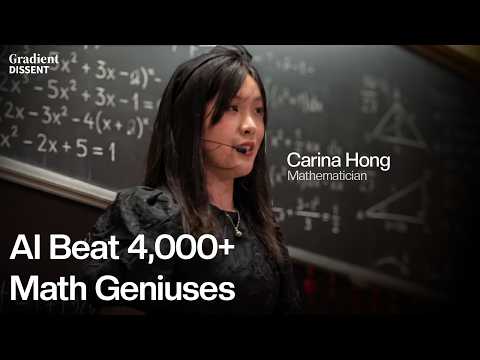
The era of "good enough" probabilistic AI for critical systems is ending; the market demands provable correctness. Axiom Math's approach signals a return to formal methods, supercharged by AI, addressing the verification bottleneck in software and hardware.
Investigate formal verification tools for safety-critical code generation, hardware design, and legacy code migration. Prioritize solutions combining AI generation with deterministic proof for speed and certainty.
Formally verifying complex systems with AI will redefine trust in software and hardware. Companies integrating these capabilities gain a competitive advantage, reducing bugs, accelerating development, and meeting regulatory demands over the next 6-12 months.
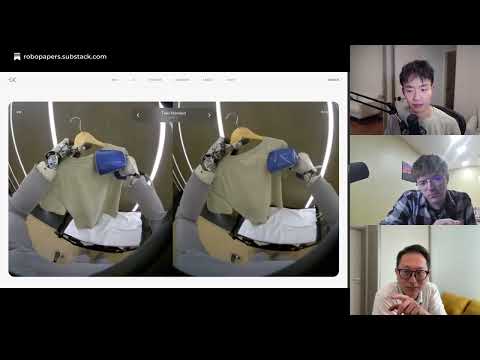
The scaling laws seen in large language and video models are now extending to physical robotics. Internet-scale human video data, combined with humanoid morphology, is creating a new paradigm for robot generalization.
Invest in or build systems that prioritize multi-stage data pipelines, especially those incorporating diverse egocentric data. This approach is proving key to unlocking zero-shot capabilities in physical AI.
World models are not just a research curiosity; they are a practical tool for accelerating robot deployment. Their ability to generalize and act as learned simulators will redefine how robots are trained, tested, and ultimately integrated into our daily lives over the next 6-12 months.
Hard Assets Are The Only Exit. Governments must monetize their staggering debt, making monetary inflation hedges like gold and crypto essential. Gold’s recent surge is the canary in the coal mine, signaling a major catch-up move for Bitcoin is imminent.
Forget the Trade War; Watch the Capital War. The real global conflict is financial. The US is building its future on digital dollars (stablecoins), while China is anchoring its system to gold. This divergence will define capital flows for the next decade.
The Bitcoin 4-Year Cycle Is Dead. Treat Bitcoin as a global macro asset driven by liquidity and its relationship with gold. Its recent price consolidation is a sign of distribution from old hands to new institutional players, setting the stage for its next major move.
Utility Trumps Scarcity: The most valuable crypto asset will be the one powering the most economic activity, not simply the one with the most predictable supply.
Solana’s Technical Roadmap is Key: A future state with multiple concurrent block producers will give Solana a decisive advantage in censorship resistance and performance over its rivals.
Bet on SOL to Flip BTC: Samani’s core investment thesis is that as Solana’s real-world adoption becomes undeniable over the next decade, SOL is positioned to become the world’s number one crypto asset.
Consolidation is Coming: The recent retail wipeout will likely funnel capital into higher-quality assets, with Bitcoin positioned to front-run altcoins in a reversal of typical bull market cycles.
Reframe Debasement as Purification: The simultaneous rise of gold and Bitcoin isn't just a hedge; it's a fundamental repricing of value and a cleansing of a broken financial system, driven by geopolitical strategy.
DATs are Not ETFs: Digital Asset Treasuries offer an active approach to crypto exposure, with smaller players uniquely positioned to capture on-chain alpha that is impossible for mega-holders to access.
**The Game Has Changed.** Stop trying to win by spot-buying overvalued altcoins in a market dominated by insiders. The real, sustainable edge is found on-chain through airdrop farming, which allows you to acquire tokens at a low cost basis and sell them to market hype.
**Become an All-Weather Farmer.** Structure your portfolio defensively. A 50%+ stablecoin allocation is not being sidelined; it's a dry powder reserve that allows you to farm, hedge, and survive while others get wiped out. Your upside comes from farming, not from being 100% long.
**Airdrops Are Your Asymmetric Bet.** Treat airdrop points as a call option on the entire crypto market. This allows you to stay risk-off with a large stablecoin position while retaining explosive upside potential if the market runs, creating a win-win scenario.
The Crash Was Technical, Not Existential: This wasn't another Luna. It was a liquidity-driven cascade originating from centralized exchanges that wiped out leveraged retail, while DeFi infrastructure proved its mettle. The fundamental bull case remains intact.
Bitcoin is a Different Animal: The stark performance divergence between a resilient Bitcoin and collapsing altcoins is the clearest signal yet that BTC now plays in a different, institutionalized league. The speculative fervor in "useless alts" is dead for the foreseeable future.
Institutions Are Buying the Debasement Story, Not the Dip: Professional investors, insulated by ETFs, completely missed the weekend's volatility. Their focus is unchanged: allocating more capital (now 3-5%) to the "purification trade" as a hedge against unstoppable fiat debasement.
Supply Shock Imminent: Corporate ETH accumulation is happening faster and with greater relative market impact than Bitcoin's history, creating a coiled spring for price.
The Stage is Set: Profit-taking from old holders is complete, hype has died down, and leverage has been wiped out. The path of least resistance for ETH is now up.
Follow the Smart Money: ETH is not just a crypto play; it's a macro-correlated, high-beta bet endorsed by some of the world's sharpest investors.