The Macro Shift: In an era of rapid technological disruption and diversified portfolios, 3G Capital's success with "old economy" brands highlights the enduring power of deep operational expertise, long-term alignment, and a relentless focus on fundamental business quality, even in non-tech sectors.
The Tactical Edge: Cultivate Ownership: Implement incentive structures that align management with long-term shareholder value, treating company capital as personal capital. This means disproportionately rewarding top performers and fostering a culture of accountability.
The Bottom Line: In a market obsessed with rapid tech cycles, 3G's long-term, deep-operator model suggests that enduring value lies in fundamental business quality, direct customer relationships, and a culture that empowers talent, offering a counter-narrative for builders and investors seeking sustainable alpha.
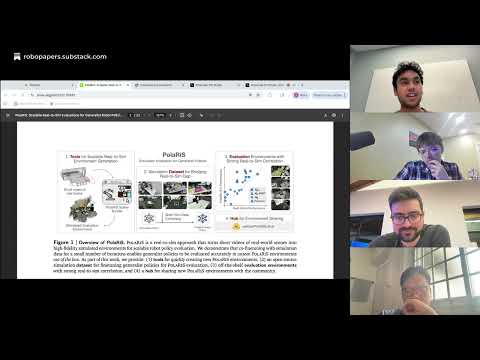
The robotics community is moving from bespoke, task-specific benchmarks to generalist policy evaluation platforms that prioritize real-world correlation and scalability. This mirrors LLM benchmark evolution, demanding tools that enable rapid, diverse testing.
Builders and researchers should prioritize evaluation frameworks that offer easy, real-to-sim environment generation (like PolaRiS's Gaussian splatting) and incorporate small, diverse sim data for distribution alignment. This accelerates policy iteration and ensures applicability.
Scalable, real-world-correlated simulation is the missing link for accelerating generalist robot policy development. Investing in or building on tools like PolaRiS, which democratize environment creation and robust evaluation, will be key to unlocking the next generation of capable robots over the next 6-12 months.
The rise of generalist robot policies demands a new generation of evaluation tools that are both scalable and highly correlated with real-world performance.
Adopt hybrid real-to-sim evaluation frameworks like PolaRiS to accelerate robot policy iteration and ensure real-world applicability.
Reliable, scalable simulation is no longer a pipe dream; it's a present reality for rigid body tasks. This means faster development cycles and more robust robot policies in the next 6-12 months.
The rise of generalist robot policies, trained on large real-world datasets, demands a new evaluation framework. PolaRiS provides a scalable, real-world correlated simulation, moving robotics towards an LLM-like benchmark ecosystem where models are tested for zero-shot generalization across diverse, easily created environments.
Adopt PolaRiS to rapidly iterate on robot policies. Leverage its real-to-sim environment generation and minimal sim-code training to achieve high correlation with real-world performance, significantly cutting development time and cost compared to physical testing.
For builders and investors, PolaRiS means faster, cheaper, and more reliable robot policy development. This tool accelerates the path to deployable, generalist robots, making advanced robotics more accessible and competitive in the next 6-12 months.
The push for generalist robot policies, akin to foundation models in other AI fields, necessitates a shift from bespoke, real-world-only evaluations to scalable, correlated simulation benchmarks.
Adopt PolaRiS for faster policy iteration. Integrate small, diverse sets of *unrelated* sim data into your co-training mix to significantly boost real-to-sim correlation.
Robotics is moving towards LLM-style benchmarking.
While the market obsesses over "bits" and rapid tech disruption, 3G Capital demonstrates that enduring value often resides in "atoms"—physical businesses with strong brands and direct customer relationships. This highlights a counter-cyclical opportunity in overlooked, tangible assets.
Cultivate an owner-operator mentality in your ventures. Focus on attracting and empowering top talent with significant equity, then decentralize execution while maintaining clear strategic alignment.
In the next 6-12 months, prioritize investments in businesses with defensible customer relationships and clear, long-term growth runways, even if they appear "boring." Your ability to instill a true ownership culture will be a differentiator, driving outsized returns where others chase fleeting trends.
In a world where capital is abundant but truly great businesses are rare and often overpriced, 3G's model highlights a strategic pivot: deep, operator-led concentration on defensible, customer-centric assets with long-term growth potential, rather than broad, passive diversification.
Cultivate an "owner operator" mindset within your organization, pushing decision-making closer to the problems and aligning incentives with long-term shareholder value, not just short-term metrics.
Over the next 6-12 months, focus on identifying businesses with strong, direct customer relationships and inherent resistance to technological disruption. These "forever businesses," often family-controlled, offer a more reliable path to compounding returns than pursuing fleeting trends or commoditized assets.
The Macro Shift: In an era of rapid technological change, businesses with strong, direct customer relationships and physical moats are increasingly resilient. Technology should improve, not replace, core offerings.
The Tactical Edge: Cultivate a "brand bigger than the business" mindset. Seek out established brands with global recognition but underperforming operations, then apply rigorous, owner-operator principles to create latent value and growth.
The Bottom Line: Long-term thinking and a relentless focus on people and business quality, even in a concentrated portfolio, remain the most powerful engines for compounding capital. This means patience, deep operational involvement, and a willingness to bet big on exceptional talent.
Hard Assets Are The Only Exit. Governments must monetize their staggering debt, making monetary inflation hedges like gold and crypto essential. Gold’s recent surge is the canary in the coal mine, signaling a major catch-up move for Bitcoin is imminent.
Forget the Trade War; Watch the Capital War. The real global conflict is financial. The US is building its future on digital dollars (stablecoins), while China is anchoring its system to gold. This divergence will define capital flows for the next decade.
The Bitcoin 4-Year Cycle Is Dead. Treat Bitcoin as a global macro asset driven by liquidity and its relationship with gold. Its recent price consolidation is a sign of distribution from old hands to new institutional players, setting the stage for its next major move.
Utility Trumps Scarcity: The most valuable crypto asset will be the one powering the most economic activity, not simply the one with the most predictable supply.
Solana’s Technical Roadmap is Key: A future state with multiple concurrent block producers will give Solana a decisive advantage in censorship resistance and performance over its rivals.
Bet on SOL to Flip BTC: Samani’s core investment thesis is that as Solana’s real-world adoption becomes undeniable over the next decade, SOL is positioned to become the world’s number one crypto asset.
Consolidation is Coming: The recent retail wipeout will likely funnel capital into higher-quality assets, with Bitcoin positioned to front-run altcoins in a reversal of typical bull market cycles.
Reframe Debasement as Purification: The simultaneous rise of gold and Bitcoin isn't just a hedge; it's a fundamental repricing of value and a cleansing of a broken financial system, driven by geopolitical strategy.
DATs are Not ETFs: Digital Asset Treasuries offer an active approach to crypto exposure, with smaller players uniquely positioned to capture on-chain alpha that is impossible for mega-holders to access.
**The Game Has Changed.** Stop trying to win by spot-buying overvalued altcoins in a market dominated by insiders. The real, sustainable edge is found on-chain through airdrop farming, which allows you to acquire tokens at a low cost basis and sell them to market hype.
**Become an All-Weather Farmer.** Structure your portfolio defensively. A 50%+ stablecoin allocation is not being sidelined; it's a dry powder reserve that allows you to farm, hedge, and survive while others get wiped out. Your upside comes from farming, not from being 100% long.
**Airdrops Are Your Asymmetric Bet.** Treat airdrop points as a call option on the entire crypto market. This allows you to stay risk-off with a large stablecoin position while retaining explosive upside potential if the market runs, creating a win-win scenario.
The Crash Was Technical, Not Existential: This wasn't another Luna. It was a liquidity-driven cascade originating from centralized exchanges that wiped out leveraged retail, while DeFi infrastructure proved its mettle. The fundamental bull case remains intact.
Bitcoin is a Different Animal: The stark performance divergence between a resilient Bitcoin and collapsing altcoins is the clearest signal yet that BTC now plays in a different, institutionalized league. The speculative fervor in "useless alts" is dead for the foreseeable future.
Institutions Are Buying the Debasement Story, Not the Dip: Professional investors, insulated by ETFs, completely missed the weekend's volatility. Their focus is unchanged: allocating more capital (now 3-5%) to the "purification trade" as a hedge against unstoppable fiat debasement.
Supply Shock Imminent: Corporate ETH accumulation is happening faster and with greater relative market impact than Bitcoin's history, creating a coiled spring for price.
The Stage is Set: Profit-taking from old holders is complete, hype has died down, and leverage has been wiped out. The path of least resistance for ETH is now up.
Follow the Smart Money: ETH is not just a crypto play; it's a macro-correlated, high-beta bet endorsed by some of the world's sharpest investors.