The digital experience economy is moving from static content to dynamic, AI-driven co-experience platforms, where user interaction data becomes the core asset for training next-generation virtual intelligence.
Invest in platforms that offer robust, cloud-connected infrastructure and proprietary, vectorized user data for AI training, as these will be the engines for future immersive content and agentic AI development.
Roblox's long-term vision, powered by its unique data moat and AI investments, positions it to define the future of virtual co-experience, making it a critical player to watch for investors and builders in the AI and gaming space over the next 6-12 months.
The exponential reduction in the cost of intelligence, coupled with open-source proliferation, is pushing AI into every corner of society, creating a collective action problem where market incentives for "engaging" AI clash with the need for societal safety and control.
Get hands-on with AI now. "Vibe coding" and actively experimenting with AI tools builds "AI muscle," inoculating users against psychosis risks and building a deeper understanding of AI's capabilities and limitations.
AI is here to stay and will redefine work and interaction. Understanding its "hyperobject" nature, advocating for clear regulatory boundaries, and actively engaging with the technology are critical for navigating the near future without falling for its simulated charms.
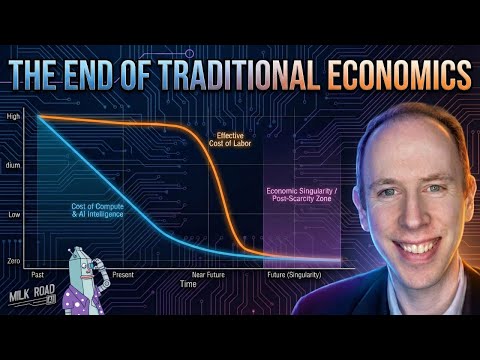
AI-driven hyperdeflation will fundamentally alter economic structures, leading to a post-scarcity future where the primary challenge shifts from production to distribution and the integration of human and machine economies.
Invest in infrastructure that bridges human and AI economies, or prepare for a future where AI agents become a significant, crypto-native economic force.
The next 6-12 months will see continued acceleration of AI capabilities, pushing us closer to a future where traditional labor and intelligence are nearly free. Understanding this change is crucial for navigating the emerging economic landscape and identifying new value creation opportunities.
The era of opaque, black-box AI is ending; the future demands intentionally designed models with human understanding and control. This shift is driven by reliability in high-stakes applications and extracting novel insights.
Investigate interpretability tools (like Goodfire's platform) to gain granular control over model behavior, moving beyond basic fine-tuning for critical applications.
Interpretability is not a niche; it's the missing piece for scaling AI safely into mission-critical domains. Mastering model understanding and intentional design will yield unprecedented capabilities and competitive advantage.
Robotics is moving from bespoke, data-hungry behavior cloning to generalized, human-informed learning via world models. This shift, mirroring the success of LLMs, means robots can use the vast, unstructured data of human experience to acquire new skills.
Invest in platforms and data pipelines that facilitate multi-modal, multi-stage training for humanoid robots. Prioritize systems that can generate synthetic data and use world models for high-throughput, targeted policy evaluation.
World models are the engine for scalable robot intelligence. They promise a future where robots learn faster, generalize wider, and self-improve through iterative simulation, making widespread humanoid deployment a near-term reality.
The Macro Shift: AI is collapsing the time horizon for technological deployment and market dominance, shifting the competitive advantage from pure innovation to a combination of innovation, capital, and rapid infrastructure deployment.
The Tactical Edge: Invest in companies that are not just building AI, but are fundamentally rethinking existing industries with AI-first principles, recognizing that traditional software moats are eroding.
The Bottom Line: The next 12-24 months will see AI's broad impact kick in, creating unprecedented opportunities for those who understand its new "laws of physics" and the critical role of policy in shaping its trajectory.
The healthcare system is moving from reactive, acute care to proactive, preventative interventions, driven by the unsustainable costs of chronic disease and a growing understanding of environmental health.
Build infrastructure that financially incentivizes lifestyle interventions, such as TrueMed's HSA/FSA payment rails for health-promoting products and services.
The next decade will see hundreds of billions of dollars redirected towards preventative health. Companies that bridge the gap between lifestyle choices and healthcare financing will capture significant market share.
The Macro Shift: Global energy demand, driven by AI, forces a strategic re-evaluation of nuclear power. This creates a window for nations to re-shore critical energy infrastructure, moving from reliance on adversaries to domestic, cost-competitive solutions.
The Tactical Edge: Investigate companies addressing foundational supply chain gaps in critical industries like energy. Look for teams with a "first principles" engineering approach and a track record of commercializing hard tech.
The Bottom Line: America's energy independence and its ability to power future technological growth, like AI, hinge on rebuilding domestic nuclear fuel enrichment. This is not just an industrial opportunity; it is a national security imperative.
Question Sacred Cows: The path to breakthrough performance lies in challenging foundational assumptions. For Layer 2s, this means recognizing that sequencer decentralization may be a solution in search of a problem.
Focus and Outsource: MegaETH’s strategy is simple: be the best at performance by outsourcing the hardest part—consensus—to Ethereum. This allows them to build a hyper-optimized execution environment without compromising on security.
Hire Outside the Echo Chamber: The next major blockchain innovation may not come from a crypto veteran. Expertise from adjacent fields like low-latency computing can provide the first-principles thinking needed to solve the industry’s most entrenched problems.
**Allocations Are Multiplying:** The standard institutional crypto allocation is moving from a timid 1% to a more confident 3-5%, driven by crypto's declining volatility and the fading fear of a "go-to-zero" event.
**The ETF Universe is Exploding:** New SEC guidelines will unleash a wave of crypto ETFs, from single assets to index funds. This will reshape market structure and provide traditional investors with simple on-ramps to the entire ecosystem.
**Stablecoins are the Real Trojan Horse:** Beyond Bitcoin, institutional demand for stablecoins is immense. They aren't just an asset; they are recognized as the critical settlement layer for a tokenized, 24/7 global market.
Becoming the Capital Stack: Coinbase's endgame is not just being a crypto exchange but providing the full, end-to-end infrastructure for any company—crypto or traditional—to issue, manage, and raise capital on-chain.
Acquire Missionaries, Not Mercenaries: Their M&A success hinges on a proactive, culture-first approach. They identify strategic needs, hunt for the best teams, and integrate them deeply, ensuring founders stay long after their earnouts expire.
Prediction Markets are the Next Trojan Horse: Coinbase is betting big on prediction markets to onboard the next wave of mainstream users, using familiar activities like sports betting as an accessible entry point into the crypto ecosystem.
Leverage Overload, Fundamental Weakness. Record leverage created a "house of cards" structure. Without strong underlying spot volume and new buyers, the market became highly susceptible to cascading liquidations.
The Profits Are In. Long-term Bitcoin holders have already cashed out nearly twice the profit they did last cycle ($900B vs. $500B), indicating the "wealth distribution" phase is well underway.
The Line in the Sand. The key level to watch is Bitcoin's 50-week moving average (around $102k). As long as Bitcoin holds above it, the bull market structure remains intact; two weekly closes below it would be a strong confirmation that the cycle is over.
**Volume is the Best Validation**: Meme coins proved Solana isn't just fast in theory; it can handle transactional loads that surpass major centralized exchanges, making it a credible platform for serious financial assets.
**Simplicity Wins**: Solana’s killer feature is its seamless user experience. By eliminating the bridging and multi-chain complexities of rivals, it has created a low-friction environment that attracts both developers and mainstream users.
**The Next Frontier is Tokenization**: The meme coin craze was the chaotic opening act. The main event is the tokenization of real-world assets, and Solana’s proven performance has positioned it as the frontrunner to become the settlement layer for this new market.
Stop Reacting, Start Anticipating: The market’s direction is a better economic predictor than official data. Focus on forward guidance, not rearview-mirror analysis.
Bitcoin Is a Macro Asset: The primary thesis for assets like Bitcoin stems from the structural debasement of fiat currencies. Analyze it through the lens of global liquidity and monetary policy.
Trust the Market, Not the Fed: The bond market can and will reject central bank policy. When market signals contradict official narratives, pay attention—the market is often right.