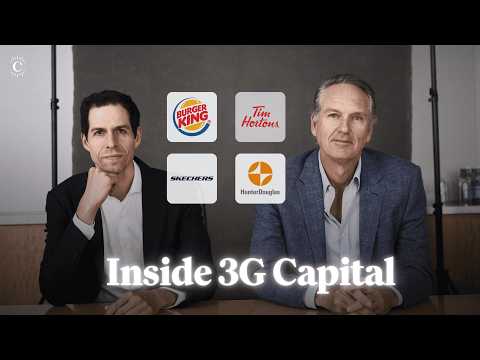
3G commits to one investment per fund, deploying significant internal capital alongside partners. This focus allows for rigorous downside analysis and patience, ensuring only truly exceptional businesses are acquired.
3G partners are seasoned operators who step into businesses, aligning incentives with ownership. This hands-on approach ensures decisions serve the business's long-term health, not just short-term management goals.
3G prioritizes businesses that directly own their customer relationships, like Burger King or Hunter Douglas. This direct connection reduces disintermediation risk from retailers or new technologies.
As capital markets become increasingly efficient and competitive, the edge moves from financial engineering to deep operational expertise and long-term, owner-aligned management.
Prioritize identifying and enabling high-potential individuals early in their careers, granting them significant responsibility and ownership.
Disciplined focus, patient relationship building, and an unwavering commitment to operational excellence in established, defensible businesses can still yield generational wealth.
The Macro Trend: In a world obsessed with digital disruption, 3G Capital's success with "atoms over bits" businesses highlights a strategic pivot: enduring value often resides in established brands with proprietary customer relationships, where operational excellence and long-term thinking create moats against fleeting tech trends.
The Tactical Edge: Identify businesses with strong, direct customer relationships and a clear path for operational improvement, even if they appear "boring." Prioritize deep, hands-on involvement to drive value, rather than relying solely on financial engineering.
The Bottom Line: The future of outsized returns may not be in chasing the next big tech wave, but in patiently acquiring and meticulously operating businesses that own their customer relationships, leveraging technology to enhance, not redefine, their core value. This strategy offers a more predictable, less volatile path to compounding capital.
The Macro Shift: In a world obsessed with digital disruption, 3G Capital's success highlights the enduring power of "hard" businesses with strong customer relationships. Their focus on foundational consumer brands, managed by operator-investors who prioritize long-term ownership and disciplined execution, offers a robust counter-narrative to the "bits over atoms" trend.
The Tactical Edge: Cultivate an extreme ownership culture by aligning incentives deeply, empowering young talent with real responsibility, and fostering a relentless bias for action.
The Bottom Line: For investors and builders, the lesson is clear: patience, deep operational involvement, and a fanatical focus on talent in defensible, "boring" businesses can yield extraordinary, long-term value, even in expensive markets.
Extreme Focus: 3G Capital commits to one investment per fund, deploying significant internal capital alongside partners. This singular focus forces rigorous downside analysis and patience, ensuring they only pursue truly exceptional opportunities.
Owner Operators: 3G partners are seasoned operators who step into businesses, aligning incentives with ownership. This means leaders act like shareholders, making decisions for the business's long-term health, not just short-term management goals.
Disruption Defense: 3G prioritizes businesses with strong customer relationships and physical components, making them less susceptible to digital disintermediation. They seek enduring brands like Hunter Douglas, where the sun will always rise and set, ensuring a consistent need for their product.
In an era of rapid technological change, businesses with strong, direct customer relationships and physical moats are increasingly valuable. 3G's focus on these "atoms" businesses, enhanced by strategic tech adoption, provides a blueprint for durable value creation.
Cultivate an ownership culture by aligning incentives deeply, empowering young talent with real responsibility, and prioritizing long-term value over short-term gains.
The future belongs to patient, operator-led investors who can identify and transform enduring businesses by focusing on fundamental quality, people, and strategic technological integration, rather than chasing fleeting trends.
3G Capital's model counters this by doubling down on "atoms" businesses with strong customer relationships and defensible positions, then applying rigorous operational excellence.
Cultivate an owner-operator mindset within your organization, even if you are not a private equity firm. Identify and back high-potential young talent with significant responsibility and aligned incentives, providing mentorship to maximize their success.
In a world obsessed with speed and diversification, 3G Capital proves that deep, patient, operator-led concentration on high-quality, defensible businesses, combined with a culture of ownership and meritocracy, remains a powerful engine for outsized value creation.
The era of celebrity endorsements is evolving into one of celebrity ownership, driven by a growing understanding of equity's compounding power and enabled by new technologies that lower the barrier to business creation.
Prioritize building a diverse, expert team and actively seek out "boring" businesses or underserved markets with clear, unmet demand.
The next 6-12 months will see an acceleration of talent leveraging their brand for equity stakes, particularly in tech-enabled ventures. Position yourself to either participate in these deals or build the tools that empower this new class of owner-operators.
Question Sacred Cows: The path to breakthrough performance lies in challenging foundational assumptions. For Layer 2s, this means recognizing that sequencer decentralization may be a solution in search of a problem.
Focus and Outsource: MegaETH’s strategy is simple: be the best at performance by outsourcing the hardest part—consensus—to Ethereum. This allows them to build a hyper-optimized execution environment without compromising on security.
Hire Outside the Echo Chamber: The next major blockchain innovation may not come from a crypto veteran. Expertise from adjacent fields like low-latency computing can provide the first-principles thinking needed to solve the industry’s most entrenched problems.
**Allocations Are Multiplying:** The standard institutional crypto allocation is moving from a timid 1% to a more confident 3-5%, driven by crypto's declining volatility and the fading fear of a "go-to-zero" event.
**The ETF Universe is Exploding:** New SEC guidelines will unleash a wave of crypto ETFs, from single assets to index funds. This will reshape market structure and provide traditional investors with simple on-ramps to the entire ecosystem.
**Stablecoins are the Real Trojan Horse:** Beyond Bitcoin, institutional demand for stablecoins is immense. They aren't just an asset; they are recognized as the critical settlement layer for a tokenized, 24/7 global market.
Becoming the Capital Stack: Coinbase's endgame is not just being a crypto exchange but providing the full, end-to-end infrastructure for any company—crypto or traditional—to issue, manage, and raise capital on-chain.
Acquire Missionaries, Not Mercenaries: Their M&A success hinges on a proactive, culture-first approach. They identify strategic needs, hunt for the best teams, and integrate them deeply, ensuring founders stay long after their earnouts expire.
Prediction Markets are the Next Trojan Horse: Coinbase is betting big on prediction markets to onboard the next wave of mainstream users, using familiar activities like sports betting as an accessible entry point into the crypto ecosystem.
Leverage Overload, Fundamental Weakness. Record leverage created a "house of cards" structure. Without strong underlying spot volume and new buyers, the market became highly susceptible to cascading liquidations.
The Profits Are In. Long-term Bitcoin holders have already cashed out nearly twice the profit they did last cycle ($900B vs. $500B), indicating the "wealth distribution" phase is well underway.
The Line in the Sand. The key level to watch is Bitcoin's 50-week moving average (around $102k). As long as Bitcoin holds above it, the bull market structure remains intact; two weekly closes below it would be a strong confirmation that the cycle is over.
**Volume is the Best Validation**: Meme coins proved Solana isn't just fast in theory; it can handle transactional loads that surpass major centralized exchanges, making it a credible platform for serious financial assets.
**Simplicity Wins**: Solana’s killer feature is its seamless user experience. By eliminating the bridging and multi-chain complexities of rivals, it has created a low-friction environment that attracts both developers and mainstream users.
**The Next Frontier is Tokenization**: The meme coin craze was the chaotic opening act. The main event is the tokenization of real-world assets, and Solana’s proven performance has positioned it as the frontrunner to become the settlement layer for this new market.
Stop Reacting, Start Anticipating: The market’s direction is a better economic predictor than official data. Focus on forward guidance, not rearview-mirror analysis.
Bitcoin Is a Macro Asset: The primary thesis for assets like Bitcoin stems from the structural debasement of fiat currencies. Analyze it through the lens of global liquidity and monetary policy.
Trust the Market, Not the Fed: The bond market can and will reject central bank policy. When market signals contradict official narratives, pay attention—the market is often right.