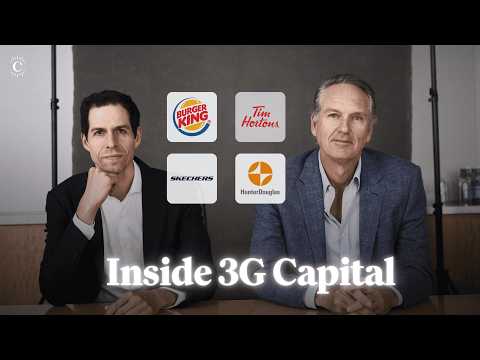
3G commits to one investment per fund, deploying significant house capital alongside partners. This singular focus drives an unparalleled rigor in due diligence and operational execution, because failure isn't an option—it's the only dish.
3G attracts top-tier talent by offering founder-like economics and accelerated responsibility. This creates a meritocracy where young leaders are given significant control and ownership earlier than traditional paths.
3G favors businesses with strong, direct customer relationships and physical assets, like Burger King or Hunter Douglas. These "atoms" businesses are inherently harder for new tech to disintermediate.
As capital markets become more efficient and valuations stretch, the edge shifts from financial engineering to deep operational expertise and a relentless focus on business quality.
Cultivate an owner-operator mindset throughout your organization, aligning incentives from the top down.
In the next 6-12 months, re-evaluate your investment criteria. Focus on businesses with clear customer relationships and robust, non-disruptable core offerings.
As market valuations stretch and technological disruption accelerates, the enduring value of well-moated, customer-centric businesses with strong physical components becomes clearer. 3G's focus on "harder to disrupt atoms" businesses, enhanced by technology, offers a resilient investment thesis.
Cultivate an owner-operator mindset, pushing decision-making closer to problems and aligning incentives with long-term success. Prioritize hiring ambitious young talent and empower them with responsibility, backed by strong mentorship.
In a world obsessed with speed and breadth, 3G Capital reminds us that deep, patient, operator-driven concentration in quality businesses, coupled with a fierce ownership culture, remains a powerful formula for outsized returns. This model builds enduring value, not just short-term gains.
In a market where digital disruption dominates headlines, 3G's success with physical, "atoms" businesses highlights that enduring value often lies in strong brands with direct customer relationships, where operational excellence and long-term thinking create defensible moats against technological fads.
Cultivate an "owner-operator" mindset in your investments and teams. Prioritize businesses with clear, simple value propositions and strong customer ties, then give young, ambitious talent significant ownership and autonomy to drive execution.
The next 6-12 months will reward investors and builders who resist the urge to chase every shiny new object. Instead, focus on fundamental business quality, deep operational involvement, and patient capital deployment in businesses that own their customer relationships. This disciplined approach, though counter-cultural, consistently compounds wealth.
As markets become more volatile and technology accelerates disruption, the traditional diversified portfolio approach faces increasing headwinds. 3G Capital's model signals a shift towards concentrated, operator-led bets on resilient, customer-owning brands with strong unit economics.
Identify businesses with deep moats, direct customer relationships, and long-term growth potential, then instill an owner-operator mindset throughout the organization, empowering young talent with significant equity and autonomy.
In a world of fleeting trends, focusing on fundamental business quality, operational excellence, and a long-term horizon offers a robust strategy for compounding capital, proving that sometimes, less truly is more.
3G commits to one investment per fund. This extreme concentration forces rigorous downside analysis and patience, ensuring capital is deployed only into truly exceptional opportunities.
Leaders are treated as shareholders, not just management. This alignment, often through outsized equity grants, drives decisions that prioritize the business's long-term health and value creation.
3G seeks businesses that own the relationship with their end customers. This direct connection provides a moat against disruption and disintermediation, as seen with brands like Burger King and Hunter Douglas.
The Macro Shift: As digital disruption accelerates, the value of businesses with inherent physical moats and direct customer relationships grows. 3G's focus on these "atoms" businesses, rather than "bits," positions them to capitalize on enduring consumer needs.
The Tactical Edge: Cultivate an owner-operator mindset in your ventures by aligning incentives deeply, empowering young talent, and relentlessly focusing on core business quality. This means prioritizing long-term value creation over short-term financial engineering.
The Bottom Line: In a world obsessed with speed and diversification, 3G Capital's patient, concentrated, and operator-driven model offers a powerful counter-narrative. For investors and builders, this means recognizing that deep, hands-on involvement in a few great businesses can still yield outsized returns, especially when others are chasing the next shiny object.
As technology accelerates disruption, businesses that own the direct customer relationship and operate in "atoms" industries become increasingly resilient.
Cultivate deep, long-term relationships with founders and owners of enduring businesses, positioning yourself as a patient, operator-led partner rather than a short-term financial buyer.
In an environment of stretched valuations and abundant capital, a disciplined, concentrated, and operator-driven approach to acquiring and growing high-quality, customer-owning businesses remains a powerful, albeit rare, path to outsized returns.
The AI infrastructure boom is transitioning from speculative buildouts to financially engineered, risk-managed investments, driven by the commodification of compute and memory.
Evaluate your compute procurement and data center buildout strategies through a financial lens, exploring futures contracts and residual value products to lock in costs and de-risk hardware investments.
The ability to quantify future compute demand and hardware value will be the differentiator for AI infrastructure players over the next 6-12 months, enabling smarter capital deployment and competitive advantage.
Embrace Financial Autonomy: Athletes are adopting crypto not just for gains, but for control. They are tired of a financial system where they are told to "shut your mouth and go play basketball" while trusting strangers with their money.
Regulation is a Two-Front War: The crypto industry must fight defensively to protect wins like stablecoin rewards while also playing offense to ensure new regulations don't stifle DeFi innovation before it can mature.
Prediction Markets are Information Markets: Their true disruption isn't just taking on FanDuel; it's creating a more efficient, decentralized, and transparent way to surface truth in real-time, for everything from sports to politics.
**Buy the Blood:** Massive open interest liquidations have historically been powerful buy signals, not a reason to panic. The data shows strong positive returns in the 30-120 days following such events.
**Invest in Token Factories:** The convergence of AI and crypto is creating a new paradigm. The most valuable companies will be those that control proprietary "token supplies" for identity, data, and assets, making the world machine-readable.
**Pick Your Winners:** The market is maturing. As barriers to entry rise, capital will consolidate around established leaders. Shift focus from chasing the "next new thing" to identifying compounding winners in categories like L1s and exchanges.
Capital Formation is the New Battleground: Coinbase’s Echo deal is a $400M bet to own the token launch pipeline, directly challenging Binance's Launchpad dominance.
Banks are Officially on Defense: The Fed’s "skinny master account" proposal threatens to let fintechs bypass banks entirely, a disruption so real that bank CEOs are publicly admitting innovators will win.
Prediction Markets are Going Mainstream: DraftKings' partnership with Polymarket validates the model as a legitimate workaround for complex state-level gambling laws, signaling a massive new distribution channel.
Sell the News, Buy the Self-Own. Eclipse’s price action demonstrates that in crypto, counter-narrative marketing can be more effective than traditional hype. When a project publicly acknowledges its own failures, it can signal a market bottom.
Culture is Strategy. The contrast between Ethereum’s perceived complacency and Solana’s hungry underdog ethos directly impacts developer incentives and innovation speed. Ecosystems with a clear, aggressive mission attract and retain talent differently.
Watch the SKR Token. As only the second token from Solana Labs, the SKR launch carries significant reputational weight. Investors should monitor its mechanics, as it will likely set a new standard for ecosystem projects launched by a parent company.
Fade the Cycle Narrative: The influx of new, cycle-agnostic capital via ETFs means the market's rhythm has changed. Sideways price action is the new up, signaling strong demand is absorbing OG selling.
Buy Picks, Shovels, and Yield: The era of riding hyped, valueless memecoins is over. The durable strategy is to own the infrastructure (Robin Hood) or assets that generate and return real fees to holders (Shuffle, Aerodrome).
Arbitrage Information Gaps: Find your edge in niche markets. Exploitable alpha exists in prediction markets, whether through contrarian betting, language advantages, or AI-powered analysis.
Stablecoins Are The Trojan Horse. They have achieved undeniable product-market fit, rivaling legacy payment rails and becoming a key tool for U.S. dollar dominance. They are the gateway for both institutional players and everyday users in emerging markets.
Usage is Divorced From Speculation. For the first time, practical on-chain activity is being driven by users in developing nations who *need* crypto, while speculation is led by those in developed nations who *want* it. The next bull run will be driven by products that bridge this divide.
The Bottleneck is No Longer Technology. With scalability largely solved (blockchains now process over 3,400 TPS), the primary barriers to adoption have shifted from infrastructure to product design, user experience, and regulatory clarity.