The automotive industry is undergoing a significant architectural change, moving from fragmented, hardware-centric systems to vertically integrated, AI-powered software-defined vehicles. This demands re-platforming, making legacy automakers vulnerable.
Invest in or build companies controlling their full technology stack: custom silicon, sensor arrays, data collection, AI model training. Vertical integration is key to cost efficiency and rapid iteration for mass-market AI autonomy.
The next few years will see dramatic divergence. Companies mastering AI-driven autonomy and software-defined architectures, like Rivian with its R2, will capture significant market share by offering compelling, continuously improving vehicles at scale. Others face obsolescence.
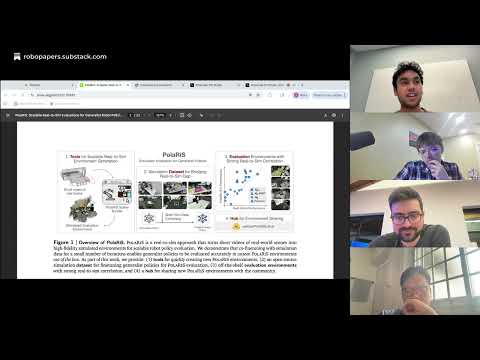
The robotics community is moving beyond task-specific benchmarks towards generalist policy evaluation, mirroring the LLM trend of testing off-the-shelf models on unseen tasks. This demands scalable, high-fidelity simulation tools that can quickly generate diverse test environments.
Builders and researchers should prioritize evaluation tools that offer strong real-to-sim correlation, even if it means a hybrid approach (like PolaRiS) over purely data-driven world models. Utilize real-to-sim environment generation (Gaussian splatting) and strategic sim data co-training to accelerate policy iteration.
PolaRiS offers a path to community-driven, crowdsourced robot benchmarks, making policy development faster and more robust. Expect a future where robot policies are evaluated across a broad suite of easily created, diverse simulated environments, pushing the boundaries of generalization and real-world applicability.
Generalist robot policies need robust, scalable evaluation. The shift is from bespoke, real-world-only testing to a hybrid real-to-sim approach that leverages modern 3D reconstruction and minimal sim data to create highly correlated, reproducible benchmarks.
Builders should adopt PolaRiS's real-to-sim environment generation and "sim co-training" methodology. This allows for rapid, cost-effective iteration on robot policies, ensuring that improvements in simulation translate directly to real-world gains.
Over the next 6-12 months, the ability to quickly and reliably evaluate robot policies in simulation will be a critical differentiator. PolaRiS provides the tools to build diverse, generalization-focused benchmarks, moving robotics closer to the rapid iteration cycles of other AI fields.
Tesla's core identity shifted from EV maker to autonomous AI and robotics. Its cars are devices for deploying its advanced AI brain; competitors miss this.
Tesla's 8 million cars collect real-world driving data. This massive dataset, combined with in-house AI processing, creates an unparalleled moat impossible for competitors to replicate.
This convergence creates an abundance of labor and transportation, driving down costs. Robo-taxis and humanoid robots automate tasks, making goods and services cheaper, even as Tesla's profitability soars.
Robotics is moving towards generalist policies that need broad, diverse evaluation. PolaRiS enables this by making it easy to create and share new, correlated benchmarks, cultivating a community-driven evaluation ecosystem similar to LLMs.
Adopt PolaRiS for rapid policy iteration on pick-and-place and articulated object tasks. Use its browser-based scene builder and existing assets to quickly create new evaluation environments, then fine-tune policies with a small amount of unrelated sim data to boost real-to-sim correlation.
Investing in tools like PolaRiS now means faster development cycles and more reliable policy improvements. This accelerates the path to robust, real-world robot deployment by providing a scalable, trustworthy intermediate testing ground.
PolaRiS enables a shift towards LLM-style generalization benchmarks, where models are tested on unseen environments and tasks, accelerating robot capabilities.
Use its browser-based scene builder and Gaussian splatting to quickly create diverse, real-world correlated evaluation environments, significantly reducing the cost and time of real robot testing.
Cheap, reliable robot policy evaluation in simulation, with strong real-world correlation, means faster development cycles, more robust generalist robots, and a path to crowdsourced, diverse benchmarks that will push the entire field forward.
AI is forcing a fundamental architectural change in automotive, moving from fragmented, rules-based systems to vertically integrated, neural network-powered platforms. This technical reality dictates market survival, favoring companies that control their entire software and hardware stack to build a continuous data flywheel.
Invest in or partner with companies demonstrating deep vertical integration in AI hardware and software for mobility. Prioritize those with a clear path to mass-market data collection and rapid iteration cycles.
Autonomy will be a must-have feature in cars within the next few years. Companies without a software-defined architecture and a vertically integrated AI stack will struggle to compete, creating a market share shift towards those few players who can deliver true self-driving at scale.
The automotive industry is undergoing a fundamental re-architecture, moving from hardware-centric, rules-based systems to software-defined, AI-powered platforms. This shift favors companies with deep vertical integration and proprietary data flywheels.
Invest in companies demonstrating full-stack control over their vehicle's software, hardware, and AI training data. This verticality is the moat against commoditization and the engine for rapid, continuous improvement.
Autonomy will be a non-negotiable feature by 2030, making software-defined vehicles the only viable path for mass-market automakers. Companies that fail to build or acquire this capability will face market irrelevance.
Tesla's core business is AI and autonomous robotics. This means its value comes from its software and data moat, not just vehicle sales.
Tesla is sunsetting Model S and X production to convert factories for humanoid robots. This signals a full commitment to autonomous devices beyond cars.
Unsupervised FSD is expected in select US states by Q2. This will enable cars to operate without human oversight, unlocking the robo-taxi network.
Airdrops Are Now Protection Money: Stop viewing airdrops as a tool for buying loyalty. The modern meta is about paying the community to prevent negative campaigns. Consider models that require financial commitment, not just clicks.
Decentralization is a Journey, Not a Destination: The path to unseating CEXs is paved with compromises. Prioritize a seamless user experience, even if it means starting with a more centralized architecture, and iterate towards permissionlessness over time.
Surviving is the Ultimate Edge: In a space where most participants wash out after one cycle, consistency is a superpower. The founders and investors who can endure the brutal bear markets and avoid personal burnout are the ones who ultimately win.
The Debasement is Permanent. The US fiscal position makes currency debasement a permanent feature, not a bug. The winning strategy is to treat hard assets like gold and Bitcoin as long-term holdings, buying on dips rather than timing a temporary "trade."
Watch Central Banks, Not Pundits. The most significant signal is that foreign central banks are systemically divesting from US Treasuries into gold. This is not market noise; it's a structural realignment of the global financial order.
Own the Physical Asset. Paper gold (like ETFs) carries a critical tail risk. In a true crisis, governments could seize the underlying physical gold and cash-settle ETF holders at a pre-crisis price. If you don't hold it, you don't own it.
Funding Rates Are a UX Bottleneck. For RWAs to succeed on-chain, derivative models must offer predictable costs. The volatile funding rates of crypto-native perps are a major barrier to mainstream adoption, pushing innovation toward CFD-like structures.
The Airdrop Is Dead; Long Live the Curated ICO. Capital formation is shifting from broad, farmed airdrops to sophisticated, curated token sales. Projects now act like luxury brands, hand-picking investors to ensure long-term alignment, killing the "spray and pray" distribution model.
Political Wins Can Backfire. The CZ pardon highlights the double-edged sword of crypto's political maneuvering. The perceived corruption and mainstream backlash create a massive reputational headache that undermines the industry’s push for legitimacy.
Banks Can't Ignore the Genie: Jamie Dimon's reversal and JPMorgan's new crypto services signal that institutional resistance is crumbling. The catalyst is the disruptive threat of stablecoins to core banking models.
Consolidation is the Game: Mature sectors like exchanges and L1s are consolidating. The strategic play is to identify the dominant platforms (e.g., ETH, Solana, major exchanges) poised to compound value as moats widen.
Regulation is the Kingmaker: Political moves, such as Trump pardoning CZ, are reshaping the competitive map. Access to the U.S. market will be a critical battleground, making regulatory strategy more important than ever.
**The "Bloomberg for Crypto" is the Endgame.** The most valuable companies will provide institutional-grade data and software. Blockworks' pivot is a bet on this future, moving from a crowded news business to a high-growth data platform with clear product-market fit.
**Tokenization is Now a Publicly Traded Thesis.** With Securitize’s IPO, investors can make a direct, public-market bet on the tokenization of real-world assets. It will likely be valued as a high-growth proxy for the entire sector.
**Adoption is Bought, Not Begged.** Layer 1s are aggressively paying for partnerships with brands like Western Union. For investors, the question is whether these deals create a sustainable flywheel or just a temporary boost.
The Q4 Pump is a Trap. The widespread belief in a year-end alt season has become a crowded exit strategy. When everyone plans to sell into the same pump, there’s no one left to buy.
ETH's Fundamentals are Hollow. Ethereum's valuation is propped up by narratives, not reality. Weak on-chain activity and a value-accrual model that benefits apps over the base layer make its current price unsustainable.
The Sellers Are Here. From VCs with token unlocks to treasury companies turning into paper hands, identifiable sellers now outweigh the speculative buyers, signaling the cycle has turned.