The Macro Shift: Celebrity capital is moving from transactional endorsements to strategic equity investments, driven by a desire for long-term wealth creation and the recognition that personal brand power can significantly accelerate startup growth.
The Tactical Edge: Cultivate a diverse network of mentors and partners, prioritizing those who bring complementary expertise and can challenge your assumptions.
The Bottom Line: The future of wealth creation for high-profile individuals and savvy investors lies in strategic, long-term equity plays, supported by strong teams and a willingness to partner.
AI agents with system-level access are shifting the core value proposition of software from discrete applications to fluid, context-aware personal assistants.
Cultivate "agent empathy" by learning to guide AI models effectively, understanding their limitations, and designing projects for agent-first navigation.
The rise of autonomous agents will redefine software's purpose and value.
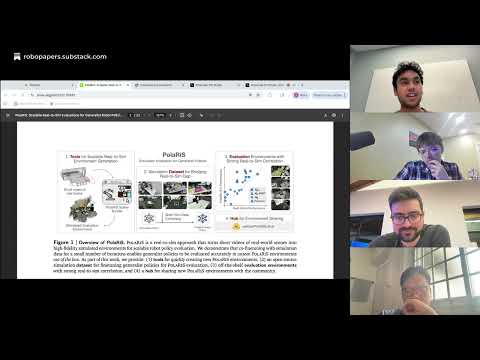
Adopt PolaRiS for rapid policy iteration. Leverage its real-to-sim environment generation and minimal sim data co-training to quickly validate robot policies in diverse, unseen environments before committing to expensive real-world deployments.
The era of generalist robot policies demands a new paradigm for evaluation. The shift is from bespoke, real-world testing to scalable, high-fidelity sim-to-real correlation, enabling faster iteration and broader generalization testing.
Reliable sim-to-real evaluation is the missing link for accelerating robot AI. PolaRiS offers a pragmatic, community-driven path to unlock faster development cycles and more robust generalist robot policies over the next 6-12 months.
Generalist robot policies demand evaluation that tests true generalization across diverse, unseen environments. The shift is from hand-tuned, task-specific benchmarks to scalable, community-driven evaluation suites that can keep pace with rapidly improving model capabilities. This requires tools that make environment creation cheap and ensure real-world predictive power.
Adopt PolaRiS for rapid, correlated policy iteration. Builders should leverage its real-to-sim environment generation (Gaussian splatting for scenes, generative models for objects) and the "sim co-training" trick to quickly validate policy improvements against real-world performance, especially for pick-and-place tasks. Contribute new environments to the Polaris Hub to expand the collective benchmark.
The future of robotics hinges on fast, reliable evaluation. PolaRiS offers a pragmatic, immediate solution to accelerate policy development by providing high-fidelity, correlated sim environments. Over the next 6-12 months, expect this hybrid approach to become a standard for iterating on generalist robot policies, while fully learned world models continue to improve for more complex, deformable tasks.
The push for generalist robot policies demands scalable, trustworthy evaluation. PolaRiS democratizes high-fidelity sim evaluation, moving robotics closer to rapid iteration cycles seen in other AI fields.
Builders should explore PolaRiS's open-source tools and pre-trained checkpoints to quickly test policies in diverse, real-world-correlated environments. Prioritize visual fidelity and use small, unrelated sim data for alignment.
Rapid, reliable sim evaluation with strong real-world correlation is a significant advancement. This tool enables faster policy iteration, broader generalization, and community-driven benchmarking, setting the stage for the next generation of robot capabilities.
Generalist robot policies demand community-driven, scalable evaluation, mirroring LLM benchmarking. PolaRiS provides the technical foundation by making high-fidelity, correlated sim environments accessible.
Adopt PolaRiS for rapid policy iteration. Use its browser-based scene builder and Gaussian splatting for quick environment creation, incorporating minimal, unrelated sim co-training data for strong real-world correlation.
PolaRiS accelerates robot development with a reliable, scalable simulation tool. This means faster iteration, more robust policies, and a clearer path to real-world deployment for your robot applications over the next 6-12 months.
The era of generalist robot policies demands evaluation tools that can keep pace with rapid development and broad generalization. PolaRiS pushes robotics toward the LLM benchmark paradigm, where models are tested on unseen environments and tasks, rather than being trained on specific benchmarks.
For builders, leverage PolaRiS's browser-based scene builder and Gaussian splatting pipeline to quickly create diverse, high-fidelity evaluation environments from real-world scans. This enables faster policy iteration and more reliable real-world deployment.
PolaRiS offers a pragmatic, scalable path to more effective robot policy development. By providing a tool that makes sim performance a reliable predictor of real-world success, it accelerates the journey from lab to real-world application, especially for pick-and-place tasks, and sets the stage for community-driven benchmarking.
Celebrity capital is evolving from passive endorsements to active, strategic equity investment, transforming athletes and entertainers into powerful venture partners who bring more than just money to the table.
Prioritize building a diverse, expert team that can challenge your assumptions and vet opportunities, especially when entering new sectors like AI or overlooked geographic markets.
Long-term thinking, a willingness to invest in growth, and a focus on strategic partnerships are non-negotiable for building lasting wealth and influence in both traditional and emerging industries over the next 6-12 months.
Airdrops Are Now Protection Money: Stop viewing airdrops as a tool for buying loyalty. The modern meta is about paying the community to prevent negative campaigns. Consider models that require financial commitment, not just clicks.
Decentralization is a Journey, Not a Destination: The path to unseating CEXs is paved with compromises. Prioritize a seamless user experience, even if it means starting with a more centralized architecture, and iterate towards permissionlessness over time.
Surviving is the Ultimate Edge: In a space where most participants wash out after one cycle, consistency is a superpower. The founders and investors who can endure the brutal bear markets and avoid personal burnout are the ones who ultimately win.
The Debasement is Permanent. The US fiscal position makes currency debasement a permanent feature, not a bug. The winning strategy is to treat hard assets like gold and Bitcoin as long-term holdings, buying on dips rather than timing a temporary "trade."
Watch Central Banks, Not Pundits. The most significant signal is that foreign central banks are systemically divesting from US Treasuries into gold. This is not market noise; it's a structural realignment of the global financial order.
Own the Physical Asset. Paper gold (like ETFs) carries a critical tail risk. In a true crisis, governments could seize the underlying physical gold and cash-settle ETF holders at a pre-crisis price. If you don't hold it, you don't own it.
Funding Rates Are a UX Bottleneck. For RWAs to succeed on-chain, derivative models must offer predictable costs. The volatile funding rates of crypto-native perps are a major barrier to mainstream adoption, pushing innovation toward CFD-like structures.
The Airdrop Is Dead; Long Live the Curated ICO. Capital formation is shifting from broad, farmed airdrops to sophisticated, curated token sales. Projects now act like luxury brands, hand-picking investors to ensure long-term alignment, killing the "spray and pray" distribution model.
Political Wins Can Backfire. The CZ pardon highlights the double-edged sword of crypto's political maneuvering. The perceived corruption and mainstream backlash create a massive reputational headache that undermines the industry’s push for legitimacy.
Banks Can't Ignore the Genie: Jamie Dimon's reversal and JPMorgan's new crypto services signal that institutional resistance is crumbling. The catalyst is the disruptive threat of stablecoins to core banking models.
Consolidation is the Game: Mature sectors like exchanges and L1s are consolidating. The strategic play is to identify the dominant platforms (e.g., ETH, Solana, major exchanges) poised to compound value as moats widen.
Regulation is the Kingmaker: Political moves, such as Trump pardoning CZ, are reshaping the competitive map. Access to the U.S. market will be a critical battleground, making regulatory strategy more important than ever.
**The "Bloomberg for Crypto" is the Endgame.** The most valuable companies will provide institutional-grade data and software. Blockworks' pivot is a bet on this future, moving from a crowded news business to a high-growth data platform with clear product-market fit.
**Tokenization is Now a Publicly Traded Thesis.** With Securitize’s IPO, investors can make a direct, public-market bet on the tokenization of real-world assets. It will likely be valued as a high-growth proxy for the entire sector.
**Adoption is Bought, Not Begged.** Layer 1s are aggressively paying for partnerships with brands like Western Union. For investors, the question is whether these deals create a sustainable flywheel or just a temporary boost.
The Q4 Pump is a Trap. The widespread belief in a year-end alt season has become a crowded exit strategy. When everyone plans to sell into the same pump, there’s no one left to buy.
ETH's Fundamentals are Hollow. Ethereum's valuation is propped up by narratives, not reality. Weak on-chain activity and a value-accrual model that benefits apps over the base layer make its current price unsustainable.
The Sellers Are Here. From VCs with token unlocks to treasury companies turning into paper hands, identifiable sellers now outweigh the speculative buyers, signaling the cycle has turned.