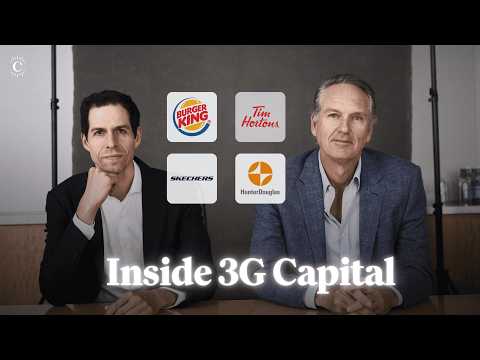
3G commits to one investment per fund, deploying significant internal capital alongside partners. This focus allows for rigorous downside analysis and patience, ensuring only truly exceptional businesses are acquired.
3G partners are seasoned operators who step into businesses, aligning incentives with ownership. This hands-on approach ensures decisions serve the business's long-term health, not just short-term management goals.
3G prioritizes businesses that directly own their customer relationships, like Burger King or Hunter Douglas. This direct connection reduces disintermediation risk from retailers or new technologies.
As capital markets become increasingly efficient and competitive, the edge moves from financial engineering to deep operational expertise and long-term, owner-aligned management.
Prioritize identifying and enabling high-potential individuals early in their careers, granting them significant responsibility and ownership.
Disciplined focus, patient relationship building, and an unwavering commitment to operational excellence in established, defensible businesses can still yield generational wealth.
The Macro Trend: In a world obsessed with digital disruption, 3G Capital's success with "atoms over bits" businesses highlights a strategic pivot: enduring value often resides in established brands with proprietary customer relationships, where operational excellence and long-term thinking create moats against fleeting tech trends.
The Tactical Edge: Identify businesses with strong, direct customer relationships and a clear path for operational improvement, even if they appear "boring." Prioritize deep, hands-on involvement to drive value, rather than relying solely on financial engineering.
The Bottom Line: The future of outsized returns may not be in chasing the next big tech wave, but in patiently acquiring and meticulously operating businesses that own their customer relationships, leveraging technology to enhance, not redefine, their core value. This strategy offers a more predictable, less volatile path to compounding capital.
The Macro Shift: In a world obsessed with digital disruption, 3G Capital's success highlights the enduring power of "hard" businesses with strong customer relationships. Their focus on foundational consumer brands, managed by operator-investors who prioritize long-term ownership and disciplined execution, offers a robust counter-narrative to the "bits over atoms" trend.
The Tactical Edge: Cultivate an extreme ownership culture by aligning incentives deeply, empowering young talent with real responsibility, and fostering a relentless bias for action.
The Bottom Line: For investors and builders, the lesson is clear: patience, deep operational involvement, and a fanatical focus on talent in defensible, "boring" businesses can yield extraordinary, long-term value, even in expensive markets.
Extreme Focus: 3G Capital commits to one investment per fund, deploying significant internal capital alongside partners. This singular focus forces rigorous downside analysis and patience, ensuring they only pursue truly exceptional opportunities.
Owner Operators: 3G partners are seasoned operators who step into businesses, aligning incentives with ownership. This means leaders act like shareholders, making decisions for the business's long-term health, not just short-term management goals.
Disruption Defense: 3G prioritizes businesses with strong customer relationships and physical components, making them less susceptible to digital disintermediation. They seek enduring brands like Hunter Douglas, where the sun will always rise and set, ensuring a consistent need for their product.
In an era of rapid technological change, businesses with strong, direct customer relationships and physical moats are increasingly valuable. 3G's focus on these "atoms" businesses, enhanced by strategic tech adoption, provides a blueprint for durable value creation.
Cultivate an ownership culture by aligning incentives deeply, empowering young talent with real responsibility, and prioritizing long-term value over short-term gains.
The future belongs to patient, operator-led investors who can identify and transform enduring businesses by focusing on fundamental quality, people, and strategic technological integration, rather than chasing fleeting trends.
3G Capital's model counters this by doubling down on "atoms" businesses with strong customer relationships and defensible positions, then applying rigorous operational excellence.
Cultivate an owner-operator mindset within your organization, even if you are not a private equity firm. Identify and back high-potential young talent with significant responsibility and aligned incentives, providing mentorship to maximize their success.
In a world obsessed with speed and diversification, 3G Capital proves that deep, patient, operator-led concentration on high-quality, defensible businesses, combined with a culture of ownership and meritocracy, remains a powerful engine for outsized value creation.
The era of celebrity endorsements is evolving into one of celebrity ownership, driven by a growing understanding of equity's compounding power and enabled by new technologies that lower the barrier to business creation.
Prioritize building a diverse, expert team and actively seek out "boring" businesses or underserved markets with clear, unmet demand.
The next 6-12 months will see an acceleration of talent leveraging their brand for equity stakes, particularly in tech-enabled ventures. Position yourself to either participate in these deals or build the tools that empower this new class of owner-operators.
Airdrops Are Now Protection Money: Stop viewing airdrops as a tool for buying loyalty. The modern meta is about paying the community to prevent negative campaigns. Consider models that require financial commitment, not just clicks.
Decentralization is a Journey, Not a Destination: The path to unseating CEXs is paved with compromises. Prioritize a seamless user experience, even if it means starting with a more centralized architecture, and iterate towards permissionlessness over time.
Surviving is the Ultimate Edge: In a space where most participants wash out after one cycle, consistency is a superpower. The founders and investors who can endure the brutal bear markets and avoid personal burnout are the ones who ultimately win.
The Debasement is Permanent. The US fiscal position makes currency debasement a permanent feature, not a bug. The winning strategy is to treat hard assets like gold and Bitcoin as long-term holdings, buying on dips rather than timing a temporary "trade."
Watch Central Banks, Not Pundits. The most significant signal is that foreign central banks are systemically divesting from US Treasuries into gold. This is not market noise; it's a structural realignment of the global financial order.
Own the Physical Asset. Paper gold (like ETFs) carries a critical tail risk. In a true crisis, governments could seize the underlying physical gold and cash-settle ETF holders at a pre-crisis price. If you don't hold it, you don't own it.
Funding Rates Are a UX Bottleneck. For RWAs to succeed on-chain, derivative models must offer predictable costs. The volatile funding rates of crypto-native perps are a major barrier to mainstream adoption, pushing innovation toward CFD-like structures.
The Airdrop Is Dead; Long Live the Curated ICO. Capital formation is shifting from broad, farmed airdrops to sophisticated, curated token sales. Projects now act like luxury brands, hand-picking investors to ensure long-term alignment, killing the "spray and pray" distribution model.
Political Wins Can Backfire. The CZ pardon highlights the double-edged sword of crypto's political maneuvering. The perceived corruption and mainstream backlash create a massive reputational headache that undermines the industry’s push for legitimacy.
Banks Can't Ignore the Genie: Jamie Dimon's reversal and JPMorgan's new crypto services signal that institutional resistance is crumbling. The catalyst is the disruptive threat of stablecoins to core banking models.
Consolidation is the Game: Mature sectors like exchanges and L1s are consolidating. The strategic play is to identify the dominant platforms (e.g., ETH, Solana, major exchanges) poised to compound value as moats widen.
Regulation is the Kingmaker: Political moves, such as Trump pardoning CZ, are reshaping the competitive map. Access to the U.S. market will be a critical battleground, making regulatory strategy more important than ever.
**The "Bloomberg for Crypto" is the Endgame.** The most valuable companies will provide institutional-grade data and software. Blockworks' pivot is a bet on this future, moving from a crowded news business to a high-growth data platform with clear product-market fit.
**Tokenization is Now a Publicly Traded Thesis.** With Securitize’s IPO, investors can make a direct, public-market bet on the tokenization of real-world assets. It will likely be valued as a high-growth proxy for the entire sector.
**Adoption is Bought, Not Begged.** Layer 1s are aggressively paying for partnerships with brands like Western Union. For investors, the question is whether these deals create a sustainable flywheel or just a temporary boost.
The Q4 Pump is a Trap. The widespread belief in a year-end alt season has become a crowded exit strategy. When everyone plans to sell into the same pump, there’s no one left to buy.
ETH's Fundamentals are Hollow. Ethereum's valuation is propped up by narratives, not reality. Weak on-chain activity and a value-accrual model that benefits apps over the base layer make its current price unsustainable.
The Sellers Are Here. From VCs with token unlocks to treasury companies turning into paper hands, identifiable sellers now outweigh the speculative buyers, signaling the cycle has turned.