The Macro Shift: Celebrity capital is moving from transactional endorsements to strategic equity investments, driven by a desire for long-term wealth creation and the recognition that personal brand power can significantly accelerate startup growth.
The Tactical Edge: Cultivate a diverse network of mentors and partners, prioritizing those who bring complementary expertise and can challenge your assumptions.
The Bottom Line: The future of wealth creation for high-profile individuals and savvy investors lies in strategic, long-term equity plays, supported by strong teams and a willingness to partner.
AI agents with system-level access are shifting the core value proposition of software from discrete applications to fluid, context-aware personal assistants.
Cultivate "agent empathy" by learning to guide AI models effectively, understanding their limitations, and designing projects for agent-first navigation.
The rise of autonomous agents will redefine software's purpose and value.
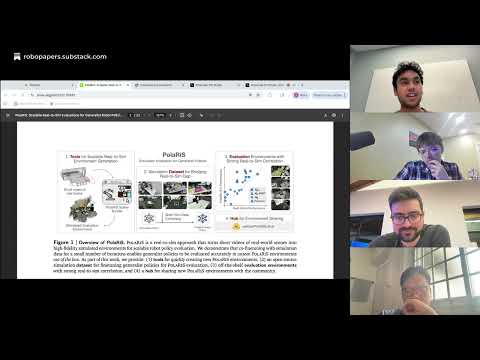
Adopt PolaRiS for rapid policy iteration. Leverage its real-to-sim environment generation and minimal sim data co-training to quickly validate robot policies in diverse, unseen environments before committing to expensive real-world deployments.
The era of generalist robot policies demands a new paradigm for evaluation. The shift is from bespoke, real-world testing to scalable, high-fidelity sim-to-real correlation, enabling faster iteration and broader generalization testing.
Reliable sim-to-real evaluation is the missing link for accelerating robot AI. PolaRiS offers a pragmatic, community-driven path to unlock faster development cycles and more robust generalist robot policies over the next 6-12 months.
Generalist robot policies demand evaluation that tests true generalization across diverse, unseen environments. The shift is from hand-tuned, task-specific benchmarks to scalable, community-driven evaluation suites that can keep pace with rapidly improving model capabilities. This requires tools that make environment creation cheap and ensure real-world predictive power.
Adopt PolaRiS for rapid, correlated policy iteration. Builders should leverage its real-to-sim environment generation (Gaussian splatting for scenes, generative models for objects) and the "sim co-training" trick to quickly validate policy improvements against real-world performance, especially for pick-and-place tasks. Contribute new environments to the Polaris Hub to expand the collective benchmark.
The future of robotics hinges on fast, reliable evaluation. PolaRiS offers a pragmatic, immediate solution to accelerate policy development by providing high-fidelity, correlated sim environments. Over the next 6-12 months, expect this hybrid approach to become a standard for iterating on generalist robot policies, while fully learned world models continue to improve for more complex, deformable tasks.
The push for generalist robot policies demands scalable, trustworthy evaluation. PolaRiS democratizes high-fidelity sim evaluation, moving robotics closer to rapid iteration cycles seen in other AI fields.
Builders should explore PolaRiS's open-source tools and pre-trained checkpoints to quickly test policies in diverse, real-world-correlated environments. Prioritize visual fidelity and use small, unrelated sim data for alignment.
Rapid, reliable sim evaluation with strong real-world correlation is a significant advancement. This tool enables faster policy iteration, broader generalization, and community-driven benchmarking, setting the stage for the next generation of robot capabilities.
Generalist robot policies demand community-driven, scalable evaluation, mirroring LLM benchmarking. PolaRiS provides the technical foundation by making high-fidelity, correlated sim environments accessible.
Adopt PolaRiS for rapid policy iteration. Use its browser-based scene builder and Gaussian splatting for quick environment creation, incorporating minimal, unrelated sim co-training data for strong real-world correlation.
PolaRiS accelerates robot development with a reliable, scalable simulation tool. This means faster iteration, more robust policies, and a clearer path to real-world deployment for your robot applications over the next 6-12 months.
The era of generalist robot policies demands evaluation tools that can keep pace with rapid development and broad generalization. PolaRiS pushes robotics toward the LLM benchmark paradigm, where models are tested on unseen environments and tasks, rather than being trained on specific benchmarks.
For builders, leverage PolaRiS's browser-based scene builder and Gaussian splatting pipeline to quickly create diverse, high-fidelity evaluation environments from real-world scans. This enables faster policy iteration and more reliable real-world deployment.
PolaRiS offers a pragmatic, scalable path to more effective robot policy development. By providing a tool that makes sim performance a reliable predictor of real-world success, it accelerates the journey from lab to real-world application, especially for pick-and-place tasks, and sets the stage for community-driven benchmarking.
Celebrity capital is evolving from passive endorsements to active, strategic equity investment, transforming athletes and entertainers into powerful venture partners who bring more than just money to the table.
Prioritize building a diverse, expert team that can challenge your assumptions and vet opportunities, especially when entering new sectors like AI or overlooked geographic markets.
Long-term thinking, a willingness to invest in growth, and a focus on strategic partnerships are non-negotiable for building lasting wealth and influence in both traditional and emerging industries over the next 6-12 months.
Social Proof is the New Alpha. FOMO’s core bet is that transparently tracking successful wallets is a more powerful discovery mechanism than traditional research. By making on-chain activity legible and social, it unlocks a new paradigm for retail investing.
User Experience Wins the Next Cycle. The next 100 million crypto users will not be onboarded with seed phrases and gas fees. By abstracting away all technical friction and mirroring the seamlessness of Web2 apps, FOMO provides a blueprint for mass adoption.
Trading is Becoming a Spectator Sport. By turning trading performance into a form of content, FOMO is building a new financial creator economy. The best traders are the new influencers, and their alpha is the content that drives the entire ecosystem.
The Internet Gets Its Native Wallet. x402 uses crypto to finally fulfill the internet's original vision of direct, peer-to-server payments, unlocking an economy of micropayments for everything from accessing an article to running an AI model.
The Ad-Supported Web Is Obsolete. AI agents that retrieve information without viewing ads are killing the web's 20-year-old business model. x402 provides the new economic rails for a pay-per-use internet where value is exchanged for resources, not attention.
Build Composable Money Legos. The biggest opportunity lies in creating simple, single-purpose APIs that agents can easily discover and compose. Think of it as building for the App Store of the emerging AI agent economy.
Despite the brutal sentiment, both speakers remain bullish, predicting a sharp reversal and a new all-time high for Bitcoin by the end of the year once macro clarity emerges.
Macro is King. Bitcoin's fate is now tied to the broader economy. Forget four-year cycles; the key catalyst is a resolution to the government shutdown, which could unlock pent-up energy in the market.
The Treasury Trade is Toast. The era of companies boosting their stock by simply buying Bitcoin is over. Expect a painful shakeout as the market demands real utility and revenue, leading to more forced selling.
Distribution is the prize, not payments. The real money in gaming isn't in payment rails, which are being competed down to zero. The scarcest and most valuable asset is user attention, and Open Game Protocol is designed to monetize distribution.
Decouple to survive. Tying a single game to a single token creates a fatal dependency. A flexible, many-to-many protocol allows ecosystems to thrive by spreading risk and aligning incentives across multiple games and communities.
Content abundance requires new discovery. As AI makes game creation cheap and fast, the bottleneck shifts from production to discovery. Integrating games directly into high-intent surfaces like crypto wallets creates a powerful, non-advertising-based discovery channel.
**Follow the Suits, Not the Shouts.** The market’s real signal is the massive disconnect between gloomy retail sentiment on social media and the unprecedented optimism from financial advisors and institutional platforms.
**Distribution is the New Kingmaker.** From Ripple buying prime brokerages to Tether leveraging its global south dominance, the primary battle is for distribution channels. The technical "best" solution is irrelevant if it can't reach users.
**Regulation Will Be a Slow Grind, Not a Big Bang.** Comprehensive crypto legislation is politically gridlocked. The industry’s integration into legacy finance will continue brick-by-brick through regulated products like ETFs, not sweeping bills from Congress.
Tokenized Funds Are a Real-World Unlock. Unlike many crypto narratives, bringing funds on-chain solves a tangible, expensive problem in traditional finance, creating massive operational efficiencies and new financial primitives.
The Bitcoin Holder Base Is Shifting. The ongoing "Bitcoin IPO" via ETFs means the asset is moving from the hands of early adopters to institutional portfolios. This structural shift will define its future trajectory.
Cash Is Your Best Hedge. In a market with fewer winners, holding cash is a strategic imperative. It prevents forced liquidation and provides the dry powder needed to seize high-conviction opportunities as they arise.