The rise of autonomous AI agents will fundamentally reshape the app economy, rendering many single-purpose applications obsolete as agents integrate and automate tasks across systems. This forces companies to either become agent-facing APIs or risk irrelevance.
Cultivate "agent empathy" by understanding how models perceive codebases and problems. This skill, combined with a willingness to experiment and "play," is crucial for effectively guiding agents to build and refactor software.
The agentic AI era demands a shift from traditional programming to a builder mindset, where human creativity and strategic guidance become paramount. Investors should seek platforms enabling this shift, and builders must adapt to a world where natural language is the new code.
Robotics is moving towards generalist policies, demanding scalable, high-fidelity evaluation tools that mirror the real world, away from task-specific benchmarks.
Adopt PolaRiS for rapid policy iteration and generalization testing, especially for pick-and-place tasks, leveraging easy environment creation and proven real-to-sim correlation.
PolaRiS provides critical infrastructure for accelerating robot learning, enabling builders to quickly validate policies against real-world performance without prohibitive cost.
AI agents are transforming software development from a manual coding craft into an "agentic engineering" discipline, where human builders orchestrate and guide autonomous AI systems. This shift means the value moves from writing boilerplate code to designing agent-friendly architectures and providing high-level strategic direction.
Embrace agentic engineering by learning to "empathize" with AI models, understanding their context limitations, and guiding them with concise, clear prompts. Experiment with open-source agents like OpenClaw to build new tools or automate existing workflows, focusing on the what and why rather than the how.
Personal AI agents will commoditize many existing apps and services, forcing companies to either become agent-facing APIs or risk obsolescence. Investors should identify platforms and infrastructure that enable agent interoperability, while builders should focus on creating agent-native experiences and tools that augment human creativity, rather than replicating existing app functionality.
Robotics is moving beyond isolated tasks to generalist policies, demanding scalable, correlated evaluation methods. This mirrors the LLM world's need for diverse, generalization-focused benchmarks.
Utilize PolaRiS's open-source tools and Hugging Face hub to quickly create and share new evaluation environments. This crowdsourcing approach accelerates community-wide progress in robot policy development.
Investing in tools like PolaRiS that bridge the real-sim gap with high-fidelity visuals and minimal sim co-training is crucial. This enables faster policy iteration and more reliable real-world deployment for the next generation of generalist robots.
The macro shift: Generalist robot policies need generalist evaluation. The shift is from hand-crafted, task-specific sim environments to easily generated, real-world-correlated simulations that test zero-shot generalization, mirroring the rapid benchmark development in LLMs. This allows for a holistic understanding of policy capabilities across diverse, unseen scenarios.
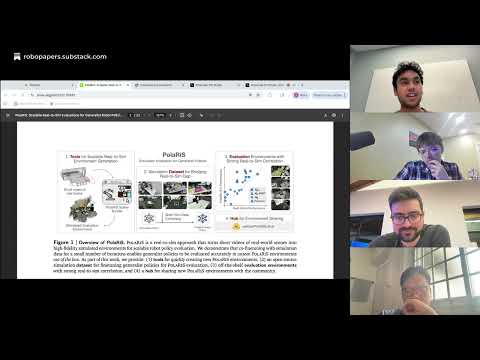
The tactical edge: Adopt PolaRiS for rapid policy iteration. Builders should use its browser-based scene builder and Gaussian Splatting to quickly create new, diverse evaluation environments from real-world scans, then fine-tune policies with small, unrelated sim data to achieve high real-to-sim correlation. This accelerates development cycles and reduces costly real-world testing.
The future of robotics hinges on scalable, trustworthy evaluation. PolaRiS provides a critical tool today to bridge the sim-to-real gap, enabling faster, more reliable development of generalist robot policies. Expect a community-driven explosion of benchmarks, pushing robot capabilities faster than ever over the next 6-12 months.
The robotics community needs to move beyond task-specific benchmarks with provided training data towards a diverse suite of generalization-focused evaluations, mirroring the LLM ecosystem. PolaRiS provides the tools to crowdsource and rapidly deploy these new benchmarks, fostering a more holistic understanding of robot policy capabilities.
For robot policy developers, prioritize tools like PolaRiS that offer high real-to-sim correlation with minimal setup. Leverage its browser-based scene builder and the "visual vaccination" co-training method to quickly iterate on policies for pick-and-place and articulated object tasks, then validate on real hardware.
Scalable, correlated simulation is the missing piece for accelerating generalist robot AI. Over the next 6-12 months, the adoption of tools like PolaRiS will enable faster policy iteration, more robust benchmarking, and ultimately, a quicker path to deploying capable robots in diverse, unstructured environments.
The robotics community is moving from hand-crafted, task-specific simulations to generalist policies that demand scalable, real-world correlated evaluation. PolaRiS enables this by making it cheap and easy to create diverse, high-fidelity sim environments from real scans, allowing for generalization testing akin to LLM benchmarks.
Implement PolaRiS for rapid policy iteration. Use its real-to-sim environment generation and minimal, unrelated sim data co-training to quickly validate robot policies against real-world performance, reducing costly physical robot time.
PolaRiS offers a critical infrastructure upgrade for robot AI development. By providing a fast, reproducible, and highly correlated simulation environment, it allows builders to iterate on generalist robot policies at software speed, significantly de-risking and accelerating the path to real-world deployment and broader robot capabilities over the next 6-12 months.
The drive for generalist robot policies demands scalable, reliable evaluation. PolaRiS pushes robotics toward the community-driven, diverse benchmarking common in LLMs, accelerating the path to truly capable robots.
Adopt PolaRiS for rapid policy iteration and generalization testing. Leverage its easy environment creation and proven real-to-sim correlation to quickly validate new robot behaviors before costly real-world deployment.
PolaRiS is a critical tool for any team building robot policies. It cuts evaluation costs, speeds up development, and provides a trustworthy signal for real-world performance, making it a must-have for your robotics roadmap over the next 6-12 months.
Builders should prioritize hybrid real-to-sim evaluation tools like PolaRiS for rapid policy iteration.
Use minimal, out-of-domain sim data to align policies to the simulation environment, ensuring your sim results accurately predict real-world performance.
Investing in tools that democratize benchmark creation and ensure strong real-to-sim correlation will accelerate robot policy development.
Social Proof is the New Alpha. FOMO’s core bet is that transparently tracking successful wallets is a more powerful discovery mechanism than traditional research. By making on-chain activity legible and social, it unlocks a new paradigm for retail investing.
User Experience Wins the Next Cycle. The next 100 million crypto users will not be onboarded with seed phrases and gas fees. By abstracting away all technical friction and mirroring the seamlessness of Web2 apps, FOMO provides a blueprint for mass adoption.
Trading is Becoming a Spectator Sport. By turning trading performance into a form of content, FOMO is building a new financial creator economy. The best traders are the new influencers, and their alpha is the content that drives the entire ecosystem.
The Internet Gets Its Native Wallet. x402 uses crypto to finally fulfill the internet's original vision of direct, peer-to-server payments, unlocking an economy of micropayments for everything from accessing an article to running an AI model.
The Ad-Supported Web Is Obsolete. AI agents that retrieve information without viewing ads are killing the web's 20-year-old business model. x402 provides the new economic rails for a pay-per-use internet where value is exchanged for resources, not attention.
Build Composable Money Legos. The biggest opportunity lies in creating simple, single-purpose APIs that agents can easily discover and compose. Think of it as building for the App Store of the emerging AI agent economy.
Despite the brutal sentiment, both speakers remain bullish, predicting a sharp reversal and a new all-time high for Bitcoin by the end of the year once macro clarity emerges.
Macro is King. Bitcoin's fate is now tied to the broader economy. Forget four-year cycles; the key catalyst is a resolution to the government shutdown, which could unlock pent-up energy in the market.
The Treasury Trade is Toast. The era of companies boosting their stock by simply buying Bitcoin is over. Expect a painful shakeout as the market demands real utility and revenue, leading to more forced selling.
Distribution is the prize, not payments. The real money in gaming isn't in payment rails, which are being competed down to zero. The scarcest and most valuable asset is user attention, and Open Game Protocol is designed to monetize distribution.
Decouple to survive. Tying a single game to a single token creates a fatal dependency. A flexible, many-to-many protocol allows ecosystems to thrive by spreading risk and aligning incentives across multiple games and communities.
Content abundance requires new discovery. As AI makes game creation cheap and fast, the bottleneck shifts from production to discovery. Integrating games directly into high-intent surfaces like crypto wallets creates a powerful, non-advertising-based discovery channel.
**Follow the Suits, Not the Shouts.** The market’s real signal is the massive disconnect between gloomy retail sentiment on social media and the unprecedented optimism from financial advisors and institutional platforms.
**Distribution is the New Kingmaker.** From Ripple buying prime brokerages to Tether leveraging its global south dominance, the primary battle is for distribution channels. The technical "best" solution is irrelevant if it can't reach users.
**Regulation Will Be a Slow Grind, Not a Big Bang.** Comprehensive crypto legislation is politically gridlocked. The industry’s integration into legacy finance will continue brick-by-brick through regulated products like ETFs, not sweeping bills from Congress.
Tokenized Funds Are a Real-World Unlock. Unlike many crypto narratives, bringing funds on-chain solves a tangible, expensive problem in traditional finance, creating massive operational efficiencies and new financial primitives.
The Bitcoin Holder Base Is Shifting. The ongoing "Bitcoin IPO" via ETFs means the asset is moving from the hands of early adopters to institutional portfolios. This structural shift will define its future trajectory.
Cash Is Your Best Hedge. In a market with fewer winners, holding cash is a strategic imperative. It prevents forced liquidation and provides the dry powder needed to seize high-conviction opportunities as they arise.