The Macro Shift: Celebrity capital is moving from transactional endorsements to strategic equity investments, driven by a desire for long-term wealth creation and the recognition that personal brand power can significantly accelerate startup growth.
The Tactical Edge: Cultivate a diverse network of mentors and partners, prioritizing those who bring complementary expertise and can challenge your assumptions.
The Bottom Line: The future of wealth creation for high-profile individuals and savvy investors lies in strategic, long-term equity plays, supported by strong teams and a willingness to partner.
AI agents with system-level access are shifting the core value proposition of software from discrete applications to fluid, context-aware personal assistants.
Cultivate "agent empathy" by learning to guide AI models effectively, understanding their limitations, and designing projects for agent-first navigation.
The rise of autonomous agents will redefine software's purpose and value.
Adopt PolaRiS for rapid policy iteration. Leverage its real-to-sim environment generation and minimal sim data co-training to quickly validate robot policies in diverse, unseen environments before committing to expensive real-world deployments.
The era of generalist robot policies demands a new paradigm for evaluation. The shift is from bespoke, real-world testing to scalable, high-fidelity sim-to-real correlation, enabling faster iteration and broader generalization testing.
Reliable sim-to-real evaluation is the missing link for accelerating robot AI. PolaRiS offers a pragmatic, community-driven path to unlock faster development cycles and more robust generalist robot policies over the next 6-12 months.
Generalist robot policies demand evaluation that tests true generalization across diverse, unseen environments. The shift is from hand-tuned, task-specific benchmarks to scalable, community-driven evaluation suites that can keep pace with rapidly improving model capabilities. This requires tools that make environment creation cheap and ensure real-world predictive power.
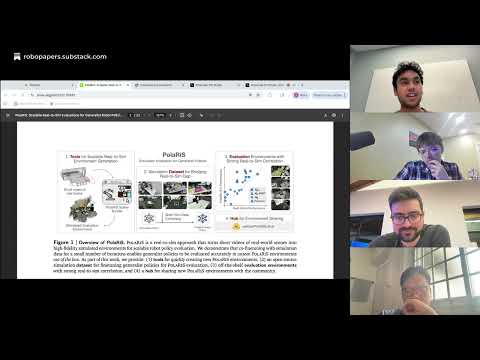
Adopt PolaRiS for rapid, correlated policy iteration. Builders should leverage its real-to-sim environment generation (Gaussian splatting for scenes, generative models for objects) and the "sim co-training" trick to quickly validate policy improvements against real-world performance, especially for pick-and-place tasks. Contribute new environments to the Polaris Hub to expand the collective benchmark.
The future of robotics hinges on fast, reliable evaluation. PolaRiS offers a pragmatic, immediate solution to accelerate policy development by providing high-fidelity, correlated sim environments. Over the next 6-12 months, expect this hybrid approach to become a standard for iterating on generalist robot policies, while fully learned world models continue to improve for more complex, deformable tasks.
The push for generalist robot policies demands scalable, trustworthy evaluation. PolaRiS democratizes high-fidelity sim evaluation, moving robotics closer to rapid iteration cycles seen in other AI fields.
Builders should explore PolaRiS's open-source tools and pre-trained checkpoints to quickly test policies in diverse, real-world-correlated environments. Prioritize visual fidelity and use small, unrelated sim data for alignment.
Rapid, reliable sim evaluation with strong real-world correlation is a significant advancement. This tool enables faster policy iteration, broader generalization, and community-driven benchmarking, setting the stage for the next generation of robot capabilities.
Generalist robot policies demand community-driven, scalable evaluation, mirroring LLM benchmarking. PolaRiS provides the technical foundation by making high-fidelity, correlated sim environments accessible.
Adopt PolaRiS for rapid policy iteration. Use its browser-based scene builder and Gaussian splatting for quick environment creation, incorporating minimal, unrelated sim co-training data for strong real-world correlation.
PolaRiS accelerates robot development with a reliable, scalable simulation tool. This means faster iteration, more robust policies, and a clearer path to real-world deployment for your robot applications over the next 6-12 months.
The era of generalist robot policies demands evaluation tools that can keep pace with rapid development and broad generalization. PolaRiS pushes robotics toward the LLM benchmark paradigm, where models are tested on unseen environments and tasks, rather than being trained on specific benchmarks.
For builders, leverage PolaRiS's browser-based scene builder and Gaussian splatting pipeline to quickly create diverse, high-fidelity evaluation environments from real-world scans. This enables faster policy iteration and more reliable real-world deployment.
PolaRiS offers a pragmatic, scalable path to more effective robot policy development. By providing a tool that makes sim performance a reliable predictor of real-world success, it accelerates the journey from lab to real-world application, especially for pick-and-place tasks, and sets the stage for community-driven benchmarking.
Celebrity capital is evolving from passive endorsements to active, strategic equity investment, transforming athletes and entertainers into powerful venture partners who bring more than just money to the table.
Prioritize building a diverse, expert team that can challenge your assumptions and vet opportunities, especially when entering new sectors like AI or overlooked geographic markets.
Long-term thinking, a willingness to invest in growth, and a focus on strategic partnerships are non-negotiable for building lasting wealth and influence in both traditional and emerging industries over the next 6-12 months.
**Corporates are building walled gardens.** Major players are leveraging public chains to create ecosystems they control, launching the "corporate chain meta" where activity is pulled onto proprietary networks like Base.
**Stablecoin M&A is white-hot, but frothy.** The frantic rush to acquire stablecoin infrastructure is driven by stock market optics as much as strategy, echoing the 2017 "add blockchain to your name" craze.
**Capital formation is returning to regulated US platforms.** Monad's ICO on Coinbase, offering zero lockups for US investors, sets a new precedent for compliant token launches and challenges the dominance of offshore exchanges.
The Fee Switch Is On. Uniswap's pivot to real-yield tokenomics is a watershed moment. Expect other DeFi protocols to follow, finally aligning token value with protocol success and rewarding long-term holders over mercenaries.
Onshore ICOs Are Back. Coinbase’s new token sales platform for US retail is a massive signal that the industry believes the regulatory tide has turned. This could unlock a new wave of capital and mainstream participation.
Privacy Is A High-Stakes Gamble. While the market is rewarding privacy tokens, the 5-year prison sentence for a wallet developer is a brutal reminder of the risks. Until clear rules are established, building privacy tools in the US remains legally treacherous.
Privacy is Paramount. SCORE’s use of TEEs for a private data track is the key that unlocks enterprise adoption, proving that decentralized networks can handle sensitive information securely.
The 1/10th Price Model Wins. Leveraging Bittensor’s incentive structure allows subnets to radically undercut legacy competitors on price without sacrificing quality, opening up previously inaccessible markets.
Tie Rewards to Revenue. The most sustainable tokenomic model directly links network emissions to real-world cash flow, ensuring the subnet's economy is grounded in tangible business success, not just speculation.
**Ethereum's New Offense:** Lean Ethereum marks a strategic pivot from a defensive, decentralization-first posture to an offensive "Beast Mode," targeting 10,000 TPS on L1—a 500x increase—to become the settlement layer for all of finance.
**The Validator Role is Evolving:** The future validator will verify tiny cryptographic proofs on cheap hardware (like a smartphone), not execute massive blocks. This radical shift, enabled by ZK-EVMs, simultaneously boosts scale and decentralization.
**L1 Scaling is Now Possible Without Centralization:** Unlike competitors who scale by using powerful hardware in data centers, Ethereum's use of SNARKs allows it to scale L1 while *decreasing* hardware requirements, reinforcing its core value proposition.
Proof-of-Work Is Now Verifiable. Targon’s TVM introduces a new primitive for Bittensor, making "proof of useful work" cryptographically verifiable. This technology could become the network’s standard, eliminating fraud and ensuring capital flows to genuine contributors.
The Internal Economy Is the Main Event. The focus has shifted from attracting external enterprise clients to building a robust, circular economy within Bittensor. The success of one subnet directly benefits others, creating a powerful collaborative incentive structure.
Bittensor Is Playing the Long Game Against Centralized AI. The strategy is clear: build a resilient, hyper-efficient decentralized alternative while centralized AI players burn through unsustainable amounts of capital. When the market turns, Bittensor aims to be the "black hole" that absorbs the distressed compute assets.
**Ditch the Alts, Buy the Adopters.** The most compelling risk/reward is no longer in L1 tokens but in publicly traded companies effectively integrating blockchain. Think Stripe and Robinhood, not the 25th-largest token on CoinMarketCap.
**Follow the Gamble.** The "gambling energy" from disillusioned younger generations is a powerful market force. That capital has pivoted from crypto to AI. The best trades lie in narratives that capture this retail attention.
**Conviction Over Diversification.** In a market with no consensus, holding a portfolio of "pretty good" assets is a losing strategy. Raise cash by cutting low-conviction plays and concentrate firepower in your highest-conviction ideas.