The Macro Shift: Celebrity capital is moving from transactional endorsements to strategic equity investments, driven by a desire for long-term wealth creation and the recognition that personal brand power can significantly accelerate startup growth.
The Tactical Edge: Cultivate a diverse network of mentors and partners, prioritizing those who bring complementary expertise and can challenge your assumptions.
The Bottom Line: The future of wealth creation for high-profile individuals and savvy investors lies in strategic, long-term equity plays, supported by strong teams and a willingness to partner.
AI agents with system-level access are shifting the core value proposition of software from discrete applications to fluid, context-aware personal assistants.
Cultivate "agent empathy" by learning to guide AI models effectively, understanding their limitations, and designing projects for agent-first navigation.
The rise of autonomous agents will redefine software's purpose and value.
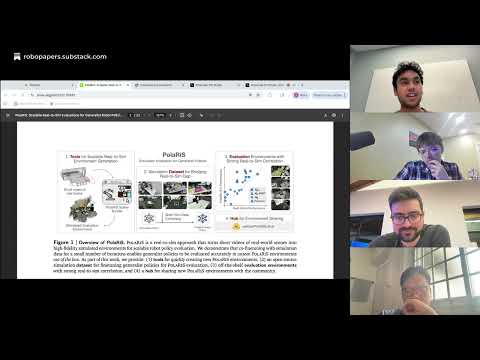
Adopt PolaRiS for rapid policy iteration. Leverage its real-to-sim environment generation and minimal sim data co-training to quickly validate robot policies in diverse, unseen environments before committing to expensive real-world deployments.
The era of generalist robot policies demands a new paradigm for evaluation. The shift is from bespoke, real-world testing to scalable, high-fidelity sim-to-real correlation, enabling faster iteration and broader generalization testing.
Reliable sim-to-real evaluation is the missing link for accelerating robot AI. PolaRiS offers a pragmatic, community-driven path to unlock faster development cycles and more robust generalist robot policies over the next 6-12 months.
Generalist robot policies demand evaluation that tests true generalization across diverse, unseen environments. The shift is from hand-tuned, task-specific benchmarks to scalable, community-driven evaluation suites that can keep pace with rapidly improving model capabilities. This requires tools that make environment creation cheap and ensure real-world predictive power.
Adopt PolaRiS for rapid, correlated policy iteration. Builders should leverage its real-to-sim environment generation (Gaussian splatting for scenes, generative models for objects) and the "sim co-training" trick to quickly validate policy improvements against real-world performance, especially for pick-and-place tasks. Contribute new environments to the Polaris Hub to expand the collective benchmark.
The future of robotics hinges on fast, reliable evaluation. PolaRiS offers a pragmatic, immediate solution to accelerate policy development by providing high-fidelity, correlated sim environments. Over the next 6-12 months, expect this hybrid approach to become a standard for iterating on generalist robot policies, while fully learned world models continue to improve for more complex, deformable tasks.
The push for generalist robot policies demands scalable, trustworthy evaluation. PolaRiS democratizes high-fidelity sim evaluation, moving robotics closer to rapid iteration cycles seen in other AI fields.
Builders should explore PolaRiS's open-source tools and pre-trained checkpoints to quickly test policies in diverse, real-world-correlated environments. Prioritize visual fidelity and use small, unrelated sim data for alignment.
Rapid, reliable sim evaluation with strong real-world correlation is a significant advancement. This tool enables faster policy iteration, broader generalization, and community-driven benchmarking, setting the stage for the next generation of robot capabilities.
Generalist robot policies demand community-driven, scalable evaluation, mirroring LLM benchmarking. PolaRiS provides the technical foundation by making high-fidelity, correlated sim environments accessible.
Adopt PolaRiS for rapid policy iteration. Use its browser-based scene builder and Gaussian splatting for quick environment creation, incorporating minimal, unrelated sim co-training data for strong real-world correlation.
PolaRiS accelerates robot development with a reliable, scalable simulation tool. This means faster iteration, more robust policies, and a clearer path to real-world deployment for your robot applications over the next 6-12 months.
The era of generalist robot policies demands evaluation tools that can keep pace with rapid development and broad generalization. PolaRiS pushes robotics toward the LLM benchmark paradigm, where models are tested on unseen environments and tasks, rather than being trained on specific benchmarks.
For builders, leverage PolaRiS's browser-based scene builder and Gaussian splatting pipeline to quickly create diverse, high-fidelity evaluation environments from real-world scans. This enables faster policy iteration and more reliable real-world deployment.
PolaRiS offers a pragmatic, scalable path to more effective robot policy development. By providing a tool that makes sim performance a reliable predictor of real-world success, it accelerates the journey from lab to real-world application, especially for pick-and-place tasks, and sets the stage for community-driven benchmarking.
Celebrity capital is evolving from passive endorsements to active, strategic equity investment, transforming athletes and entertainers into powerful venture partners who bring more than just money to the table.
Prioritize building a diverse, expert team that can challenge your assumptions and vet opportunities, especially when entering new sectors like AI or overlooked geographic markets.
Long-term thinking, a willingness to invest in growth, and a focus on strategic partnerships are non-negotiable for building lasting wealth and influence in both traditional and emerging industries over the next 6-12 months.
Capital Efficiency Is King. In the perps world, platforms offering unified margin will win. Aggregators that fragment capital are a structural disadvantage, making trading terminals the more logical endgame.
Onboard Hobbies, Not Traders. Crypto’s growth depends on moving beyond unsustainable, zero-sum trading narratives. The next million users will be onboarded through "hobbyified" social and entertainment apps, not another DEX.
Cash Now, Builders Later. In this environment, cash is king. Use this quiet period to identify teams grinding through the bear market, especially those with performance-locked incentives like MetaDAO projects. They are the asymmetric bets of the next cycle.
**Solve the Privacy Bug.** Institutions will not move sensitive operations onto fully transparent ledgers. The future is permissioned visibility, where regulators and involved parties can see data, but the public cannot.
**Composability is the Killer App.** The true unlock for on-chain finance is the ability to atomically combine different assets and workflows without operational risk. Fragmented L2s endanger this core value proposition.
**The Next Wave is Capital Markets Infrastructure.** The long-term moat for any network targeting institutional finance is not just its tech, but its ecosystem of interconnected banks, funds, and market makers operating in a compliant, private environment.
Stop Obsessing Over the Fed. The dominant force driving market liquidity is the geopolitical rivalry between the U.S. and China, which dictates massive cross-border capital flows and underpins U.S. asset valuations.
This Is a Repricing, Not a Recession. The current market drawdown is a healthy positioning unwind, not a crisis. The lack of a fear bid in long-term bonds signals this is an opportunity to buy the dip in a structural bull market.
Bitcoin Failed the Safe-Haven Test. Gold remains the premier asset for hedging geopolitical risk. Bitcoin has demonstrated it is a high-beta risk asset, with its recent rally driven more by speculative corporate treasury activity than a fundamental macro role.
Value is Decoupling from EBITDA. A brand's true worth is increasingly measured by its cultural impact, not just its revenue. Tokenization provides the mechanism to price and trade this cultural capital.
Memecoins are a Feature, Not a Bug. They are the earliest, purest form of tokenized culture, proving that a financial layer can supercharge a community's growth and alignment.
Invest in Cultural Arbitrage. The biggest opportunities are in projects and brands whose cultural influence dramatically outweighs their current financial metrics. This gap between impact and income is where tokenization creates exponential value.
Transparency Is the Best Moderator. Instead of policing content, Dune makes the underlying source code for every analysis public, empowering the community to self-regulate and verify data quality.
Build With the Ethos of the Ecosystem. Dune succeeded by embracing crypto's open-source nature, creating a collaborative platform that felt native to the space, unlike closed-source competitors.
Incentives Don't Have to Be Financial. Reputation, influence, and the ability to contribute to a shared body of knowledge are powerful motivators for community participation in open platforms.
**Short Everything But Bitcoin.** The vast majority of crypto assets trade at unjustifiable multiples based on cyclical, speculative revenue. Bitcoin, as a "digital gold" macro hedge, is the only asset with a durable investment thesis that stands apart from the overvalued tech plays.
**The L1 Thesis is Dead.** Investing in L1s is a bet on obsolete infrastructure. Future returns will be captured by killer applications that build real businesses and bring non-speculative users on-chain, not by the commoditized blockspace they run on.
**Acquire Users, Don't Wait For Them.** Crypto's central problem is its failure to grow its user base. The winning strategy is to buy existing businesses with real customers and integrate blockchain technology, thereby acquiring distribution rather than trying to build it from scratch in a hyper-competitive market.