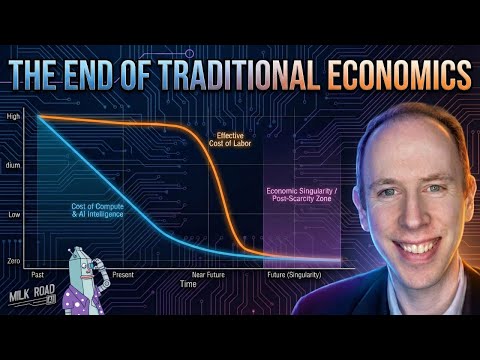
The Macro Shift: AI-driven hyperdeflation is colliding with the technical reality of autonomous AI agents creating their own crypto-backed economies, threatening a decoupling from human fiat systems.
The Tactical Edge: Investigate and build infrastructure that bridges human and AI economies, focusing on fiat-to-crypto rails that can accommodate agent-driven transactions to prevent a complete split.
The Bottom Line: The next 5-10 years will see an unprecedented economic transformation. Understanding AI's deflationary power and the emerging AI agent economy is critical for navigating a world where traditional economic models may no longer apply.
The time of practical AI agents is here, moving compute demand beyond pure GPU inference to a significant reliance on CPUs for coordination, data handling, and security.
Evaluate your agent deployment strategy now, prioritizing sandboxed environments (VPS, dedicated local servers) and exploring cost-optimized model routing to manage API expenses.
Prepare for a future where AI agents become integral to workflows, but recognize the hidden infrastructure costs and security implications, particularly the growing importance of CPU capacity and robust access controls.
The shift from "how" to "why" in AI agent capabilities creates a new, multi-trillion-dollar market for companies that can capture institutional decision logic.
Invest in or build agentic systems that are in the "right path" of business processes, actively capturing decision traces from unstructured data.
Hundreds of context graphs will be in production at scale within a year, defining a new "context graph stack." The winning companies will be those that master this flywheel, extracting value to accelerate automation and build deep, defensible moats.
The shift from linear, bottleneck-driven technological progress to a multi-layered, interconnected advancement model in AI has rendered traditional forecasting obsolete, forcing a re-evaluation of what "singularity" truly represents.
Prioritize adaptability: Invest in modular, composable AI infrastructure and tools that thrive in multi-layered, unpredictable environments, rather than betting on single-bottleneck solutions.
The inability to narrate AI's future means traditional roadmaps are obsolete; success hinges on navigating simultaneous, interconnected advancements and embracing the emergent.
The era of infrastructure-heavy tech deployment is over; AI's internet-native nature means immediate, widespread application. This shifts the competitive advantage from capital-intensive builds to rapid iteration and data leverage.
Invest in companies that are not just using AI, but are fundamentally rethinking their business models around AI's ability to collapse traditional cost structures and accelerate product development.
AI is a force multiplier for both individual opportunity and national power. Understanding its immediate deployability and the new rules of company building is crucial for investors and builders aiming to lead in the next wave of innovation over the next 12-24 months.
Unprecedented fiscal and monetary stimulus, coupled with a deregulatory environment, creates a powerful tailwind for financial assets and tech, driving a capital investment super cycle.
Investors should prioritize companies with proprietary data and GPU access, as these are the new moats in an AI-driven world where traditional software leads are eroding.
The convergence of a stimulative macro environment and AI's disruptive force means capital will flow to those who can scale, innovate, and navigate complex policy landscapes, making strategic positioning now critical for future relevance.
The macro trend of autonomous AI agents is shifting compute demand beyond GPUs, creating an unexpected CPU crunch and forcing a re-evaluation of on-premise inference and cost-optimized model routing for security and efficiency.
Investigate hybrid compute strategies, combining secure local environments (Mac Minis, home servers) with cloud-based LLMs, and explore multi-model API gateways like OpenRouter to optimize agent costs and performance.
AI agents are here, demanding a rethink of your compute stack and security protocols. Prepare for a future where CPU capacity, not just GPU, becomes a critical bottleneck, and strategic cost management for diverse AI models is non-negotiable for competitive advantage.
The move from general-purpose LLMs to specialized AI agents demands a new data architecture that captures the *why* of decisions, not just the *what*. This creates a new, defensible layer of institutional memory, moving value from raw model IP to proprietary decision intelligence.
Invest in or build agentic systems that are in the *orchestration path* of specific business processes. This allows for the organic capture of decision traces, forming a proprietary context graph that incumbents cannot easily replicate.
Over the next 12 months, the ability to build and extract value from context graphs will define the winners in the enterprise AI space, creating a new "context graph stack" that will be 10x more valuable than the modern data stack.
Capital Efficiency Is King. In the perps world, platforms offering unified margin will win. Aggregators that fragment capital are a structural disadvantage, making trading terminals the more logical endgame.
Onboard Hobbies, Not Traders. Crypto’s growth depends on moving beyond unsustainable, zero-sum trading narratives. The next million users will be onboarded through "hobbyified" social and entertainment apps, not another DEX.
Cash Now, Builders Later. In this environment, cash is king. Use this quiet period to identify teams grinding through the bear market, especially those with performance-locked incentives like MetaDAO projects. They are the asymmetric bets of the next cycle.
**Solve the Privacy Bug.** Institutions will not move sensitive operations onto fully transparent ledgers. The future is permissioned visibility, where regulators and involved parties can see data, but the public cannot.
**Composability is the Killer App.** The true unlock for on-chain finance is the ability to atomically combine different assets and workflows without operational risk. Fragmented L2s endanger this core value proposition.
**The Next Wave is Capital Markets Infrastructure.** The long-term moat for any network targeting institutional finance is not just its tech, but its ecosystem of interconnected banks, funds, and market makers operating in a compliant, private environment.
Stop Obsessing Over the Fed. The dominant force driving market liquidity is the geopolitical rivalry between the U.S. and China, which dictates massive cross-border capital flows and underpins U.S. asset valuations.
This Is a Repricing, Not a Recession. The current market drawdown is a healthy positioning unwind, not a crisis. The lack of a fear bid in long-term bonds signals this is an opportunity to buy the dip in a structural bull market.
Bitcoin Failed the Safe-Haven Test. Gold remains the premier asset for hedging geopolitical risk. Bitcoin has demonstrated it is a high-beta risk asset, with its recent rally driven more by speculative corporate treasury activity than a fundamental macro role.
Value is Decoupling from EBITDA. A brand's true worth is increasingly measured by its cultural impact, not just its revenue. Tokenization provides the mechanism to price and trade this cultural capital.
Memecoins are a Feature, Not a Bug. They are the earliest, purest form of tokenized culture, proving that a financial layer can supercharge a community's growth and alignment.
Invest in Cultural Arbitrage. The biggest opportunities are in projects and brands whose cultural influence dramatically outweighs their current financial metrics. This gap between impact and income is where tokenization creates exponential value.
Transparency Is the Best Moderator. Instead of policing content, Dune makes the underlying source code for every analysis public, empowering the community to self-regulate and verify data quality.
Build With the Ethos of the Ecosystem. Dune succeeded by embracing crypto's open-source nature, creating a collaborative platform that felt native to the space, unlike closed-source competitors.
Incentives Don't Have to Be Financial. Reputation, influence, and the ability to contribute to a shared body of knowledge are powerful motivators for community participation in open platforms.
**Short Everything But Bitcoin.** The vast majority of crypto assets trade at unjustifiable multiples based on cyclical, speculative revenue. Bitcoin, as a "digital gold" macro hedge, is the only asset with a durable investment thesis that stands apart from the overvalued tech plays.
**The L1 Thesis is Dead.** Investing in L1s is a bet on obsolete infrastructure. Future returns will be captured by killer applications that build real businesses and bring non-speculative users on-chain, not by the commoditized blockspace they run on.
**Acquire Users, Don't Wait For Them.** Crypto's central problem is its failure to grow its user base. The winning strategy is to buy existing businesses with real customers and integrate blockchain technology, thereby acquiring distribution rather than trying to build it from scratch in a hyper-competitive market.