The digital experience economy is moving from static content to dynamic, AI-driven co-experience platforms, where user interaction data becomes the core asset for training next-generation virtual intelligence.
Invest in platforms that offer robust, cloud-connected infrastructure and proprietary, vectorized user data for AI training, as these will be the engines for future immersive content and agentic AI development.
Roblox's long-term vision, powered by its unique data moat and AI investments, positions it to define the future of virtual co-experience, making it a critical player to watch for investors and builders in the AI and gaming space over the next 6-12 months.
The exponential reduction in the cost of intelligence, coupled with open-source proliferation, is pushing AI into every corner of society, creating a collective action problem where market incentives for "engaging" AI clash with the need for societal safety and control.
Get hands-on with AI now. "Vibe coding" and actively experimenting with AI tools builds "AI muscle," inoculating users against psychosis risks and building a deeper understanding of AI's capabilities and limitations.
AI is here to stay and will redefine work and interaction. Understanding its "hyperobject" nature, advocating for clear regulatory boundaries, and actively engaging with the technology are critical for navigating the near future without falling for its simulated charms.
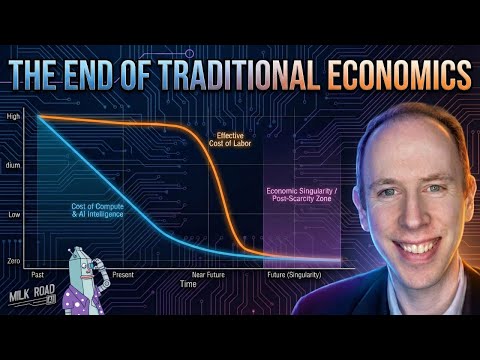
AI-driven hyperdeflation will fundamentally alter economic structures, leading to a post-scarcity future where the primary challenge shifts from production to distribution and the integration of human and machine economies.
Invest in infrastructure that bridges human and AI economies, or prepare for a future where AI agents become a significant, crypto-native economic force.
The next 6-12 months will see continued acceleration of AI capabilities, pushing us closer to a future where traditional labor and intelligence are nearly free. Understanding this change is crucial for navigating the emerging economic landscape and identifying new value creation opportunities.
The era of opaque, black-box AI is ending; the future demands intentionally designed models with human understanding and control. This shift is driven by reliability in high-stakes applications and extracting novel insights.
Investigate interpretability tools (like Goodfire's platform) to gain granular control over model behavior, moving beyond basic fine-tuning for critical applications.
Interpretability is not a niche; it's the missing piece for scaling AI safely into mission-critical domains. Mastering model understanding and intentional design will yield unprecedented capabilities and competitive advantage.
Robotics is moving from bespoke, data-hungry behavior cloning to generalized, human-informed learning via world models. This shift, mirroring the success of LLMs, means robots can use the vast, unstructured data of human experience to acquire new skills.
Invest in platforms and data pipelines that facilitate multi-modal, multi-stage training for humanoid robots. Prioritize systems that can generate synthetic data and use world models for high-throughput, targeted policy evaluation.
World models are the engine for scalable robot intelligence. They promise a future where robots learn faster, generalize wider, and self-improve through iterative simulation, making widespread humanoid deployment a near-term reality.
The Macro Shift: AI is collapsing the time horizon for technological deployment and market dominance, shifting the competitive advantage from pure innovation to a combination of innovation, capital, and rapid infrastructure deployment.
The Tactical Edge: Invest in companies that are not just building AI, but are fundamentally rethinking existing industries with AI-first principles, recognizing that traditional software moats are eroding.
The Bottom Line: The next 12-24 months will see AI's broad impact kick in, creating unprecedented opportunities for those who understand its new "laws of physics" and the critical role of policy in shaping its trajectory.
The healthcare system is moving from reactive, acute care to proactive, preventative interventions, driven by the unsustainable costs of chronic disease and a growing understanding of environmental health.
Build infrastructure that financially incentivizes lifestyle interventions, such as TrueMed's HSA/FSA payment rails for health-promoting products and services.
The next decade will see hundreds of billions of dollars redirected towards preventative health. Companies that bridge the gap between lifestyle choices and healthcare financing will capture significant market share.
The Macro Shift: Global energy demand, driven by AI, forces a strategic re-evaluation of nuclear power. This creates a window for nations to re-shore critical energy infrastructure, moving from reliance on adversaries to domestic, cost-competitive solutions.
The Tactical Edge: Investigate companies addressing foundational supply chain gaps in critical industries like energy. Look for teams with a "first principles" engineering approach and a track record of commercializing hard tech.
The Bottom Line: America's energy independence and its ability to power future technological growth, like AI, hinge on rebuilding domestic nuclear fuel enrichment. This is not just an industrial opportunity; it is a national security imperative.
Capital Efficiency Is King. In the perps world, platforms offering unified margin will win. Aggregators that fragment capital are a structural disadvantage, making trading terminals the more logical endgame.
Onboard Hobbies, Not Traders. Crypto’s growth depends on moving beyond unsustainable, zero-sum trading narratives. The next million users will be onboarded through "hobbyified" social and entertainment apps, not another DEX.
Cash Now, Builders Later. In this environment, cash is king. Use this quiet period to identify teams grinding through the bear market, especially those with performance-locked incentives like MetaDAO projects. They are the asymmetric bets of the next cycle.
**Solve the Privacy Bug.** Institutions will not move sensitive operations onto fully transparent ledgers. The future is permissioned visibility, where regulators and involved parties can see data, but the public cannot.
**Composability is the Killer App.** The true unlock for on-chain finance is the ability to atomically combine different assets and workflows without operational risk. Fragmented L2s endanger this core value proposition.
**The Next Wave is Capital Markets Infrastructure.** The long-term moat for any network targeting institutional finance is not just its tech, but its ecosystem of interconnected banks, funds, and market makers operating in a compliant, private environment.
Stop Obsessing Over the Fed. The dominant force driving market liquidity is the geopolitical rivalry between the U.S. and China, which dictates massive cross-border capital flows and underpins U.S. asset valuations.
This Is a Repricing, Not a Recession. The current market drawdown is a healthy positioning unwind, not a crisis. The lack of a fear bid in long-term bonds signals this is an opportunity to buy the dip in a structural bull market.
Bitcoin Failed the Safe-Haven Test. Gold remains the premier asset for hedging geopolitical risk. Bitcoin has demonstrated it is a high-beta risk asset, with its recent rally driven more by speculative corporate treasury activity than a fundamental macro role.
Value is Decoupling from EBITDA. A brand's true worth is increasingly measured by its cultural impact, not just its revenue. Tokenization provides the mechanism to price and trade this cultural capital.
Memecoins are a Feature, Not a Bug. They are the earliest, purest form of tokenized culture, proving that a financial layer can supercharge a community's growth and alignment.
Invest in Cultural Arbitrage. The biggest opportunities are in projects and brands whose cultural influence dramatically outweighs their current financial metrics. This gap between impact and income is where tokenization creates exponential value.
Transparency Is the Best Moderator. Instead of policing content, Dune makes the underlying source code for every analysis public, empowering the community to self-regulate and verify data quality.
Build With the Ethos of the Ecosystem. Dune succeeded by embracing crypto's open-source nature, creating a collaborative platform that felt native to the space, unlike closed-source competitors.
Incentives Don't Have to Be Financial. Reputation, influence, and the ability to contribute to a shared body of knowledge are powerful motivators for community participation in open platforms.
**Short Everything But Bitcoin.** The vast majority of crypto assets trade at unjustifiable multiples based on cyclical, speculative revenue. Bitcoin, as a "digital gold" macro hedge, is the only asset with a durable investment thesis that stands apart from the overvalued tech plays.
**The L1 Thesis is Dead.** Investing in L1s is a bet on obsolete infrastructure. Future returns will be captured by killer applications that build real businesses and bring non-speculative users on-chain, not by the commoditized blockspace they run on.
**Acquire Users, Don't Wait For Them.** Crypto's central problem is its failure to grow its user base. The winning strategy is to buy existing businesses with real customers and integrate blockchain technology, thereby acquiring distribution rather than trying to build it from scratch in a hyper-competitive market.