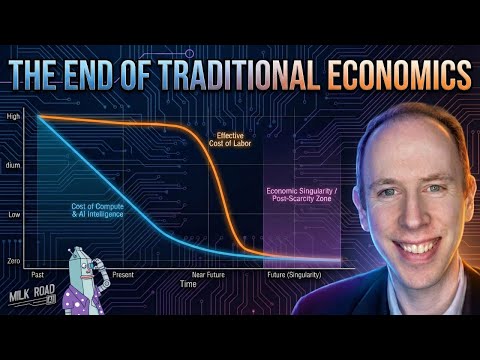
The Macro Shift: AI-driven hyperdeflation is colliding with the technical reality of autonomous AI agents creating their own crypto-backed economies, threatening a decoupling from human fiat systems.
The Tactical Edge: Investigate and build infrastructure that bridges human and AI economies, focusing on fiat-to-crypto rails that can accommodate agent-driven transactions to prevent a complete split.
The Bottom Line: The next 5-10 years will see an unprecedented economic transformation. Understanding AI's deflationary power and the emerging AI agent economy is critical for navigating a world where traditional economic models may no longer apply.
The time of practical AI agents is here, moving compute demand beyond pure GPU inference to a significant reliance on CPUs for coordination, data handling, and security.
Evaluate your agent deployment strategy now, prioritizing sandboxed environments (VPS, dedicated local servers) and exploring cost-optimized model routing to manage API expenses.
Prepare for a future where AI agents become integral to workflows, but recognize the hidden infrastructure costs and security implications, particularly the growing importance of CPU capacity and robust access controls.
The shift from "how" to "why" in AI agent capabilities creates a new, multi-trillion-dollar market for companies that can capture institutional decision logic.
Invest in or build agentic systems that are in the "right path" of business processes, actively capturing decision traces from unstructured data.
Hundreds of context graphs will be in production at scale within a year, defining a new "context graph stack." The winning companies will be those that master this flywheel, extracting value to accelerate automation and build deep, defensible moats.
The shift from linear, bottleneck-driven technological progress to a multi-layered, interconnected advancement model in AI has rendered traditional forecasting obsolete, forcing a re-evaluation of what "singularity" truly represents.
Prioritize adaptability: Invest in modular, composable AI infrastructure and tools that thrive in multi-layered, unpredictable environments, rather than betting on single-bottleneck solutions.
The inability to narrate AI's future means traditional roadmaps are obsolete; success hinges on navigating simultaneous, interconnected advancements and embracing the emergent.
The era of infrastructure-heavy tech deployment is over; AI's internet-native nature means immediate, widespread application. This shifts the competitive advantage from capital-intensive builds to rapid iteration and data leverage.
Invest in companies that are not just using AI, but are fundamentally rethinking their business models around AI's ability to collapse traditional cost structures and accelerate product development.
AI is a force multiplier for both individual opportunity and national power. Understanding its immediate deployability and the new rules of company building is crucial for investors and builders aiming to lead in the next wave of innovation over the next 12-24 months.
Unprecedented fiscal and monetary stimulus, coupled with a deregulatory environment, creates a powerful tailwind for financial assets and tech, driving a capital investment super cycle.
Investors should prioritize companies with proprietary data and GPU access, as these are the new moats in an AI-driven world where traditional software leads are eroding.
The convergence of a stimulative macro environment and AI's disruptive force means capital will flow to those who can scale, innovate, and navigate complex policy landscapes, making strategic positioning now critical for future relevance.
The macro trend of autonomous AI agents is shifting compute demand beyond GPUs, creating an unexpected CPU crunch and forcing a re-evaluation of on-premise inference and cost-optimized model routing for security and efficiency.
Investigate hybrid compute strategies, combining secure local environments (Mac Minis, home servers) with cloud-based LLMs, and explore multi-model API gateways like OpenRouter to optimize agent costs and performance.
AI agents are here, demanding a rethink of your compute stack and security protocols. Prepare for a future where CPU capacity, not just GPU, becomes a critical bottleneck, and strategic cost management for diverse AI models is non-negotiable for competitive advantage.
The move from general-purpose LLMs to specialized AI agents demands a new data architecture that captures the *why* of decisions, not just the *what*. This creates a new, defensible layer of institutional memory, moving value from raw model IP to proprietary decision intelligence.
Invest in or build agentic systems that are in the *orchestration path* of specific business processes. This allows for the organic capture of decision traces, forming a proprietary context graph that incumbents cannot easily replicate.
Over the next 12 months, the ability to build and extract value from context graphs will define the winners in the enterprise AI space, creating a new "context graph stack" that will be 10x more valuable than the modern data stack.
Privacy Intents Beat Liquidity Fragmentation: Aztec’s architecture blankets existing Ethereum DeFi with privacy, bypassing the need to bootstrap a siloed ecosystem and turning it into a universal privacy utility layer.
ZK Passport Is Web3's Answer to AI Deepfakes: By leveraging hardware-level passport verification, ZK Passport offers a cryptographically secure solution to identity verification, enabling compliant privacy without trusting intermediaries.
Decentralization Is a Baseline Requirement: Aztec is launching as a fully decentralized L2, arguing that for a privacy network, neutrality and censorship resistance are not future goals but non-negotiable starting conditions.
Leverage is the Real Trigger. The BOJ pivot was just the spark. The crypto market’s bonfire was fueled by excessive leverage, turning a macro ripple into a tidal wave and signaling a broader rotation from high-beta assets to value.
Narrative Trumps Fundamentals (For Now). MicroStrategy’s CEO stated a basic corporate finance reality—they’d sell BTC if required to service debt—and the market tanked. This proves that in retail-driven markets, violating the "diamond hands" story is more damaging than a weak balance sheet.
TradFi's Glass House. While legacy finance lobbies against crypto’s perceived risks, its own critical infrastructure is failing due to mundane issues like a broken air conditioner, making a powerful, real-time case for decentralized resilience.
Leverage is the Accelerant: The market's violent reaction to predictable macro news reveals a system still prone to painful, cascading deleveraging events driven by over-leveraged players.
Narratives are Fragile Assets: MicroStrategy’s stumble shows that in crypto, narrative integrity is as critical as financial solvency. A violation can trigger sell-offs regardless of underlying fundamentals.
Old Systems Break While New Ones are Built: The CME outage is a powerful, real-time advertisement for decentralized alternatives, underscoring TradFi's fragility even as its gatekeepers resist change.
Macro is Back in Charge. The era of cheap leverage is facing a global reckoning, with the unwind of the Yen Carry Trade serving as a key trigger. High-beta assets like crypto are the first to feel the pain.
Narrative Trumps Numbers. MicroStrategy's dip wasn't about math; it was about breaking a story. In crypto, violating a core community belief can be more damaging than a weak earnings report.
TradFi's Fragility is Crypto's Calling Card. While crypto fends off FUD, a major institution like the CME went offline for 10 hours due to a failed air conditioner. This is a powerful, real-world advertisement for decentralized resilience.
High-Beta is a Crowded Trade: Crypto, alongside assets like uranium and quantum stocks, is being sold off in unison as investors rotate into value stocks. In this defensive environment, expect Bitcoin to outperform altcoins.
Narrative Trumps Fundamentals (For Now): MicroStrategy’s stock plunged not on a fundamental crisis but on the CEO admitting they *might* sell Bitcoin in a corner case—a direct violation of their "never sell" narrative.
Don't Fight the Central Banks: The BOJ’s tightening signal was the trigger for the dump. Conversely, the Fed's expected rate cuts and potential for future dovish leadership remain the key bullish catalysts to watch.
DEXes Are Winning by Default: The sheer volume of new, on-chain-only tokens is an unstoppable force driving users to DEXes. Centralized exchanges can either integrate or become irrelevant for the long tail of assets.
The Real Money is in the Rails: Don't focus on who will issue the next dominant stablecoin. The biggest opportunity lies in building the interoperability infrastructure that will connect the coming flood of branded, corporate, and national stablecoins.
Bitcoin's Ultimate Bull Case is Geopolitical: In a world of fragmenting currencies and rising geopolitical tensions, Bitcoin's status as a non-sovereign, politically neutral asset makes it the ultimate contender for a global reserve currency.