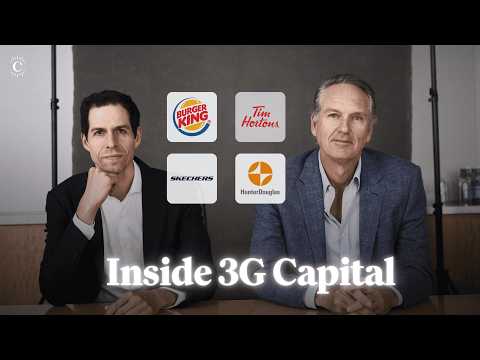
3G commits to one investment per fund, deploying significant internal capital alongside partners. This focus allows for rigorous downside analysis and patience, ensuring only truly exceptional businesses are acquired.
3G partners are seasoned operators who step into businesses, aligning incentives with ownership. This hands-on approach ensures decisions serve the business's long-term health, not just short-term management goals.
3G prioritizes businesses that directly own their customer relationships, like Burger King or Hunter Douglas. This direct connection reduces disintermediation risk from retailers or new technologies.
As capital markets become increasingly efficient and competitive, the edge moves from financial engineering to deep operational expertise and long-term, owner-aligned management.
Prioritize identifying and enabling high-potential individuals early in their careers, granting them significant responsibility and ownership.
Disciplined focus, patient relationship building, and an unwavering commitment to operational excellence in established, defensible businesses can still yield generational wealth.
The Macro Trend: In a world obsessed with digital disruption, 3G Capital's success with "atoms over bits" businesses highlights a strategic pivot: enduring value often resides in established brands with proprietary customer relationships, where operational excellence and long-term thinking create moats against fleeting tech trends.
The Tactical Edge: Identify businesses with strong, direct customer relationships and a clear path for operational improvement, even if they appear "boring." Prioritize deep, hands-on involvement to drive value, rather than relying solely on financial engineering.
The Bottom Line: The future of outsized returns may not be in chasing the next big tech wave, but in patiently acquiring and meticulously operating businesses that own their customer relationships, leveraging technology to enhance, not redefine, their core value. This strategy offers a more predictable, less volatile path to compounding capital.
The Macro Shift: In a world obsessed with digital disruption, 3G Capital's success highlights the enduring power of "hard" businesses with strong customer relationships. Their focus on foundational consumer brands, managed by operator-investors who prioritize long-term ownership and disciplined execution, offers a robust counter-narrative to the "bits over atoms" trend.
The Tactical Edge: Cultivate an extreme ownership culture by aligning incentives deeply, empowering young talent with real responsibility, and fostering a relentless bias for action.
The Bottom Line: For investors and builders, the lesson is clear: patience, deep operational involvement, and a fanatical focus on talent in defensible, "boring" businesses can yield extraordinary, long-term value, even in expensive markets.
Extreme Focus: 3G Capital commits to one investment per fund, deploying significant internal capital alongside partners. This singular focus forces rigorous downside analysis and patience, ensuring they only pursue truly exceptional opportunities.
Owner Operators: 3G partners are seasoned operators who step into businesses, aligning incentives with ownership. This means leaders act like shareholders, making decisions for the business's long-term health, not just short-term management goals.
Disruption Defense: 3G prioritizes businesses with strong customer relationships and physical components, making them less susceptible to digital disintermediation. They seek enduring brands like Hunter Douglas, where the sun will always rise and set, ensuring a consistent need for their product.
In an era of rapid technological change, businesses with strong, direct customer relationships and physical moats are increasingly valuable. 3G's focus on these "atoms" businesses, enhanced by strategic tech adoption, provides a blueprint for durable value creation.
Cultivate an ownership culture by aligning incentives deeply, empowering young talent with real responsibility, and prioritizing long-term value over short-term gains.
The future belongs to patient, operator-led investors who can identify and transform enduring businesses by focusing on fundamental quality, people, and strategic technological integration, rather than chasing fleeting trends.
3G Capital's model counters this by doubling down on "atoms" businesses with strong customer relationships and defensible positions, then applying rigorous operational excellence.
Cultivate an owner-operator mindset within your organization, even if you are not a private equity firm. Identify and back high-potential young talent with significant responsibility and aligned incentives, providing mentorship to maximize their success.
In a world obsessed with speed and diversification, 3G Capital proves that deep, patient, operator-led concentration on high-quality, defensible businesses, combined with a culture of ownership and meritocracy, remains a powerful engine for outsized value creation.
The era of celebrity endorsements is evolving into one of celebrity ownership, driven by a growing understanding of equity's compounding power and enabled by new technologies that lower the barrier to business creation.
Prioritize building a diverse, expert team and actively seek out "boring" businesses or underserved markets with clear, unmet demand.
The next 6-12 months will see an acceleration of talent leveraging their brand for equity stakes, particularly in tech-enabled ventures. Position yourself to either participate in these deals or build the tools that empower this new class of owner-operators.
Embrace Futarchy: Explore and implement market-driven governance mechanisms to enhance decision-making in decentralized organizations, reducing reliance on traditional, potentially biased, governance models.
Prioritize Investor Protection: Adopt capital formation models, such as MetaDAO's, that offer robust investor protections through market-based checks and balances, mitigating risks associated with centralized control and poorly informed token allocation.
Prepare for Crypto-Native Solutions: Build cryptonative primitives that can compete with traditional financial systems. This can prevent tradFi from dominating the blockchain space.
**Regulation is inevitable:** Crypto's foray into traditional financial activities necessitates regulatory oversight to protect investors and maintain market integrity.
**Compliance is key:** Crypto firms seeking legitimacy and long-term sustainability must prioritize regulatory compliance and address inherent conflicts of interest.
**Philosophical divide persists:** Fundamental disagreements regarding decentralization, code as speech, and the role of intermediaries continue to fuel tensions between the SEC and the crypto industry.
**Seize the Opportunity:** Bitcoin's undervaluation relative to gold presents a strategic entry point for investors who believe in its long-term potential.
**Explore Layer 1 Potential:** Ethereum's enhanced scalability post-Fusaka makes it increasingly viable for developers to build directly on layer 1, unlocking new possibilities.
**Monitor Regulatory Developments:** The evolving regulatory landscape for prediction markets requires careful attention, as state-level challenges could impact their accessibility and operation.
Active DATs are high-fee ETFs in disguise. The only DATs that will survive are those actively using on-chain strategies and unique financing structures to generate yield beyond simple staking, providing value that a passive ETF cannot.
The crypto market is no longer its own island. The four-year cycle is dead. Treat major crypto assets as a leveraged play on the NASDAQ and global liquidity; macro trends now dictate the market's direction.
The Solana vs. Ethereum trade is a conviction play. DFDV's core bet is that Solana's superior fundamentals will inevitably close the massive valuation gap with Ethereum, making it the highest-upside L1 asset.
DATs Must Be More Than ETFs. The DATs that survive won't be passive holders charging high fees. They will be active managers using unique tools like convertible bonds and on-chain yield farming to grow assets per share.
The Solana Flippening Thesis is Real. DFDV's core bet is on a fundamental mismatch: Solana's superior tech and user growth versus Ethereum's legacy valuation. They believe the gap will close, driving massive upside.
Crypto is a Macro Play. The four-year cycle is obsolete. Crypto now acts as a high-beta instrument tied to global liquidity, meaning its performance hinges on macro trends, not just internal events like the halving.