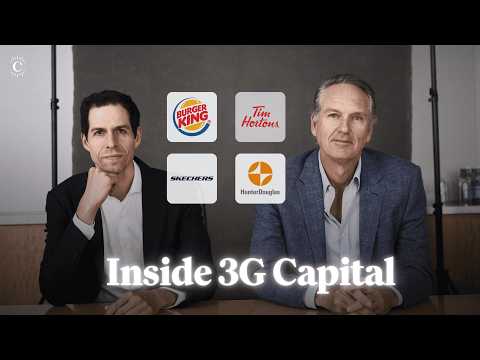
3G commits to one investment per fund, deploying significant internal capital alongside partners. This focus allows for rigorous downside analysis and patience, ensuring only truly exceptional businesses are acquired.
3G partners are seasoned operators who step into businesses, aligning incentives with ownership. This hands-on approach ensures decisions serve the business's long-term health, not just short-term management goals.
3G prioritizes businesses that directly own their customer relationships, like Burger King or Hunter Douglas. This direct connection reduces disintermediation risk from retailers or new technologies.
As capital markets become increasingly efficient and competitive, the edge moves from financial engineering to deep operational expertise and long-term, owner-aligned management.
Prioritize identifying and enabling high-potential individuals early in their careers, granting them significant responsibility and ownership.
Disciplined focus, patient relationship building, and an unwavering commitment to operational excellence in established, defensible businesses can still yield generational wealth.
The Macro Trend: In a world obsessed with digital disruption, 3G Capital's success with "atoms over bits" businesses highlights a strategic pivot: enduring value often resides in established brands with proprietary customer relationships, where operational excellence and long-term thinking create moats against fleeting tech trends.
The Tactical Edge: Identify businesses with strong, direct customer relationships and a clear path for operational improvement, even if they appear "boring." Prioritize deep, hands-on involvement to drive value, rather than relying solely on financial engineering.
The Bottom Line: The future of outsized returns may not be in chasing the next big tech wave, but in patiently acquiring and meticulously operating businesses that own their customer relationships, leveraging technology to enhance, not redefine, their core value. This strategy offers a more predictable, less volatile path to compounding capital.
The Macro Shift: In a world obsessed with digital disruption, 3G Capital's success highlights the enduring power of "hard" businesses with strong customer relationships. Their focus on foundational consumer brands, managed by operator-investors who prioritize long-term ownership and disciplined execution, offers a robust counter-narrative to the "bits over atoms" trend.
The Tactical Edge: Cultivate an extreme ownership culture by aligning incentives deeply, empowering young talent with real responsibility, and fostering a relentless bias for action.
The Bottom Line: For investors and builders, the lesson is clear: patience, deep operational involvement, and a fanatical focus on talent in defensible, "boring" businesses can yield extraordinary, long-term value, even in expensive markets.
Extreme Focus: 3G Capital commits to one investment per fund, deploying significant internal capital alongside partners. This singular focus forces rigorous downside analysis and patience, ensuring they only pursue truly exceptional opportunities.
Owner Operators: 3G partners are seasoned operators who step into businesses, aligning incentives with ownership. This means leaders act like shareholders, making decisions for the business's long-term health, not just short-term management goals.
Disruption Defense: 3G prioritizes businesses with strong customer relationships and physical components, making them less susceptible to digital disintermediation. They seek enduring brands like Hunter Douglas, where the sun will always rise and set, ensuring a consistent need for their product.
In an era of rapid technological change, businesses with strong, direct customer relationships and physical moats are increasingly valuable. 3G's focus on these "atoms" businesses, enhanced by strategic tech adoption, provides a blueprint for durable value creation.
Cultivate an ownership culture by aligning incentives deeply, empowering young talent with real responsibility, and prioritizing long-term value over short-term gains.
The future belongs to patient, operator-led investors who can identify and transform enduring businesses by focusing on fundamental quality, people, and strategic technological integration, rather than chasing fleeting trends.
3G Capital's model counters this by doubling down on "atoms" businesses with strong customer relationships and defensible positions, then applying rigorous operational excellence.
Cultivate an owner-operator mindset within your organization, even if you are not a private equity firm. Identify and back high-potential young talent with significant responsibility and aligned incentives, providing mentorship to maximize their success.
In a world obsessed with speed and diversification, 3G Capital proves that deep, patient, operator-led concentration on high-quality, defensible businesses, combined with a culture of ownership and meritocracy, remains a powerful engine for outsized value creation.
The era of celebrity endorsements is evolving into one of celebrity ownership, driven by a growing understanding of equity's compounding power and enabled by new technologies that lower the barrier to business creation.
Prioritize building a diverse, expert team and actively seek out "boring" businesses or underserved markets with clear, unmet demand.
The next 6-12 months will see an acceleration of talent leveraging their brand for equity stakes, particularly in tech-enabled ventures. Position yourself to either participate in these deals or build the tools that empower this new class of owner-operators.
Strategic Implication: Solana's focus on PropAMMs and perpetuals is a foundational shift, positioning it as a global financial hub rather than just a speculative playground. This creates a more sustainable revenue model for the chain.
Builder/Investor Note: Builders should leverage Solana's market structure for innovative financial primitives. Investors must scrutinize tokenomics, especially the "two-asset model," and prioritize projects with transparent investor relations.
The "So What?": The next 6-12 months will see a significant increase in onchain trading sophistication and volume on Solana, driven by PropAMMs and the expansion into perpetuals. This will attract more institutional capital and solidify Solana's role in global finance.
Market Bifurcation: The crypto market is splitting. Protocols with strong FinTech distribution partnerships (the "DeFi mullets") will outpace those relying solely on crypto-native power users.
Builder/Investor Note: Builders should prioritize Base App integration and AI-driven simplification. Investors should identify DeFi protocols securing these large-scale distribution deals and those building in tokenized RWAs and prediction markets.
The "So What?": Coinbase's aggressive expansion into traditional assets, combined with Base App's creator-first, self-custodial "everything app" vision, signals a significant push for mainstream adoption. The next 6-12 months will see a race to onboard millions of new users and creators, fundamentally reshaping how we interact with finance and digital ownership.
Clarity is King: The industry needs clearer, legally defensible definitions of token holder rights and revenue accrual to build trust and sustainable value.
Builder/Investor Note: Builders should prioritize explicit tokenomics and robust governance. Investors must scrutinize token rights beyond speculative narratives and be hyper-vigilant against social engineering scams.
The "So What?": The next 6-12 months will test which projects can evolve beyond ambiguous structures to deliver tangible value and accountability, separating sustainable innovation from speculative chaos.
**Evolving Human-AI Interaction:** Our relationship with AI, especially digital personas, will evolve rapidly. Society will develop "genre literacy" to understand and integrate these new forms of connection.
**Builder/Investor Note:** Prioritize user agency in design. Implement "sunsets" for grief bots and avoid intrusive notifications. Invest in decentralized data solutions that empower individual control over digital legacy.
**The "So What?":** Grief tech forces a philosophical reckoning. As digital personas become more sophisticated, the very definition of "death" and "being alive" will blur, creating unprecedented social, legal, and economic implications.
AI Development Shift: BitTensor is redefining how complex AI is built, offering a decentralized, capital-efficient, and talent-rich alternative to traditional corporate and VC models.
Investor Opportunity: This creates a new asset class for investors seeking early-stage AI exposure with token liquidity, but demands a high tolerance for volatility and a deep understanding of technical roadmaps.
Builder's Playbook: For AI builders, BitTensor offers a platform to focus on core technology, leverage specialized models, and build interoperable services, accelerating innovation without the typical startup overhead.
**Narrative Shift:** BitTensor is actively moving beyond its crypto-native roots to position itself as a serious, efficient platform for mainstream AI development.
**Builder Opportunity:** For AI engineers, BitTensor offers a unique model to access distributed compute and talent, potentially reducing development costs and accelerating innovation.
**Long-Term Play:** Exploit, scheduled for 2026, signals a long-term strategic vision for BitTensor's growth and mainstream adoption, requiring sustained community and developer engagement.